
Notice: Conservation status reflects the active WDFW Species List. Wildlife data is dynamic and updates frequently. To report a needed update or correction, please reach out to us at wildsprout@hotmail.com.
The loggerhead sea turtle (Caretta caretta) is a broad-headed, ocean-roaming reptile found throughout the world’s temperate and subtropical seas. These turtles have a complex, long-lived life cycle and play a critical role in marine ecosystems. While loggerheads do not nest in Washington, they are rare visitors to Washington waters, with most records involving stranded individuals. The North Pacific population that occurs along the U.S. West Coast nests in Japan and migrates across the Pacific to feeding areas off Mexico and California, with only occasional sightings farther north (National Oceanic and Atmospheric Administration [NOAA] Fisheries, 2026; Washington Department of Fish and Wildlife [WDFW], n.d.).
“The sea will grant each man new hope, and sleep will bring dreams of home.”
–The Diario of Christopher Columbus’s first voyage to America, 1492–1493
Description
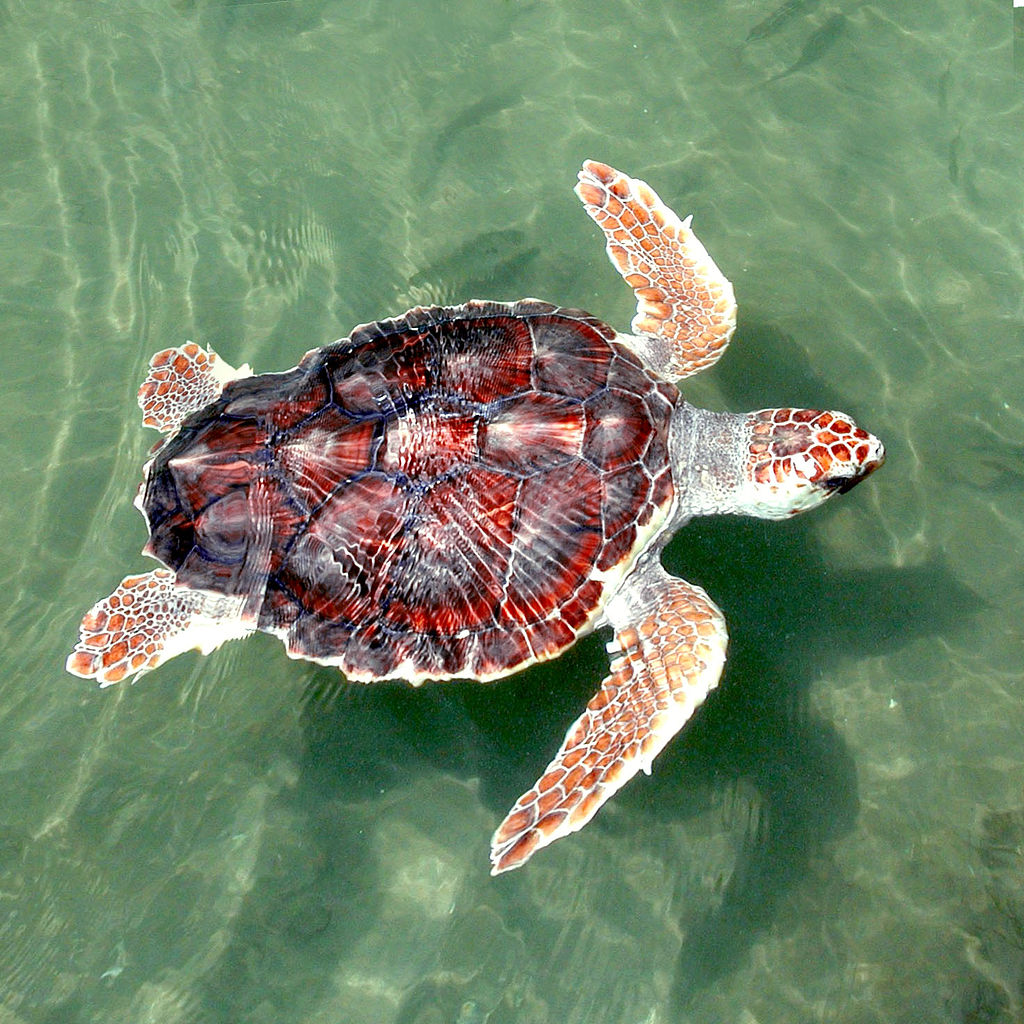
Loggerheads are large sea turtles with broad heads and powerful jaws adapted for crushing hard-shelled prey such as crabs and mollusks. Adults generally reach about 3 feet (1 m) in length and can weigh more than 200 pounds. Their carapaces are reddish-brown to brown, with yellowish undersides (NOAA Fisheries, 2026; WDFW, n.d.).
Loggerheads have a long life cycle. Females return to sandy nesting beaches to lay clutches of eggs, generally at night. Hatchlings emerge after roughly two months of incubation and enter the ocean, where young turtles spend years in pelagic habitats before moving toward coastal feeding areas as they grow. Females reach sexual maturity at approximately 35 years of age (NOAA Fisheries, 2026; WDFW, n.d.).
Adelita — Crossing the Pacific
In 1996, researchers satellite-tracked a loggerhead named Adelita from Baja California across the Pacific to Japan. Her journey covered approximately 9,000 miles and provided compelling evidence of the extraordinary trans-Pacific migrations undertaken by North Pacific loggerheads (PBS, 2010; Nichols, 2001).
Adelita’s journey helped demonstrate the connection between loggerhead turtles found along the eastern Pacific and their nesting grounds in Japan. The North Pacific population spends much of its life far from its nesting beaches, making international cooperation essential to its conservation (Sato, 2017).
Distribution and Natural History
Loggerheads occur throughout tropical and temperate regions of the Atlantic, Pacific, and Indian oceans (NOAA Fisheries, 2026). In the North Pacific, the only known nesting areas are in Japan. After leaving their nesting beaches, juvenile turtles migrate across the Pacific to feeding areas along the eastern Pacific, particularly off Mexico and California (Sato, 2017; WDFW, n.d.).
In Washington, loggerheads are rare visitors. WDFW reports that very few sightings occur this far north, and records are generally associated with stranded individuals. Loggerheads do not nest in Washington; the species’ North Pacific nesting grounds are in Japan (Sato, 2017; WDFW, n.d.).
Loggerheads were first listed as a threatened species in Washington in 1990. A 2017 WDFW status review recommended that the species be upgraded to endangered because of the decline of the North Pacific population and the continuing threats it faces. Washington now lists the loggerhead sea turtle as Endangered (Sato, 2017; WDFW, n.d.).
Status
Globally, the loggerhead sea turtle is considered Vulnerable. NatureServe currently assigns the species a global conservation rank of G3, also reflecting a vulnerable conservation status (International Union for Conservation of Nature [IUCN], 2015; NatureServe, 2026).
In the United States, loggerheads are managed as distinct population segments. The North Pacific Ocean distinct population segment (DPS) is federally listed as Endangered under the U.S. Endangered Species Act (NOAA Fisheries, 2026).
At the state level, Washington lists the loggerhead sea turtle as Endangered (WDFW, n.d.).
State
Endangered
🔶
North America
G3 Vulnerable
🔶
Global
Vulnerable ↓
🔶
***** Status References: WA State: WDFW North America: NatureServe Global: IUCN Red List *****
Conservation
Protecting loggerheads is a team effort that spans the Pacific Ocean. Major threats include accidental capture in fishing gear, marine debris, loss and degradation of nesting habitat, direct harvest, vessel interactions, and changing environmental conditions (NOAA Fisheries, 2026; Sato, 2017).
In Washington, conservation is focused less on nesting habitat and more on documenting and responding to rare animals that reach state waters. WDFW identifies improved documentation of loggerhead sightings and continued efforts to reduce ocean pollution as conservation priorities (WDFW, n.d.).
Because North Pacific loggerheads migrate thousands of miles between nesting and feeding areas, conservation efforts in Washington are only one part of a much larger international effort. Protecting nesting beaches in Japan, reducing fisheries bycatch, and maintaining healthy ocean habitats throughout the turtles’ migratory range are all important to the population’s recovery (NOAA Fisheries, 2026; Sato, 2017).
What you can do
Even though loggerheads do not nest in Washington, the choices we make here can affect animals traveling through the Pacific Ocean. Reducing single-use plastics helps keep marine debris out of the ocean. Lost and discarded fishing gear can entangle sea turtles, while plastic debris may be mistaken for food. NOAA Fisheries recommends reducing marine debris and reporting stranded or injured sea turtles to trained responders (NOAA Fisheries, 2026).
If you encounter a stranded or injured sea turtle on a Washington beach, do not approach or attempt to move it yourself. Contact the appropriate marine wildlife response network so trained personnel can assess the animal (WDFW, n.d.).
Sea Turtle Events
Loggerheads aren’t the focus of festivals in Washington, but national events celebrate sea turtles:
- Sea Turtle Week (June, nationwide): Led by NOAA Fisheries each June, highlighting turtle science and conservation. More info.
- TurtleFest (Juno Beach, Florida): Annual spring event hosted by Loggerhead Marinelife Center. More info.
- Aquarium outreach events: Many U.S. aquariums, including Florida’s Gumbo Limbo Nature Center and Georgia Sea Turtle Center, host seasonal turtle talks and releases. More info.
Nature Art
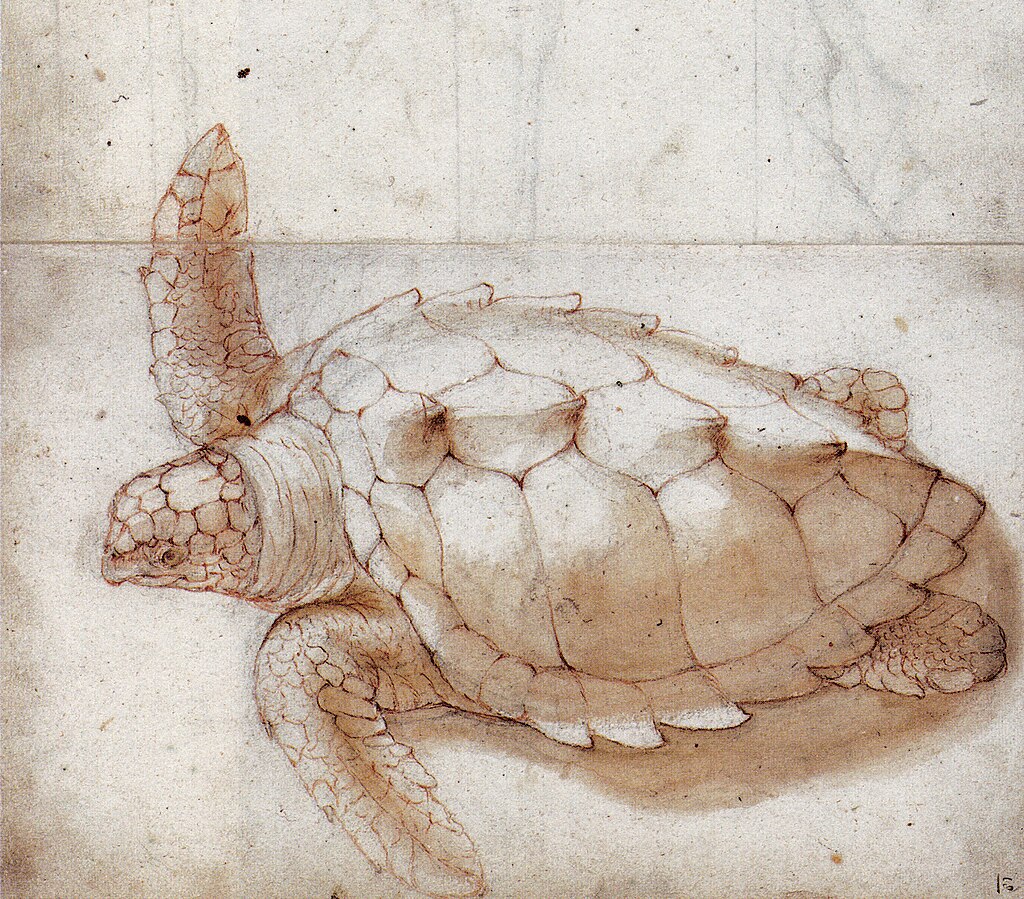
Caretta caretta appears in early European natural-history illustrations, including an illustration attributed to Jan Huygen van Linschoten dating to 1601–1603. Such early images reflect the growing European interest in documenting unfamiliar animals and marine life.
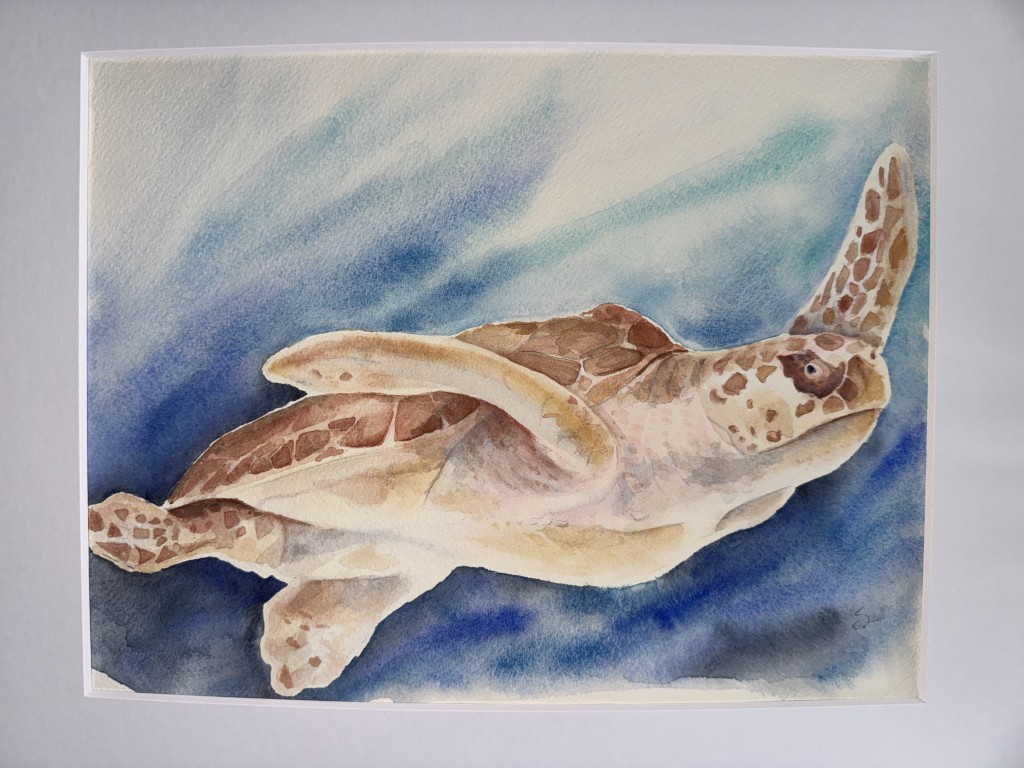
The Smith (2026) painting of a loggerhead sea turtle was inspired by a photograph by M. Gonzalez (2007). The painting portrays the turtle swimming through blue water, using warm brown, red, and ivory tones to emphasize the animal’s earthy strength and calm, enduring presence.
Cover photo credit: Loggerhead Sea Turtle (Gonzalez, 2007).
References
International Union for Conservation of Nature. (2015). Caretta caretta. The IUCN Red List of Threatened Species. https://www.iucnredlist.org/species/8416/121661122
National Oceanic and Atmospheric Administration Fisheries. (2026). Loggerhead turtle (Caretta caretta). https://www.fisheries.noaa.gov/species/loggerhead-turtle
NatureServe. (2026). Caretta caretta: Loggerhead sea turtle. NatureServe Explorer. https://explorer.natureserve.org/Taxon/ELEMENT_GLOBAL.2.105239/Caretta_caretta
Nichols, W. J. (2001, June 1). Pacific loggerhead turtles. Wallace J. Nichols. https://www.wallacejnichols.org/234/203/outside-magazine-and-a-cast-of-thousands.html
PBS. (2010, May 27). Interview: Wallace J. Nichols. Nature. https://www.pbs.org/wnet/nature/voyage-of-the-lonely-turtle-interview-wallace-j-nichols/2508/
Sato, C. L. (2017). Periodic status review for the green and loggerhead sea turtles in Washington. Washington Department of Fish and Wildlife. https://wdfw.wa.gov/publications/01870
Washington Department of Fish and Wildlife. (n.d.). Loggerhead sea turtle (Caretta caretta). https://wdfw.wa.gov/species-habitats/species/caretta-caretta
Image Credits
- Gonzalez, M. (2007). Loggerhead sea turtle [Photograph]. Wikimedia Commons. CC BY-SA 3.0.
- Linschoten, J. H. van. (1601–1603). Caretta caretta [Illustration]. Wikimedia Commons. Public domain.
- NOAA. (2011). Loggerhead sea turtle [Photograph]. Wikimedia Commons. Public domain.
- Smith, I. (2026). Loggerhead sea turtle [Watercolor painting]. Shared with permission.
- ukanda. (2006). Loggerhead sea turtle swimming [Photograph]. Wikimedia Commons. CC BY-SA 2.0.


You must be logged in to post a comment.