
Steelhead trout (Oncorhynchus mykiss) are among the most iconic fish of Washington’s rivers. Sleek and silvery, these remarkable salmonids are born in freshwater streams, migrate to the ocean to grow, and return years later to their natal rivers to spawn. Unlike most Pacific salmon, steelhead can survive spawning and return to the ocean to repeat the cycle (National Marine Fisheries Service, 2023).
“The charm of the trout is that he is the only fish that fights for his life in our streams; he leaps, he struggles, he lives.”
–Thoreau (1817–1862)
Description
Steelhead are the migratory, or anadromous, form of rainbow trout (Oncorhynchus mykiss). “Anadromous” means they hatch in freshwater streams, migrate to the ocean to grow and mature, and then return to freshwater rivers to spawn. Rainbow trout that remain in freshwater their entire lives are the same species; the difference lies in whether the fish migrates to the ocean (Behnke, 2002).
Steelhead coloration and spotting vary with life stage and environment. Ocean-going fish are typically silvery, while freshwater residents or spawning individuals may develop darker or reddish tones (Behnke, 2002).
Sexual dimorphism is subtle but noticeable: males often develop hooked jaws (“kypes”) and brighter colors during spawning, whereas females are generally more streamlined and silvery. Despite life stage differences or migration patterns, all individuals remain Oncorhynchus mykiss (Behnke, 2002).
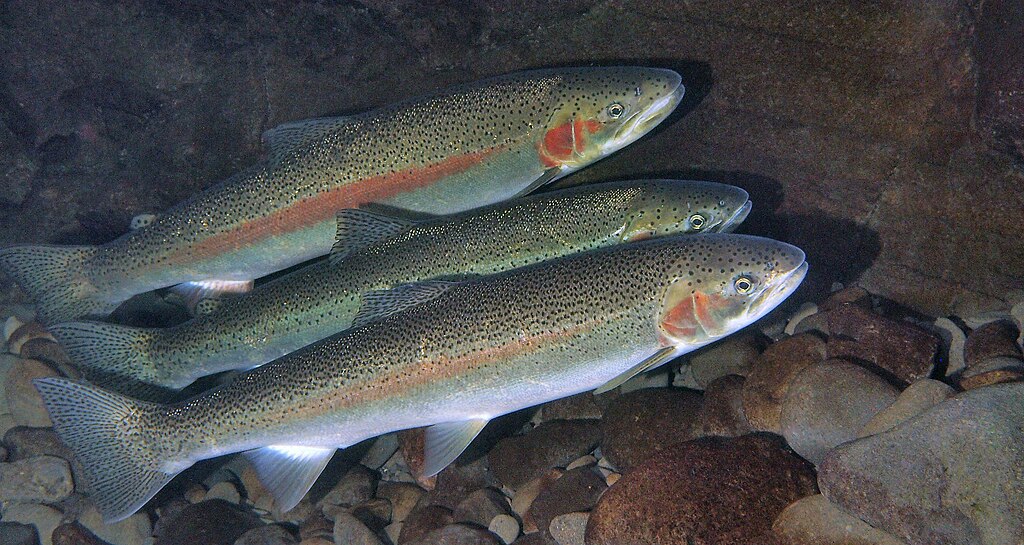
Distinguishing Features
Steelhead are recognized for their streamlined shape, silvery sides, and spots along their back and fins. Historical illustrations show natural variation in color and spotting: some depict greenish hues, others silvery-pink; some show dense spotting, others more delicate patterns (Denton, 1896; New York State Commissioners, 1898; Evermann & Goldsborough, 1907; Cobb, 1917; National Park Service, n.d.). These differences reflect both artistic interpretation and natural diversity, influenced by habitat, life stage, or spawning condition.
| Feature | Rainbow Trout (Oncorhynchus mykiss) | Steelhead Trout (Oncorhynchus mykiss, anadromous) |
|---|---|---|
| Adult Length | 12–30 in (30–75 cm) | 20–40 in (50–100 cm), can reach 45+ in (115+ cm) |
| Adult Weight | 2–8 lbs (0.9–3.6 kg) | 8–20 lbs (3.6–9 kg), can reach 30+ lbs (13+ kg) |
| Color | Olive to bluish-green back, silvery sides, pink lateral stripe | Silvery body with blue-green back while in ocean; may develop reddish or darker tones when spawning in freshwater |
| Stripes / Spots | Pink lateral stripe; scattered black spots on back, dorsal fin, and tail | Similar lateral stripe; often more pronounced black spots along back, dorsal fin, and tail; color varies with life stage |
| Eye Color | Golden to amber with dark pupil | Golden to amber with dark pupil; slightly darker during spawning |
| Mouth Shape | Terminal, slightly pointed; jaw straight | Terminal, slightly more robust; males may develop hooked jaw (“kype”) during spawning |
| Life History / Behavior | Lives entirely in freshwater | Anadromous: migrates to ocean to grow, returns to freshwater to spawn |
Why They Matter
Steelhead aren’t just pretty fish—they’re vital players in our rivers. When they spawn, they bring nutrients from the ocean back into freshwater streams, feeding insects, plants, and other animals. Young steelhead are a key food source for birds, mammals, and bigger fish.
They’re also nature’s early warning system: if steelhead populations are healthy, it usually means our rivers are in good shape. When numbers decline, it’s a red flag that streams and habitats might be struggling.
Steelhead hold deep cultural meaning, too. For many Indigenous tribes in Washington, these fish are part of traditions, stories, and ceremonies. And let’s not forget the joy they bring to anglers and wildlife watchers—connecting people to rivers, nature, and the seasons.
In short, healthy steelhead populations mean healthy rivers, thriving wildlife, and communities that stay connected to the natural world.
Status
Washington State and federal agencies recognize the precarious status of steelhead populations. The Upper Columbia River Steelhead ESU is listed as endangered, while multiple others are federally threatened, including:
- Snake River Steelhead
- Upper Columbia Steelhead
- Middle Columbia Steelhead
- Lower Columbia Steelhead
- Puget Sound Steelhead (WDFW, 2024)
What is an ESU?
An ESU, or Evolutionarily Significant Unit, is a population of a species that is genetically distinct and ecologically important. In plain terms, each ESU—like the Upper Columbia River steelhead—represents a unique population adapted to its local rivers and worth protecting (National Marine Fisheries Service, 2023).
State
Endangered
🔶
North America
Imperiled
🔶
Global
Vulnerable ↓
🔶
***** Status References: WA State: WDFW North America: NatureServe Global: IUCN Red List *****
Indigenous Significance
Steelhead trout hold cultural and spiritual significance for many Indigenous tribes in Washington. These fish appear in tribal stories, art, and ceremonial practices and are sometimes used as symbols or logos representing resilience, abundance, or connection to rivers. Tribes such as the Yakama Nation, Muckleshoot, and Swinomish have long-standing cultural ties to steelhead, emphasizing the importance of these fish beyond their ecological value (Yakama Nation Fisheries, n.d.; Muckleshoot, n.d.; Swinomish, n.d.).
For example, the Yakama Nation has been involved in steelhead conservation efforts, including habitat restoration projects like the Sunnyslope Side Channel Project on the Wenatchee River (Yakama Nation Fisheries, n.d.). Similarly, the Muckleshoot Tribe has advocated for fish conservation through legal and restoration efforts (Muckleshoot, n.d.), while the Swinomish Tribe focuses on habitat protection and fish monitoring programs (Swinomish, n.d.).
Conservation
Steelhead populations face threats from habitat loss, dams, water withdrawals, and changing ocean conditions. Washington State is actively engaged in recovery efforts, including:
- Habitat restoration: improving stream flows, planting native riparian vegetation, and removing barriers to migration (WDFW, 2024).
- Fish passage improvements: installing fish ladders and modifying culverts to allow steelhead to reach spawning grounds (WDFW, 2024).
- Population monitoring: tracking ESUs to assess recovery and manage harvest sustainably (NMFS, 2023).
These state-led efforts complement federal protections under the Endangered Species Act for listed populations. Local conservation groups and volunteers also support stream cleanup, habitat monitoring, and education (WDFW, 2024).
How You Can Help
You don’t need to live on a river to make a difference for steelhead. Here are practical, backyard-friendly actions anyone can take:
- Plant native vegetation along waterways – Even small riparian plantings stabilize banks, shade streams, and reduce runoff.
- Reduce chemical runoff – Limit fertilizers, herbicides, and pesticides. Rain washes these into streams, harming fish and insects.
- Create or maintain native ponds responsibly – Avoid non-native species and plant native vegetation along edges.
- Prevent erosion – Use mulch, groundcovers, or rain gardens to prevent soil runoff into nearby streams.
- Conserve water – Reduce irrigation and household water use to help maintain healthy stream flows.
- Volunteer locally – Join stream restoration, adopt-a-stream, or watershed monitoring programs.
- Educate and advocate – Share information with neighbors, participate in community forums, and support river-friendly policies (WDFW, 2024; NMFS, 2023).
Even small actions in backyards, gardens, and neighborhoods improve water quality, habitat connectivity, and ecosystem health—critical for steelhead survival.
Nature Art
These historic illustrations reveal just how changeable steelhead and rainbow trout can be—shifting colors, spots, and shapes make them surprisingly tricky to tell apart. Denton’s 1896 trout (Salmo irideus, now Oncorhynchus mykiss) glows silvery-pink, Evermann and Goldsborough’s 1907 steelhead leans green, and Cobb’s 1917 fish, in black and white, highlights form over color. In Smith’s 2026 watercolor, the two adult phases sit side by side: the upper fish bursts with the deep, vibrant hues of a spawning steelhead, while the lower gleams bright silver, capturing the ocean-run adult—two lives, one species, dramatically transformed.
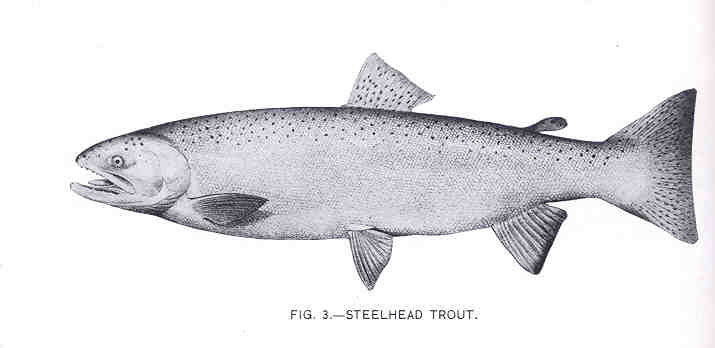
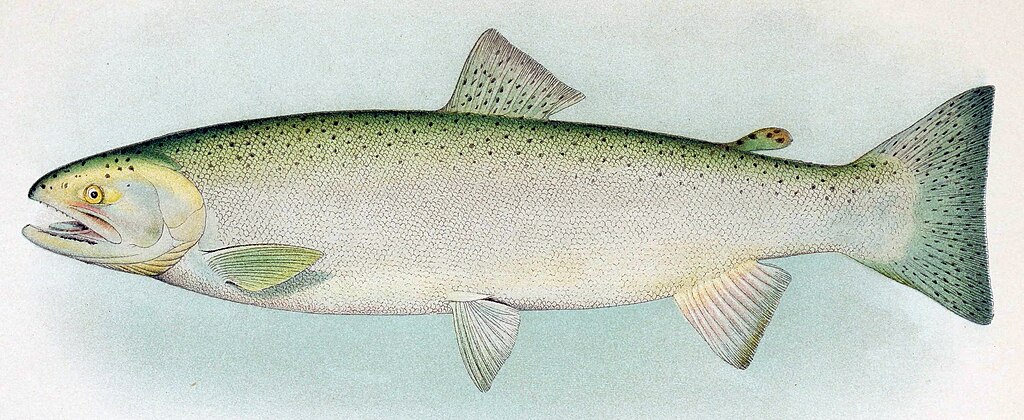
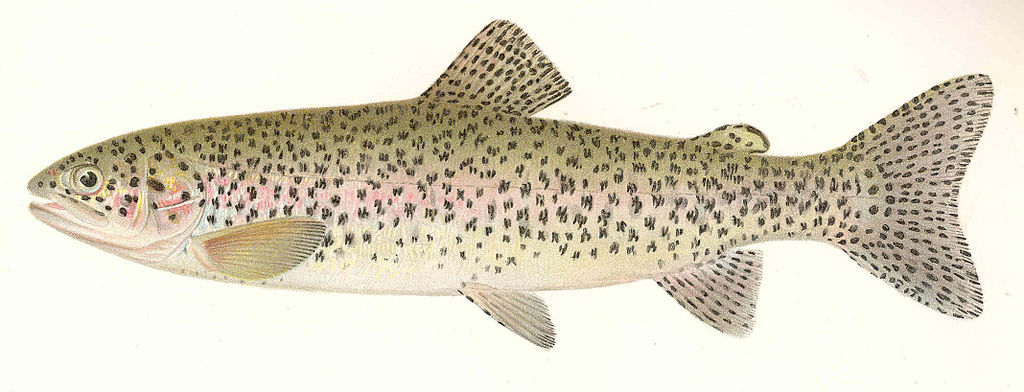
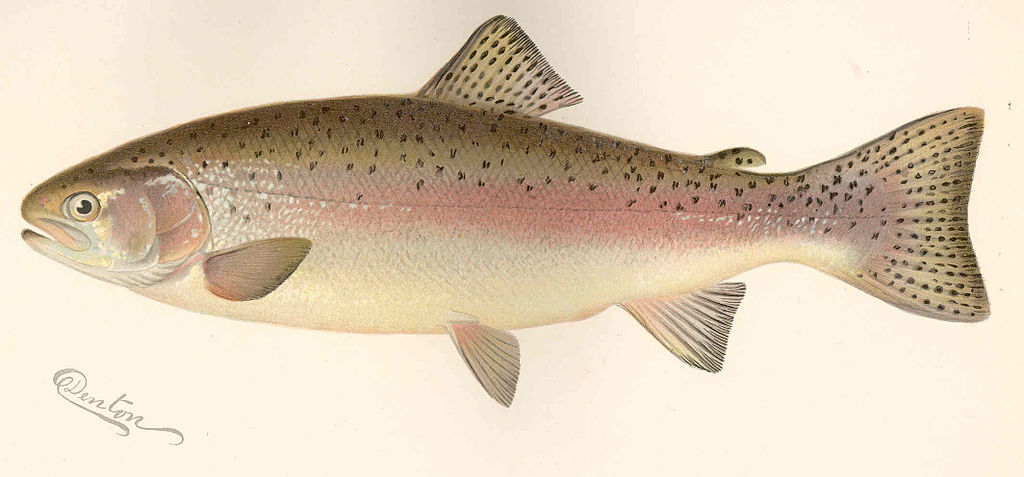
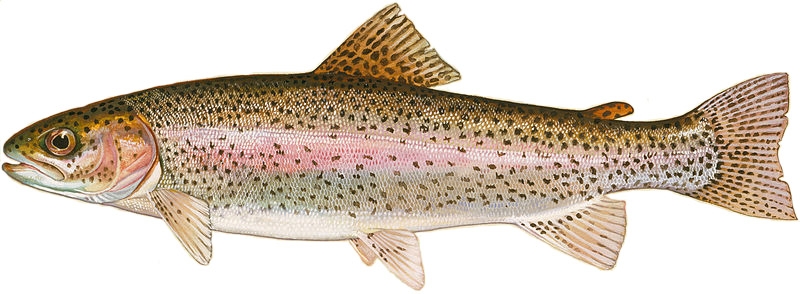
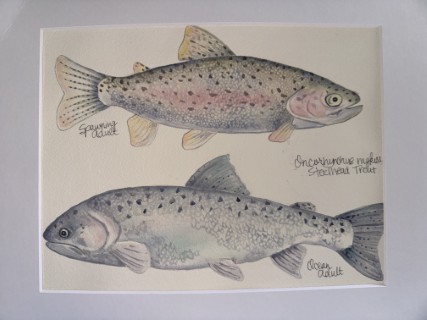
Cover photo credit: Rainbow trout (Oncorhynchus mykiss) illustration (Knepp, n.d.)
References
Behnke, R. J. (2002). Trout and salmon of North America. New York, NY: The Free Press.
Cobb, J. N. (1917). Steelhead trout (Oncorhynchus mykiss; historically referred to as Salmo gairdneri) [Illustration]. In Pacific salmon fisheries. Annual report of the Commissioner of Fisheries to the Secretary of Commerce, 1915–1916. Government Printing Office. Wikimedia Commons. Public domain. Retrieved September 13, 2025, from https://commons.wikimedia.org/wiki/File:FMIB_34518_Steelhead_Trout.jpeg
Denton, S. F. (1896). Rainbow trout (Salmo irideus; now recognized as Oncorhynchus mykiss) [Illustration]. In First annual report of the Commissioners of Fisheries, Game and Forests of the State of New York, 1895. Wynkoop Hallenbeck Crawford Co., Printers. Freshwater and Marine Image Bank, University of Washington. Wikimedia Commons. Public domain. Retrieved September 13, 2025, from https://commons.wikimedia.org/wiki/File:FMIB_43023_Rainbow_Trout_%28Salmo_irideus%29.jpeg
Evermann, B. W., & Goldsborough, E. L. (1907). Steelhead (Oncorhynchus mykiss; historically referred to as Salmo gairdneri) [Illustration]. In The fishes of Alaska (Plate). Department of Commerce and Labor, Bureau of Fisheries. Stanford University Press. Retrieved September 13, 2025, from https://commons.wikimedia.org/wiki/File:Steelhead_Oncorhynchus_mykiss.jpg
Muckleshoot. (n.d.). History. Retrieved September 13, 2025, from https://www.muckleshoot.nsn.us/history
National Marine Fisheries Service. (2023). Steelhead recovery overview. Retrieved September 13, 2025, from https://www.fisheries.noaa.gov/species/steelhead
National Park Service. (n.d.). Rainbow trout/steelhead [Illustration]. PICRYL. Public domain. Retrieved September 13, 2025, from https://picryl.com/media/rainbow-troutsteelhead-c73447
New York (State) Commissioners of Fisheries, Game and Forests. (1898). Steelhead or salmon trout (Salmo gairdneri Richardson; now recognized as Oncorhynchus mykiss) [Illustration]. In Third annual report of the Commissioners of Fisheries, Game and Forests of the State of New York, 1897. Wynkoop Hallenbeck Crawford Co., Printers. Wikimedia Commons. Public domain. Retrieved September 13, 2025, from https://commons.wikimedia.org/wiki/File:FMIB_43127_Steelhead_or_Salmon_Trout_%28Salmo_gairdneri_Richardson%29.jpeg
Oregon State University. (2016, February 12). Steelhead trout drifting in an Oregon stream [Photograph]. Wikimedia Commons. Public domain. Retrieved September 13, 2025, from https://commons.wikimedia.org/wiki/File:Steelhead_%2824354769644%29.jpg
Swinomish. (n.d.). Environmental policy. Retrieved September 13, 2025, from https://www.swinomish-nsn.gov/natural-resources/page/environmental-policy
WDFW. (2024). Washington state listed and candidate species. Retrieved September 13, 2025, from https://wdfw.wa.gov/sites/default/files/2024-03/wa-state-listed-and-candidate-species-list.pdf
Yakama Nation Fisheries. (n.d.). Sunnyslope Side Channel project. Retrieved September 13, 2025, from https://yakamafish-nsn.gov/restore/projects/targeted-population/steelhead

 wild sprout


You must be logged in to post a comment.