
Published Date: September 30, 2026
Golden paintbrush (Castilleja levisecta) is a striking wildflower of Washington’s prairie landscapes, known for its brilliant golden-yellow bracts that brighten open grasslands each spring. Once reduced to fewer than 20,000 plants at 10 known sites across its Pacific Northwest range, the species has made a remarkable recovery through habitat protection, restoration, reintroduction, and long-term prairie management. In 2023, it was removed from the federal Endangered Species Act list following recovery (U.S. Fish & Wildlife Service [USFWS], 2023).
“It’s a good day for the paintbrush, but more needs to be done to save Puget and Willamette prairies and the many endangered species that depend on them.” — Quinn Read, Center for Biological Diversity (Center for Biological Diversity, 2021)
Description
Golden paintbrush is a short-lived perennial herb in the broomrape family (Orobanchaceae). Plants grow up to about 12 inches tall and are covered with soft, somewhat sticky hairs. Narrow lower leaves and broader upper leaves surround a terminal flower spike of brilliant golden-yellow bracts and small flowers. It generally flowers from April through June and reproduces by seed (USFWS, n.d.; USFWS, 2023).
Like other Castilleja, golden paintbrush is hemiparasitic. It photosynthesizes but also connects to the roots of neighboring plants to obtain additional water and nutrients, linking its survival to the surrounding prairie community (USFWS, 2023).
Habitat & Range
Historically, golden paintbrush ranged from southwestern British Columbia through western Washington and south into Oregon’s Willamette Valley. Many populations disappeared as prairie habitat was converted for development and agriculture (USFWS, 2023; Washington Natural Heritage Program [WNHP], n.d.).
Today, it occurs primarily in open, low-elevation prairie and grassland in British Columbia, Washington, and Oregon. Washington populations include South Puget Sound, Whidbey Island, and the San Juan Islands (USFWS, n.d.; USFWS, 2023).
The species depends on sunny, open habitat with little competition from shrubs and tall grasses. Glacial outwash prairies, coastal prairies, and upland dry meadows provide important habitat, while prescribed fire and other management help maintain these conditions (USFWS, n.d.; WNHP, n.d.). Although some populations occur on islands surrounded by marine environments, golden paintbrush itself is a prairie plant, not a marine or shoreline species.
Conservation Status
Washington’s Natural Heritage Program classifies golden paintbrush as Threatened, with a G2/S2 conservation rank (WNHP, n.d.). NatureServe also ranks it G2 — Imperiled, reflecting its rarity and vulnerability across its range (NatureServe, n.d.).
State
Threatened
🔶
North America
Imperiled
🔶
Global
NOT LISTED
⚪
***** Status References: WA State: WA-DNR North America: NatureServe Global: IUCN Red List *****
- Federal ESA: Delisted in 2023 following recovery.
When the species was federally listed as threatened in 1997, fewer than 20,000 plants were known at 10 sites. By 2018, hundreds of thousands were documented at 48 sites, leading to federal delisting in 2023 (USFWS, 2023).
Federal delisting does not mean the species is secure. Its Washington Threatened status and NatureServe G2 rank reflect continuing conservation concerns, while its prairie habitat remains fragmented and dependent on active management. The IUCN Red List has not evaluated C. levisecta, so “Not Evaluated” should not be interpreted as Least Concern.
Ecological Importance
Golden paintbrush depends on insect pollinators for reproduction, while its hemiparasitic roots connect it to neighboring plants (USFWS, 2023).
It is also a food plant for the larvae of Taylor’s checkerspot butterfly, an endangered prairie butterfly. Its caterpillars feed on several plant species, including golden paintbrush, particularly during early development (USFWS, n.d.).
Protecting golden paintbrush therefore helps protect the prairie ecosystem and the many species that depend on these increasingly rare grasslands.
What You Can Do
- Learn to recognize golden paintbrush and other native prairie plants.
- If you have suitable conditions, consider planting nursery-grown golden paintbrush with other native prairie plants.
- Support prairie restoration and habitat-management programs.
- Stay on designated trails and avoid picking plants or disturbing sensitive habitat.
- Support organizations and public agencies working to protect Washington’s remaining prairies.
Nature Art
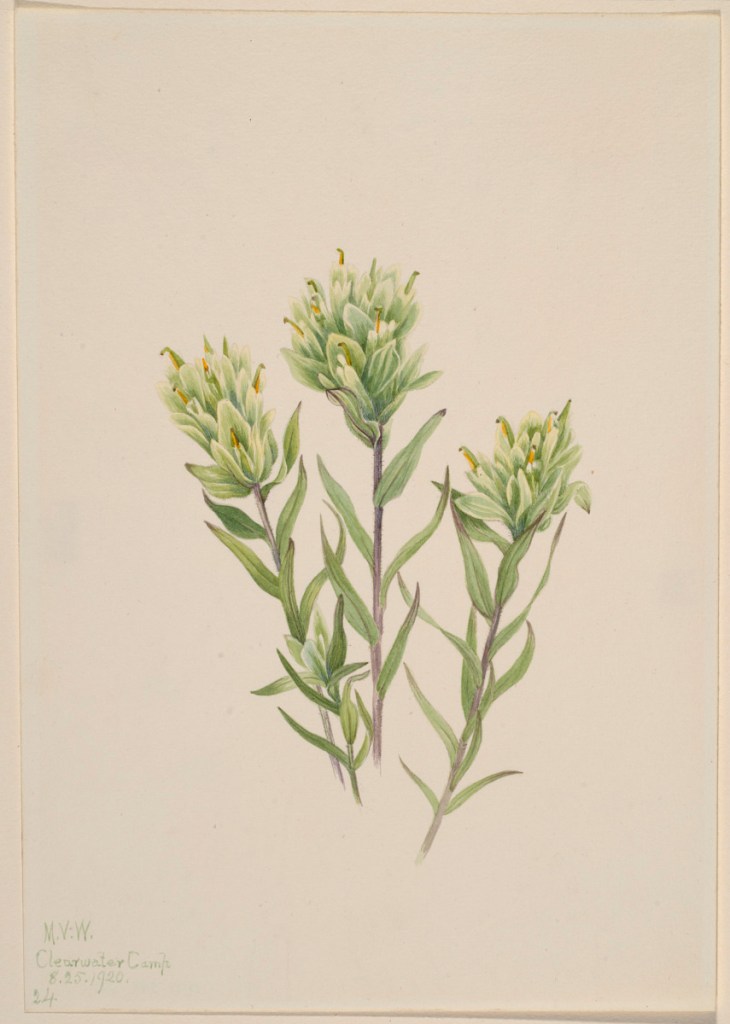
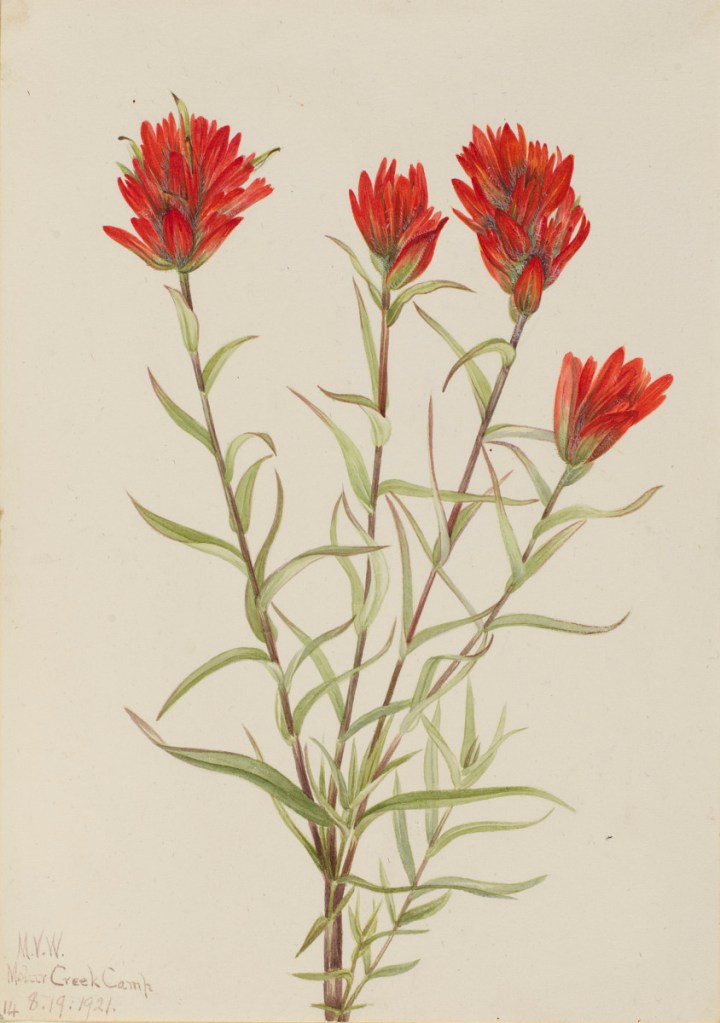
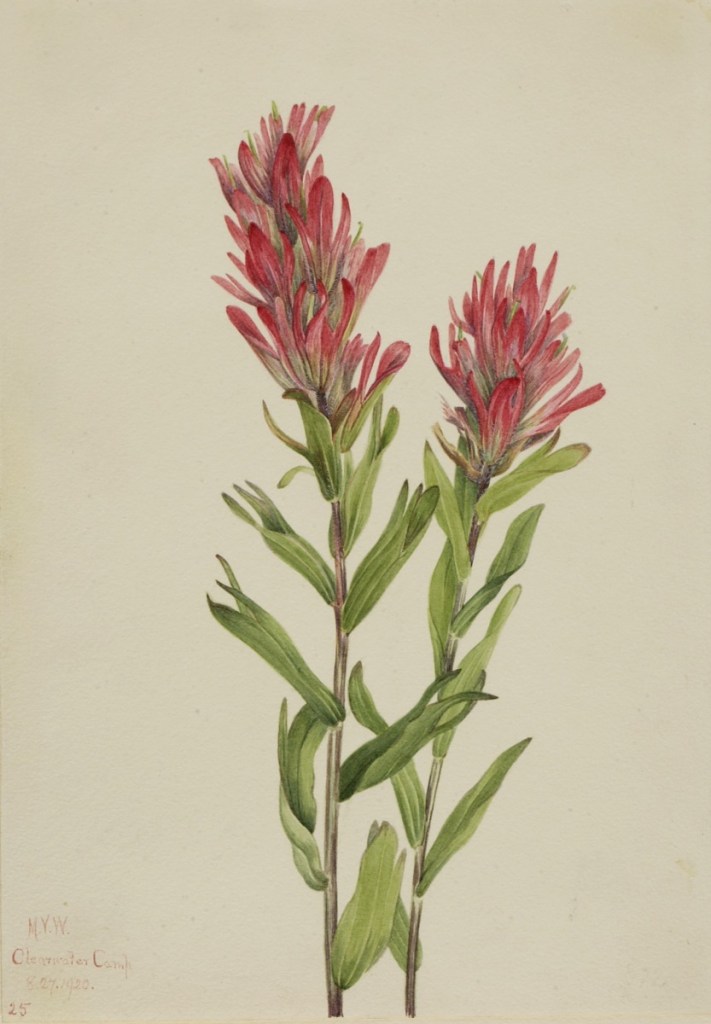
A historical public-domain botanical watercolor of golden paintbrush itself is difficult to find, so we’re featuring three watercolors by Mary Vaux Walcott of related Castilleja species: Alberta Paintbrush (C. miniata), Giant Red Paintbrush (C. miniata), and White Indian Paintbrush (C. occidentalis). Together, they highlight the diversity of color and form within the genus (Walcott, 1920a, 1920b, 1921). CWalcott’s paintings show red and white paintbrushes, while sharing the distinctive bract-and-flower structure of the genus.
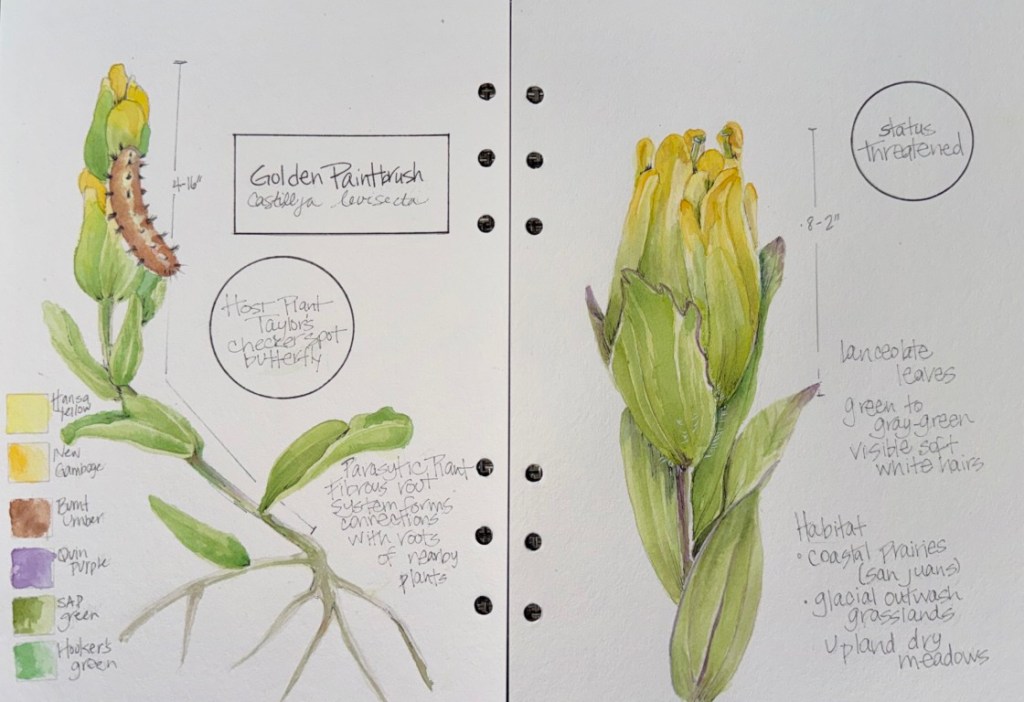
Smith’s (2026) Golden Paintbrush field-journal sketch combines watercolor, measurements, color notes, habitat observations, and botanical details. It shows the flower spike, leaves, roots, and root connections associated with the plant’s hemiparasitic biology. A Taylor’s checkerspot caterpillar represents the plant’s role as a larval food plant, while habitat notes identify coastal prairies, glacial outwash grasslands, and upland dry meadows. The sketch’s “Status — Threatened” note reflects the plant’s current Washington Natural Heritage Program status. Although golden paintbrush was removed from the federal endangered-species list in 2023, it remains classified as Threatened in Washington in 2026 (WNHP, n.d.; USFWS, 2023).
Cover Photo
Castilleja levisecta bracts (LRFtheLion, 2019). Photograph, Wikimedia Commons. CC BY-SA 4.0.
Notice: Conservation status reflects the active WDFW Species List. Wildlife data is dynamic and updates frequently. To report a needed update or correction, please reach out to us at wildsprout@hotmail.com.
References
Center for Biological Diversity. (2021, June 29). Golden paintbrush is latest endangered species act success story. https://biologicaldiversity.org/w/news/press-releases/golden-paintbrush-is-latest-endangered-species-act-success-story-2021-06-29/
International Union for Conservation of Nature. (2026). The IUCN Red List of Threatened Species. https://www.iucnredlist.org
LRFtheLion. (2019, May 6). Castilleja levisecta bracts [Photograph]. Wikimedia Commons. CC BY-SA 4.0. Retrieved January 2, 2026, from https://commons.wikimedia.org/wiki/File:Castilleja_levisecta_bracts.jpg
NatureServe. (n.d.). Castilleja levisecta. NatureServe Explorer. Retrieved September 17, 2026, from https://explorer.natureserve.org/Taxon/ELEMENT_GLOBAL.2.136348/Castilleja_levisecta
U.S. Fish & Wildlife Service. (n.d.). Golden paintbrush (Castilleja levisecta) [Species profile]. Retrieved January 2, 2026, from https://www.fws.gov/species/golden-paintbrush-castilleja-levisecta
U.S. Fish & Wildlife Service. (2023). Endangered and threatened wildlife and plants; Removing golden paintbrush from the Federal List of Endangered and Threatened Plants [Final rule]. Federal Register, 88, 46088–46104. https://www.federalregister.gov/documents/2023/07/19/2023-14971/endangered-and-threatened-wildlife-and-plants-removing-golden-paintbrush-from-the-federal-list-of
Walcott, M. V. (1920a). Alberta paintbrush (Castilleja miniata) [Watercolor on paper]. Smithsonian American Art Museum, Gift of the artist. Retrieved January 2, 2026, from https://americanart.si.edu/artwork/alberta-paintbrush-catilleja-miniata-25817
Walcott, M. V. (1920b). White Indian paintbrush (Castilleja occidentalis) [Watercolor on paper]. Smithsonian American Art Museum, Gift of the artist. Retrieved January 2, 2026, from https://americanart.si.edu/artwork/white-indian-paintbrush-castilleja-occidentalis-26566
Walcott, M. V. (1921). Giant red paintbrush (Castilleja miniata) [Watercolor on paper]. Smithsonian American Art Museum, Gift of the artist. Retrieved January 2, 2026, from https://americanart.si.edu/artwork/giant-red-paintbrush-castilleja-miniata-26096
Washington Natural Heritage Program. (n.d.). Castilleja levisecta: Golden paintbrush [Species data sheet]. Washington State Department of Natural Resources. Retrieved September 17, 2026, from https://dnr.wa.gov/natural-heritage-program/rare-species/online-field-guide-rare-plants-washington


You must be logged in to post a comment.