
Notice: Conservation status reflects the active WDFW Species List. Wildlife data is dynamic and updates frequently. To report a needed update or correction, please reach out to us at wildsprout@hotmail.com.
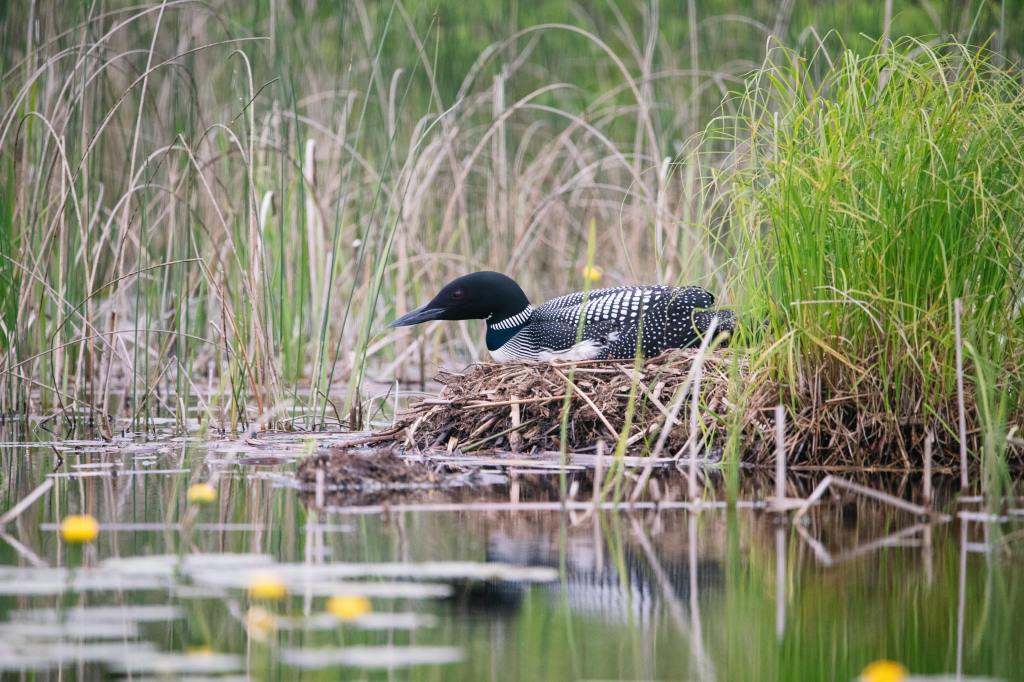
Few birds capture the wild spirit of northern waters quite like the Common Loon. Its eerie, echoing calls have become a symbol of wilderness, evoking solitude, mystery, and the quiet strength of untamed lakes and coasts. With its striking black-and-white summer plumage, blood-red eyes, and graceful dives, the loon is not just an emblem of nature’s beauty—it is also a species whose presence tells us much about the health of the waters it inhabits (Washington Department of Fish & Wildlife [WDFW], n.d.).
“Those who contemplate the beauty of the earth find reserves of strength that will endure as long as life lasts.”
— Rachel Carson, Silent Spring (1962)
Description
The Common Loon is a large diving bird, measuring 26 to 36 inches long with a wingspan of nearly five feet. Breeding adults display a glossy black head, bold checkered back, and a white throat necklace, while winter plumage softens to gray and white. Males and females look nearly identical, though males are slightly heavier (WDFW, n.d.).
These expert divers primarily feed on fish but will also eat crustaceans, aquatic insects, and small amphibians such as tadpoles when fish are scarce.
Loons breed across Canada, Alaska, and the northern United States, and occasionally in Greenland, Iceland, and Scotland, making them a bird of the northern hemisphere (Coastal Observation and Seabird Survey Team [COASST], 2010). During migration and winter, they move to coastal waters, bays, estuaries, and large ice-free lakes.
In Washington and the Pacific Northwest, loons are rare summer residents, nesting on a few remote freshwater lakes. Outside the breeding season, they are more often seen along the coast, in Puget Sound, or on large inland lakes and reservoirs, splitting their lives between freshwater and marine habitats (WDFW, n.d.).
Status
Although the Common Loon is not federally listed as endangered, it is considered a Sensitive Species in Washington due to the very small number of breeding pairs in the state—just over twenty are currently known (Biodiversity Research Institute, n.d.). Loons face a host of challenges, from shoreline development and recreation pressure to pollution and oil spills. One of the most serious threats is lead poisoning: loons often swallow fishing sinkers or jigs lost in the water, and a single piece of lead can be fatal (Poleschook & Gumm, 2001).
State
Endangered
🔶
North America
Vulnerable
🔶
Global
Endangered ↓
🔶
*** Status References: WA State: WDFW North America: NatureServe Global: IUCN Red List ***
Conservation
Washington has responded to threats by banning the use of small lead tackle on thirteen lakes where loons are known to breed. These restrictions, in place since 2011, protect both adult loons and their chicks from accidental poisoning (WDFW, 2019). For anglers, there are excellent alternatives made from steel, tungsten, bismuth, and tin. They may feel a little different to cast, but they’re widely available, effective, and far safer for wildlife (The Nature Conservancy, 2016). Conservation groups and volunteers have also installed floating nesting platforms on lakes where natural nest sites are scarce, giving loons a fighting chance to raise young successfully (WDFW, 2019).
Cultural Significance
The haunting calls of the loon have long held cultural meaning across North America. Among many Indigenous peoples, loons are not just birds, but spiritual figures—guides, healers, and givers of vision. A well-known Coast Salish story tells of a blind man who was led by a loon across the water. After many dives, the loon restored the man’s sight. In gratitude, he gave the loon a necklace of shell beads, which remains today as the bird’s striking white collar (Aleck, 2018). These stories remind us that loons are woven not only into ecosystems but also into the spiritual and cultural fabric of the Pacific Northwest.
Beyond Indigenous traditions, loons have become symbols of wilderness across North America. They appear on Canadian currency—the one-dollar “loonie” coin—and are celebrated in literature, film, and art. In every context, their voice calls us back to the water, urging us to protect the quiet, clean places they need to survive.
What You Can Do
If you fish, make the switch to lead-free tackle, and encourage others to do the same. When boating or paddling, give loons plenty of space, especially in spring and summer when they may be nesting. Support conservation programs that protect Washington’s lakes and coastal waters. And, perhaps most importantly, take the time to listen when you hear a loon call—it is a sound of wildness worth preserving.
Nature Art
The Common Loon has captivated artists and naturalists alike. John James Audubon’s Great Northern Diver or Loon (Plate 306, 1836), engraved by Robert Havell Jr. for The Birds of America, presents the bird in striking black-and-white plumage and a poised, attentive stance along a lakeshore. Nearly a century later, the von Wright brothers’ 1929 plate in Svenska Fåglar offers a more delicate, watercolor-like rendering, depicting the loon in quiet motion within its serene habitat. Both works reveal the artists’ deep commitment to close observation and lifelike detail, and they continue to shape how we understand and admire this iconic waterbird (Audubon, 1836; von Wright, von Wright, & von Wright, 1929). Inspired by Hennessy’s (2020) photograph, Smith’s 2026 watercolor carries this tradition forward, highlighting the loon’s vibrant red eye and the contrast of its bold patterning softened by reflections on still water.
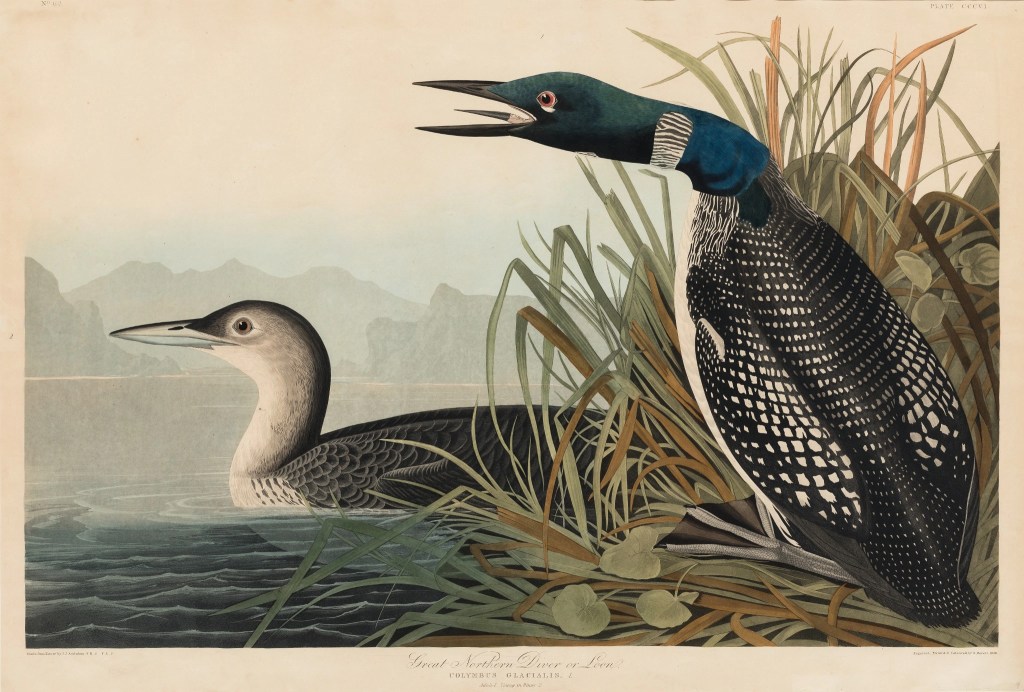
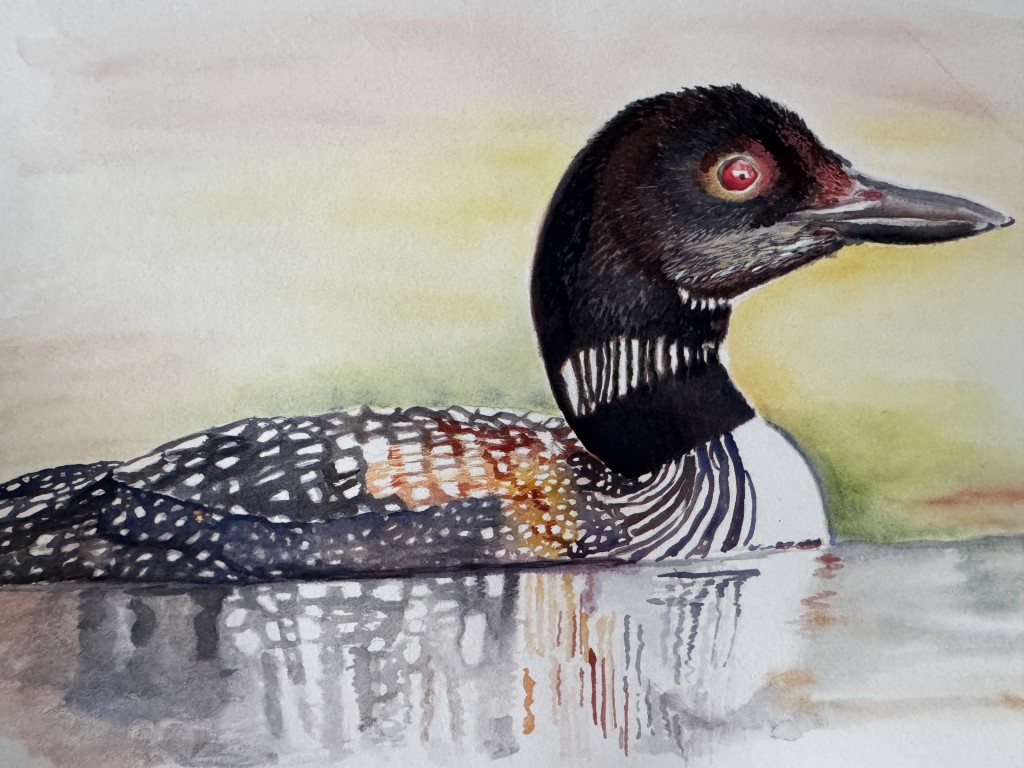
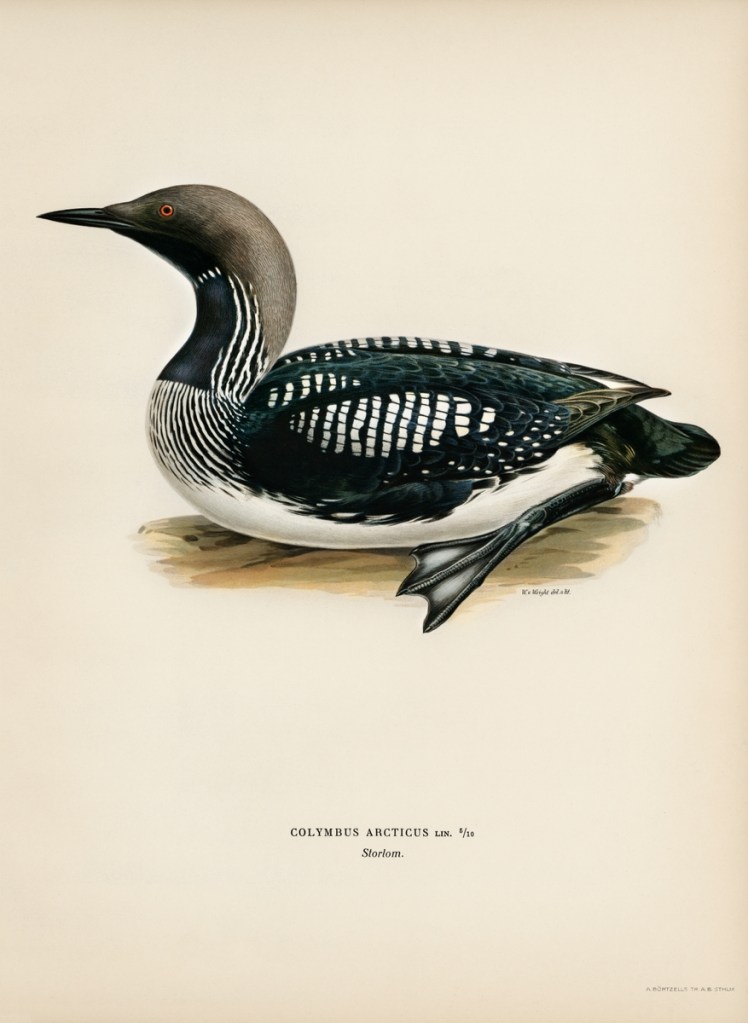
Cover photo credit: Common Loon drifting on calm water in the last bit of sun one evening (Hennessy, 2020)
References
Aleck, C. (2018). Coast Salish stories: Loon story. Salish Sea Sentinel. Retrieved September 16, 2025, from https://salishseasentinel.ca/2018/07/coast-salish-stories-loon-story/
Audubon, J. J. (1836). Great Northern Diver or Loon [Engraving and aquatint, hand-colored, engraved by R. Havell Jr.]. In The Birds of America (Vol. 4, Plate 306). Detroit Institute of Arts. https://dia.org/collection/great-northern-diver-or-loon-33315
Biodiversity Research Institute. (n.d.). Washington loons. Biodiversity Research Institute. Retrieved September 16, 2025, from https://briwildlife.org/loon-program/washington-loons/
Carson, Rachel. Silent Spring. Houghton Mifflin, 1962.
Coastal Observation and Seabird Survey Team. (2010). The great northern diver: The Common Loon. University of Washington. Retrieved September 16, 2025, from https://depts.washington.edu/coasst/news/features/common_loon.html
Hanson, J. (2024). Common Loon nesting in tranquil wetland habitat [Photograph]. Pexels. Pexels License (https://www.pexels.com/license/). Retrieved September 16, 2025, from https://www.pexels.com/photo/common-loon-nesting-in-tranquil-wetland-habitat-31347862/
Hennessy, R. (2020, September 4). Common Loon drifting on calm water in the last bit of sun one evening [Photograph]. Unsplash. Unsplash License (https://unsplash.com/license). Retrieved September 16, 2025, from https://unsplash.com/photos/black-and-white-duck-on-water-YF-nygeNGR8
Poleschook, D., Jr., & Gumm, V. R. (2001). Washington common loon: Management and status. Washington Department of Fish & Wildlife. Retrieved September 16, 2025, from https://wdfw.wa.gov/sites/default/files/2019-03/common_loon.pdf
Smith, I. (2026). Loon on lake (illustration). Posted with permission.
The Nature Conservancy. (2016, November 28). On the recovery: Saving the Common Loon from lead fishing tackle poisoning. Retrieved September 16, 2025, from https://blog.nature.org/2016/11/28/recovery-saving-common-loon-lead-fishing-tackle-poisoning-birds/
von Wright, W., von Wright, F., & von Wright, T. (1929). Common Loon (Colymbus immer) [Illustration]. Rawpixel. Public domain.
Washington Department of Fish & Wildlife. (2019). Common loon (Gavia immer) lead tackle restrictions. Washington Department of Fish & Wildlife. Retrieved September 16, 2025, from https://wdfw.wa.gov/sites/default/files/2019-03/common_loon.pdf
Washington Department of Fish & Wildlife. (n.d.). Common loon — Gavia immer. Species profile. Washington Department of Fish & Wildlife. Retrieved September 16, 2025, from https://wdfw.wa.gov/species-habitats/species/gavia-immer


You must be logged in to post a comment.