
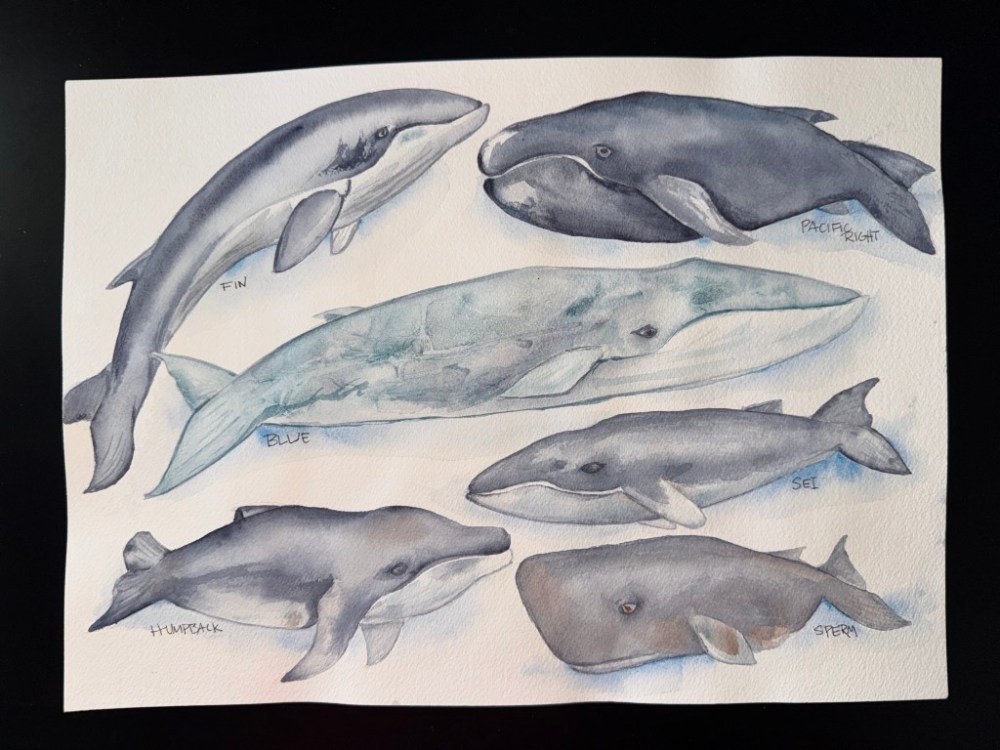
Washington’s coastal waters host a collection of whales: from massive blue whales to deep-diving sperm whales. Most pass through offshore corridors, feeding or migrating, and are rarely seen close to shore. All the whales featured here are listed as endangered under both the U.S. Endangered Species Act and the Washington State endangered species list (Washington Department of Fish & Wildlife [WDFW], n.d.-a).
Some whales, like right whales (Eubalaena japonica) and blue whales (Balaenoptera musculus), are now so rare that sightings are most often only documented by scientists (WDFW, n.d.-b).
Who They Are
These whales include both baleen and toothed species, each using Washington waters differently:
- Blue whale (Balaenoptera musculus) – the largest animal known to exist (WDFW, n.d.-a)
- Fin whale (Balaenoptera physalus) – fast-moving and far-ranging (WDFW, n.d.-c)
- Sei whale (Balaenoptera borealis) – offshore and elusive (WDFW, n.d.-d)
- Humpback whale (Megaptera novaeangliae) – migratory feeders (WDFW, n.d.-e)
- North Pacific right whale (Eubalaena japonica) – one of the rarest whales on Earth (WDFW, n.d.-b)
- Sperm whale (Physeter macrocephalus) – deep-diving toothed whale (WDFW, n.d.-f)
Some of these species are regular seasonal visitors; others are only occasionally observed. All have been shaped by human activity and conservation history.
A Brief History of Whaling in the North Pacific
The decline of large whales in this region was not accidental. Beginning in the mid-1800s, commercial whaling expanded quickly along the Pacific coast. Early whalers targeted slow-moving species that floated when killed — especially right whales — as they were easy to retrieve (Wiles, 2017).
By the early 1900s, industrial whaling (with steam ships and explosive harpoons) made it possible to hunt faster and larger whales like blue, fin, and sei whales. Whalers targeted whales for oil (used for lamp fuel and lubricants), meat, and baleen (flexible keratin plates once used in products from corsets to umbrella ribs) (Wiles, 2017).
By the 1960s, many whale populations were severely depleted. Protections came late — after decades of industrial exploitation had reshaped the ocean. These whales became endangered by design, not by chance.
What Happened to Each
North Pacific Right Whale (Eubalaena japonica)
Hunted relentlessly in the 1800s for oil and meat, right whales were nearly eliminated by the early 1900s. Today, the eastern North Pacific population is estimated to number only in the dozens — among the rarest large whales in the world (WDFW, n.d.-b).
Blue Whale (Balaenoptera musculus)
Hunted primarily for oil, blue whales were once heavily targeted. Their huge size made them difficult to catch at first, but once industrial whaling advanced, they became frequent targets. Today, blue whales remain endangered and populations are below historic levels (WDFW, n.d.-a).
Fin Whale (Balaenoptera physalus) and Sei Whale (Balaenoptera borealis)
Both species were heavily hunted in the mid‑20th century for oil, meat, and baleen. While some fin whale populations have grown and are regularly detected offshore, sei whales remain rare visitors and vulnerable (WDFW, n.d.-c; WDFW, n.d.-d).
Sperm Whale (Physeter macrocephalus)
Hunted extensively in the 1800s for spermaceti oil, prized for lamps and machinery, sperm whales later became secondary targets. Their deep‑offshore lifestyle helped some individuals persist, but the species remains endangered (WDFW, n.d.-f).
Humpback Whale (Megaptera novaeangliae)
Hunted for oil, meat, and baleen, humpbacks were severely depleted. Since protections were enacted, some populations have rebounded, though distinct population segments that visit Washington waters remain below historic abundance (WDFW, n.d.-e; Sato & Wiles, 2021).
Whales in Culture and Story
Long before scientific classification, whales were known through story and song. For many Indigenous coastal cultures of the Pacific Northwest, whales are powerful beings—ancestors, guides, and carriers of knowledge. They appear in carvings, songs, and oral histories as navigators of the sea and keepers of memory (WDFW, n.d.-a).
This cultural reverence contrasts sharply with the industrial era, when whales were reduced to commodities. Holding both truths — cultural significance and the history of exploitation — offers a fuller understanding of what has been lost, and what still matters.
When We See Them
Most of the whales featured here are seasonal visitors to Washington waters, not permanent residents. They travel along broad ocean “superhighways” known as Pacific blue corridors, linking feeding, breeding, and migration areas across vast ocean regions (Blue Corridors, n.d.).
| Species | Typical Presence in WA Waters |
|---|---|
| Blue whale – Balaenoptera musculus | Summer–Fall (feeding offshore) |
| Fin whale – Balaenoptera physalus | Most of the year offshore, occasional sightings |
| Humpback whale – Megaptera novaeangliae | Summer–Early Fall feeding period |
| Sei whale – Balaenoptera borealis | Rare, irregular sightings |
| North Pacific right whale – Eubalaena japonica | Extremely rare, incidental |
| Sperm whale – Physeter macrocephalus | Offshore seasonal pattern |
Seeing Them Now
Today, these whales still traverse Washington waters, often far offshore. Sightings can be brief — a blow, a back, a fin — before the animal continues its vast journey.
Protection does not guarantee recovery. Some populations show signs of return; others remain well below historic numbers. Their presence here is a reminder of how connected these waters are to distant feeding grounds, calving areas, and the wider Pacific.
A Note on Other Whales
While this collage focuses on species listed as endangered federally and in Washington, other whales like the gray whale (Eschrichtius robustus) are designated “sensitive” in Washington. Though some gray whale populations have recovered, other stocks remain small and vulnerable (WDFW, n.d.-g).
Further Reading / Orcas
Although orcas (Orcinus orca) are the most familiar cetaceans in Washington waters, they are technically dolphins — part of the toothed whale group with their own distinct ecology and conservation story. For more, see our post on orcas.
Noticing What Passes By
These whales are still here, moving through cold, productive waters shaped by currents and time. Many will never be seen by most people on shore — but noticing them, through science, story, or art, is one way of resisting disappearance. Sometimes, attention is the first step toward care.
Nature Art
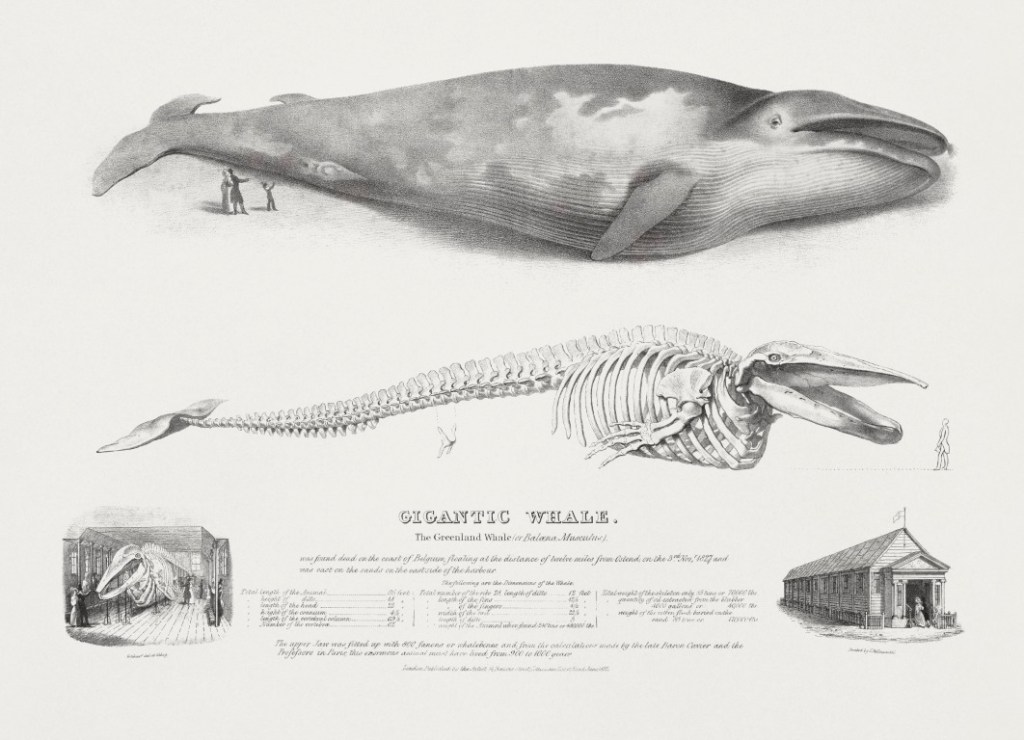
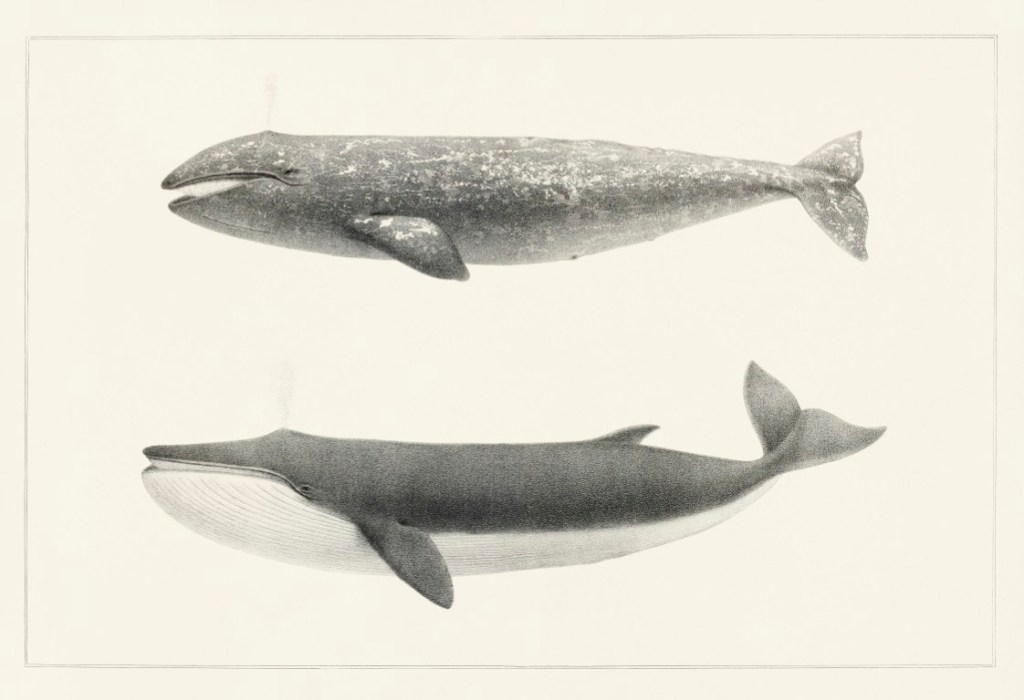
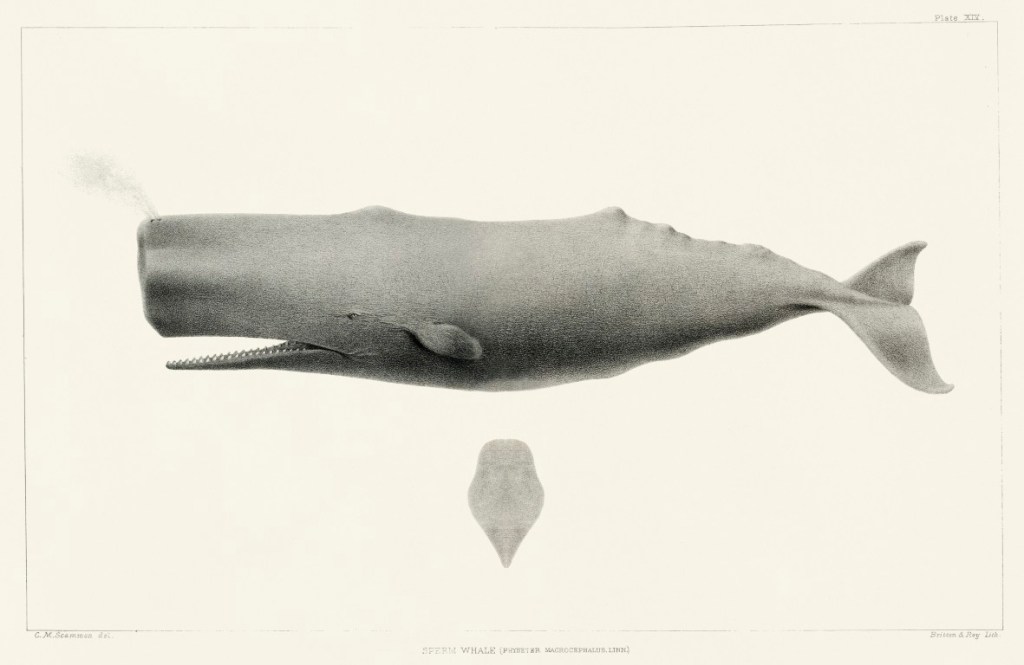
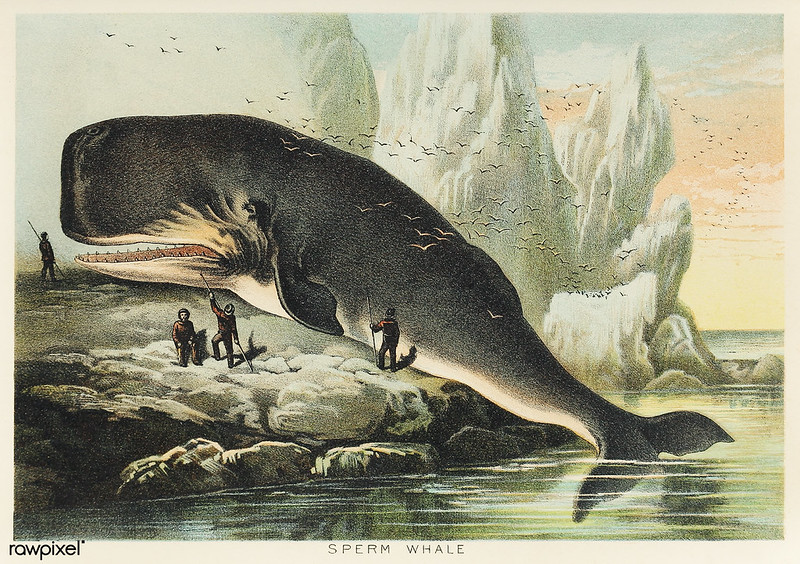
The nineteenth-century whale illustrations by Charles Melville Scammon (1872), George Johann Scharf (1832), and John Karst (1880) reflect an era when whales were studied with increasing scientific precision even as commercial whaling intensified across the Pacific. Scammon’s detailed depictions of the sperm whale, gray whale, and finback emerged from firsthand experience at sea, blending close observation with exploitation. Scharf’s engraving of the blue whale emphasizes immense scale and anatomical clarity, while Karst’s sperm whale plate situates the species within the nineteenth-century tradition of cataloging the natural world. These works present whales as specimens — carefully measured, labeled, and rendered for study.
In Smith’s Endangered Pacific Whales of Washington (2026), five endangered whales found in Washington waters are arranged together forming a modern field plate. The simplified presentation emphasizes relative size and distinguishing form, inviting comparison while underscoring the shared vulnerability of these giants.
Cover photo credit: Humpback whale, breaching (Welles, 2007)
References
Blue Corridors. (n.d.). Protecting blue corridors. https://bluecorridors.org/explore/threats
Blue whale (Balaenoptera musculus). (n.d.-a). Washington Department of Fish & Wildlife. https://wdfw.wa.gov/species-habitats/species/balaenoptera-musculus?utm_source=chatgpt.com
Fin whale (Balaenoptera physalus). (n.d.-c). Washington Department of Fish & Wildlife. https://wdfw.wa.gov/species-habitats/species/balaenoptera-physalus?utm_source=chatgpt.com
Gray whale (Eschrichtius robustus). (n.d.-g). Washington Department of Fish & Wildlife. https://wdfw.wa.gov/species-habitats/species/eschrichtius-robustus?utm_source=chatgpt.com
Humpback whale (Megaptera novaeangliae). (n.d.-e). Washington Department of Fish & Wildlife. https://wdfw.wa.gov/species-habitats/species/megaptera-novaeangliae?utm_source=chatgpt.com
Karst, J. (1880). Sperm whale from Johnson’s household book of nature [Photograph]. Flickr. Creative Commons Attribution 4.0 International (CC BY 4.0). Retrieved February 26, 2026, from https://www.flickr.com/photos/vintage_illustration/46657482371
North Pacific right whale (Eubalaena japonica). (n.d.-b). Washington Department of Fish & Wildlife. https://wdfw.wa.gov/species-habitats/species/eubalaena-japonica?utm_source=chatgpt.com
Sato, C., & Wiles, G. J. (2021). Periodic status review for the humpback whale in Washington. Washington Department of Fish and Wildlife.
Scammon, C. M. (1872). Sperm whale (Physeter macrocephalus) [Illustration]. Rawpixel. Public domain (CC0). Retrieved February 26, 2026, from https://www.rawpixel.com/image/328230/free-illustration-image-whale-sperm-fish
Scammon, C. M. (1872). 1. The California Gray Whale (Rhachieanectes claucus) & 2. The Finback (Balaenoptera velifera) [Illustration]. Rawpixel. Public domain (CC0). Retrieved February 26, 2026, from https://www.rawpixel.com/image/328229/free-illustration-image-whale-fish-sea
Scharf, G. J. (1832). Gigantic whale: The Greenland whale (or Baloena Musculus), blue whale, Balaenoptera musculus (Linnaeus, 1758) [Illustration]. Rawpixel. Public domain (CC0). Retrieved February 26, 2026, from https://www.rawpixel.com/image/2334397/free-illustration-image-vintage-whale-animals
Smith, I. (2026). Endangered Pacific Whales of Washington [illustration]. Posted with permission.
Sperm whale (Physeter macrocephalus). (n.d.-f). Washington Department of Fish & Wildlife. https://wdfw.wa.gov/sites/default/files/publications/01909/wdfw01909.pdf?utm_source=chatgpt.com
Welles, W. (2007). Humpback whale, breaching, Stellwagen Bank National Marine Sanctuary [Photograph]. Wikimedia Commons. CC BY 3.0 (https://creativecommons.org/licenses/by/3.0/). Retrieved February 26, 2026, from https://en.wikipedia.org/wiki/File:Humpback_stellwagen_edit.jpg
Wiles, G. J. (2017). Periodic status review for blue, fin, sei, North Pacific right, and sperm whales in Washington. Washington Department of Fish and Wildlife.

 wild sprout

You must be logged in to post a comment.