
The Island Marble Butterfly (Euchloe ausonides insulanus) is a strikingly beautiful and critically endangered butterfly native to the San Juan Islands of Washington State. Once thought extinct, its rediscovery in 1998 has spurred conservation efforts to preserve this rare insect.
“Well, I must endure the presence of a few caterpillars if I wish to become acquainted with the butterflies.”
–Antoine de Saint-Exupéry, The Little Prince (1943)
Status
The Island Marble Butterfly is listed as endangered under the U.S. Endangered Species Act (U.S. Fish and Wildlife Service, 2020). In Washington State, it is currently under consideration* for listing as endangered (Washington Department of Fish and Wildlife, 2025).
***** Status References: WA State: WDFW North America: NatureServe Global: IUCN Red List *****
Threats include habitat loss, invasive species, and climate change. Conservation strategies involve habitat restoration, captive breeding programs, and public education (National Park Service, n.d.).
Conservation
Washington State has taken several steps to monitor and protect the Island Marble Butterfly. Key efforts include:
- Habitat Management: The Washington Department of Fish and Wildlife (WDFW) works with landowners and conservation organizations to maintain and restore native prairie habitats that support butterfly populations, including control of invasive plants and promotion of native flowering species alongside the nonnative field mustard (WDFW, 2025).
- Population Monitoring: WDFW conducts regular surveys during the flight season (late spring) to track population numbers, document sightings, and identify potential threats. This monitoring informs adaptive management strategies.
- Public Engagement & Education: WDFW partners with local organizations such as the San Juan Preservation Trust and the Xerces Society to educate residents and visitors about the butterfly, encouraging citizen science and reporting of sightings.
- Research and Conservation Planning: Studies are underway to better understand the butterfly’s habitat needs, breeding success, and interactions with nonnative and native plants. This data helps guide future conservation strategies and potential updates to its official state listing status.
These state-level actions complement federal protections and highlight the collaborative effort required to prevent the extinction of this rare butterfly.
Description
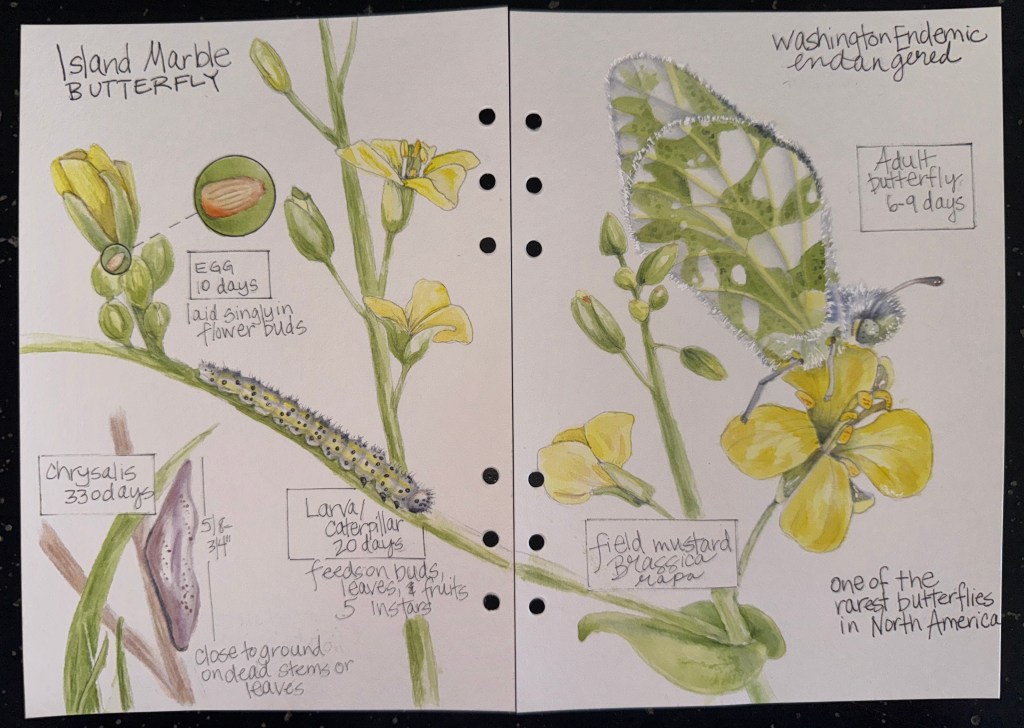
The Island Marble Butterfly has a wingspan of approximately 1.75 inches. Its wings feature a distinctive green-and-white marbled pattern on the underside, providing camouflage in its prairie habitat (Washington Department of Fish and Wildlife, 2025). Adults live for roughly 7–9 days, during which they mate and lay eggs on host plants. Larvae feed on plant buds and flowers before pupating and overwintering as chrysalises.
| Stage | Important Plant(s) | Estimated Duration | Time of Year |
|---|---|---|---|
| Egg | Field mustard (Brassica rapa) | ~5–7 days | Early spring (March–April) |
| Larva (caterpillar) | Field mustard, other Brassicaceae | ~14–21 days | Spring (April–May) |
| Pupa (chrysalis) | Attached to host plant or nearby vegetation | ~10–14 days | Late spring (May) |
| Adult | Nectar from field mustard and other flowers | 7–9 days | Late spring (May–June) |
Range
Historically, the Island Marble Butterfly was found on Vancouver Island and the Canadian Gulf Islands—a group of islands in the Strait of Georgia, between Vancouver Island and mainland British Columbia, Canada, many of which are inhabited by small communities and farms (Wikipedia, 2025). Gabriola Island, the last known Canadian site where the butterfly was observed in 1908, is part of this Canadian group.
Today, the butterfly’s current range is restricted to the United States, specifically to San Juan and Lopez Islands in Washington State, with American Camp on San Juan Island being the primary habitat (National Park Service, n.d.; Island Marble Butterfly Hub, n.d.).
How you can help
Support Local Conservation Efforts: Organizations like the San Juan Preservation Trust and the Xerces Society are actively working to protect habitat.
Educate Others: Raising awareness can lead to greater community involvement in conservation.
Report Sightings: Observations help agencies monitor and study populations.
Nature Art
The Smith (2025) watercolor field sketch of the Island Marble Butterfly provides a detailed and visually engaging lifecycle diagram of this rare species. The artwork depicts each stage—from egg to larva, pupa, and adult—highlighting the butterfly’s reliance on nonnative field mustard. Painted in soft, naturalistic tones, the illustration emphasizes both the delicate patterns of the adult butterfly’s wings and the subtle textures of the surrounding vegetation. By combining scientific accuracy with artistic clarity, Smith’s work offers readers an accessible way to understand the butterfly’s development and ecological needs, making it a valuable educational and conservation resource.
No other historic illustrations have been found in public domain for this species.
Cover photo credit: Island marble butterfly (U.S. Fish and Wildlife Service, 2013)
References
Click here for full reference list
Island Marble Butterfly Hub. (n.d.). Island Marble Butterfly. https://www.islandmarblebutterflyhub.org
National Park Service. (n.d.). Island Marble Butterfly. https://www.nps.gov/sajh/learn/nature/island-marble-butterfly.htm
National Park Service. (n.d.). Rearing the rare Island Marble Butterfly at San Juan Island National Historical Park. https://www.nps.gov/articles/rearing-the-rare-island-marble-butterfly-at-san-juan-island-national-historical-park.htm
NatureServe. (n.d.). Argynnis zerene. NatureServe Explorer. https://explorer.natureserve.org/Taxon/ELEMENT_GLOBAL.2.111503/Argynnis_zerene
Smith, I. (2025). Island Marble Butterfly Lifecycle Field Journal. Posted with permission.
U.S. Fish and Wildlife Service. (2020, May 5). After 18 years, the Island Marble Butterfly finally receives federal protection. https://xerces.org/press/after-18-years-island-marble-butterfly-finally-receives-federal-protection
U.S. Fish and Wildlife Service. (2013, February 26). Island marble butterfly [Photograph]. Wikimedia Commons. https://commons.wikimedia.org/wiki/File:Island_marble_butterfly.jpg
Washington Department of Fish and Wildlife. (2025). Status Report for the Island Marble Butterfly in Washington. https://wdfw.wa.gov/publications/02581
Wikipedia contributors. (2025). Euchloe ausonides. Wikipedia. https://en.wikipedia.org/wiki/Euchloe_ausonides

 wild sprout

You must be logged in to post a comment.