
Summary
The western gray squirrel (Sciurus griseus) is the largest native tree squirrel in Washington, once ranging widely across oak and pine forests throughout the state (Washington Department of Fish & Wildlife [WDFW], n.d.-a). Today, its range in the state has contracted severely, with only three isolated populations remaining: South Puget Sound, Klickitat County, and portions of Okanogan County (WDFW, n.d.-a). Habitat loss, competition with non-native squirrels, and disease have contributed to this decline.
“The squirrel is a survivor. It is ever-present. It is changeable. The squirrel is legion.”
-Mary Treat, 19th-century American naturalist and entomologist
Description
The western gray squirrel is a striking rodent with a long, bushy, silver-gray tail and sleek steel-gray fur accented with white underparts. Adults can measure up to 24 inches in length, making them the largest tree squirrel in Washington (U.S. Forest Service, 2011). Unlike some mammals, there is little sexual dimorphism in this species—males and females are similar in size and appearance (WDFW, n.d.-a).
A key challenge for the western gray squirrel is competition with non-native squirrels introduced to the region. The eastern gray squirrel (Sciurus carolinensis) is smaller, stockier, and highly adaptable, thriving in urban parks and residential areas. The eastern fox squirrel (Sciurus niger) is larger, with a reddish-brown belly and rusty-colored tail. Both species reproduce quickly, tolerate fragmented habitats, and often outcompete western gray squirrels for food and nesting sites (Stuart & WDFW, 2012; WDFW, n.d.-b).
| Feature | Western Gray Squirrel (Sciurus griseus) | Eastern Fox Squirrel (Sciurus niger) | Eastern Gray Squirrel (Sciurus carolinensis) |
|---|---|---|---|
| Size (total length) | 22–24 in | 18–24 in | 16–20 in |
| Fur Color | Steel-gray back, white underparts | Reddish-brown or orange belly, rusty-colored tail | Gray back, white underparts; can have brownish tones |
| Tail | Long, bushy, silver-gray | Bushy, often reddish or rusty | Bushy, gray with white edges |
| Native to WA? | Yes | No; introduced 1920s–40s | No; introduced early 20th century |
| Habitat Preference | Contiguous oak and pine forests | Open woodlands, farmland edges, urban neighborhoods | Urban, suburban parks; adaptable |
| Reproduction / Adaptability | Slower reproduction; specialized habitat | Fast reproduction; highly adaptable | Fast reproduction; very adaptable |
| Identification Tip | Large, silver-gray tail, white belly | Reddish belly, rusty tail; very distinctive | Smaller gray tail, gray belly |
| Distinctive Sounds | High-pitched “kuk” or “kik” call; alarm or contact call | Loud barking or “rattle” sounds; alarm and territorial | Series of rapid “quaa” or “chirp” notes; alarm or mating call |
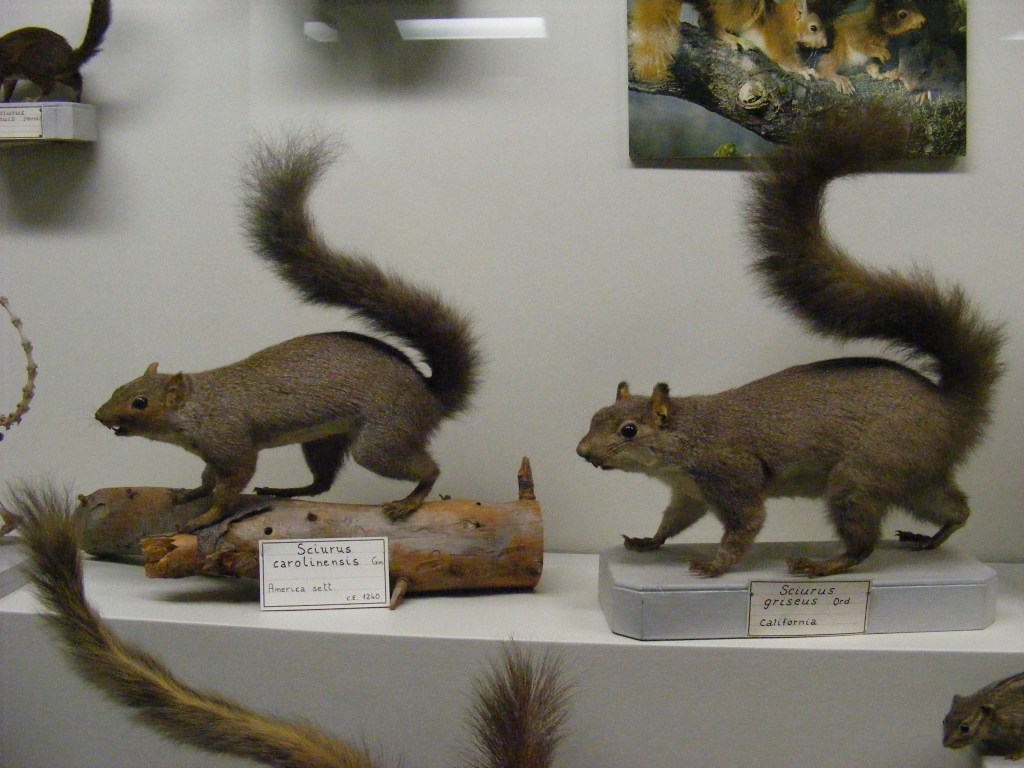
History of Eastern Gray and Eastern Fox Squirrels in the West
Both the eastern gray squirrel and eastern fox squirrel were introduced to Washington and other western states by humans in the early 20th century. Eastern gray squirrels were intentionally released in Seattle, Spokane, and other cities during the 1920s–30s to provide “charming” wildlife for urban parks (Stuart & WDFW, 2012). Eastern fox squirrels were introduced around the same period, often by private individuals or hunting clubs seeking a game species.
Once established, both species expanded quickly. They tolerate fragmented habitats, reproduce more frequently than western gray squirrels, and thrive in urban, suburban, and open woodland environments. Their adaptability and rapid population growth have allowed them to dominate human-dominated landscapes, often at the expense of native western gray squirrels, which require larger tracts of contiguous oak and pine forest to survive (Stuart & WDFW, 2012; WDFW, n.d.-b).
Status
At the federal level, the western gray squirrel is not listed under the Endangered Species Act. However, in Washington, it is classified as a state threatened species due to its fragmented distribution and population declines (WDFW, n.d.-a). Local extinctions have already occurred in parts of its historical range, such as the San Juan Islands and much of the Puget Sound lowlands.
State
Endangered
🔶
North America
Secure
🟢
Global
Least Concern ?
🟢
***** Status References: WA State: WDFW North America: NatureServe Global: IUCN Red List *****
Conservation Efforts in Washington
Washington’s conservation efforts for the western gray squirrel focus on habitat protection and restoration. Programs include:
- Oak woodland conservation – Since acorns are a critical food source, preserving Garry oak (Quercus garryana) stands is essential (WDFW, n.d.-a).
- Connectivity projects – Wildlife agencies work with landowners to maintain forested corridors so squirrels can move between isolated patches of habitat.
- Research and monitoring – Biologists track populations to better understand threats like disease (particularly mange) and the impact of invasive squirrel species (WDFW, n.d.-a).
What Homeowners Can Do in Their Backyard
Even if you don’t live directly in western gray squirrel territory, there are ways for homeowners and landowners to contribute:
- Plant native oaks and pines – Garry oak and ponderosa pine support native food webs and provide the nuts and seeds western gray squirrels depend on.
- Protect large trees – Mature forests with big trees provide essential nesting sites. Avoid removing them unnecessarily.
- Limit pesticide use – Reducing chemicals helps sustain the fungi and insects that are part of a healthy forest ecosystem.
- Report sightings – If you think you’ve seen a western gray squirrel, report it to WDFW’s wildlife reporting portal. Citizen science data helps track populations.
- Discourage non-native squirrels – Do not feed eastern gray or eastern fox squirrels, as supplemental food allows their populations to expand at the expense of native western gray squirrels.
By making mindful choices in landscaping and wildlife stewardship, Washington residents can play a small but meaningful role in keeping the western gray squirrel a part of our forests.
Nature Art
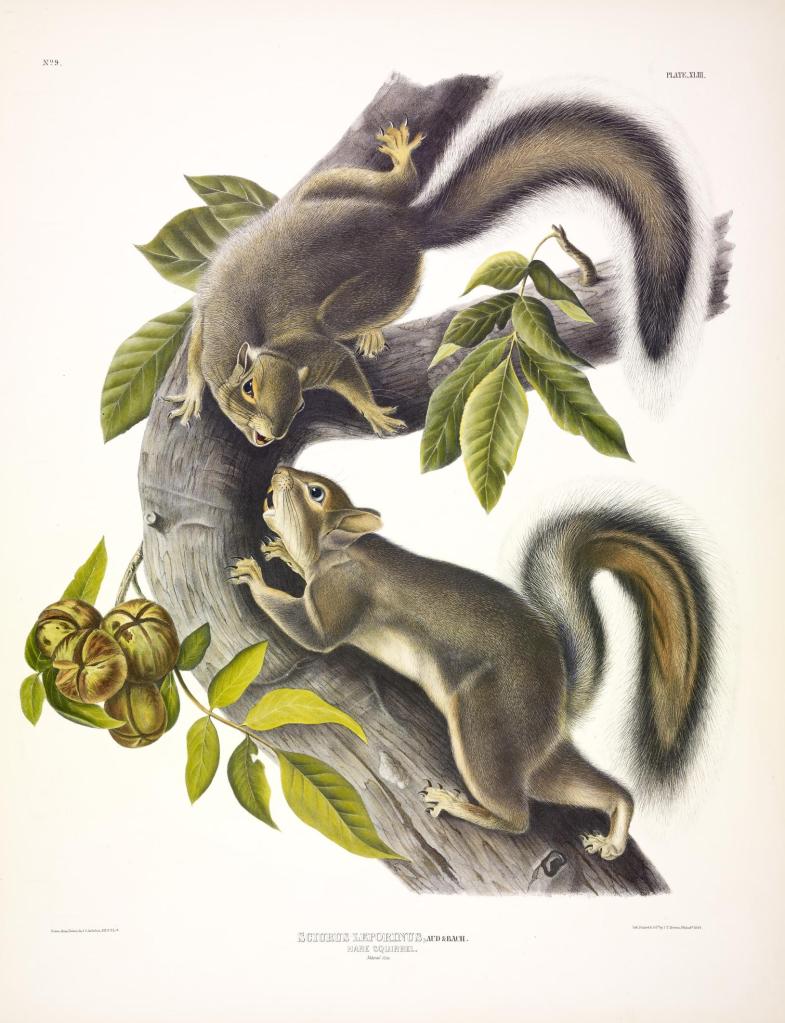
This detailed hand-colored lithograph by John James Audubon depicts the western gray squirrel (Sciurus griseus), historically labeled as the “Hare Squirrel” (Plate 43) in The Viviparous Quadrupeds of North America (1845–1848). Audubon likely used the name “Hare Squirrel” because early naturalists often applied names based on superficial features rather than modern taxonomy. In this lively scene, the squirrels are shown chasing each other along a tree branch, with long, sleek tails rather than the fully bushy tails we often associate with tree squirrels today, emphasizing their energetic movement and interaction.
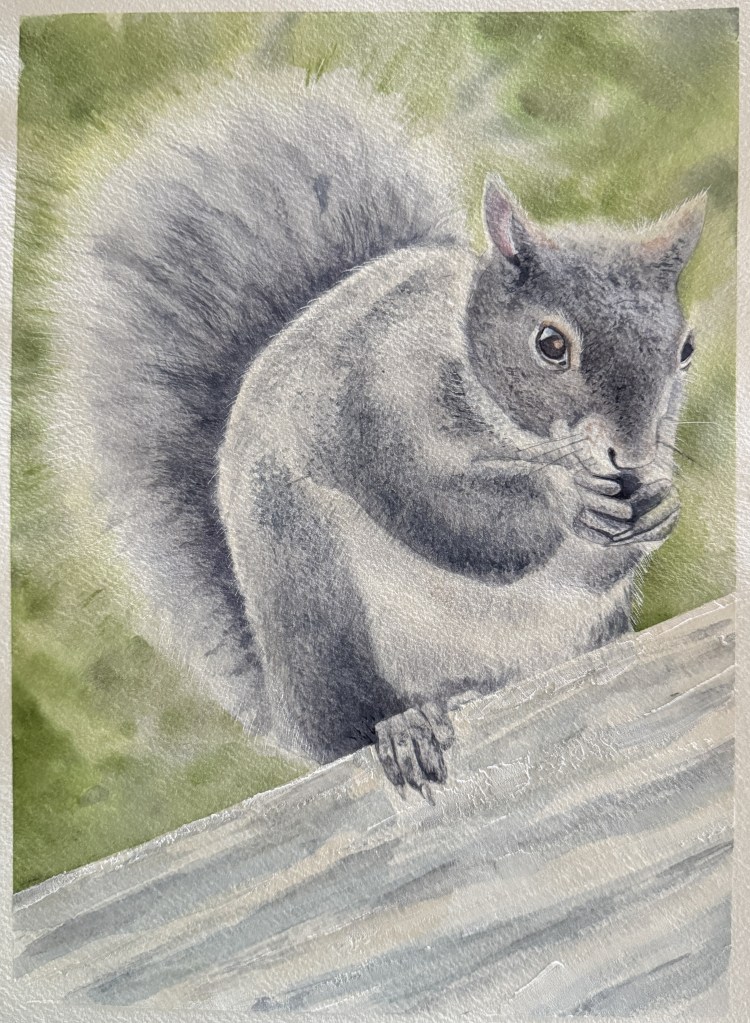
In Smith’s 2025 illustration, a western gray squirrel sits perched on a fence board, nibbling on a small snack, perhaps a nut. The squirrel’s fur is a soft gray, and its tail is notably bushy, capturing the species’ characteristic appearance in a calm, natural moment.
Cover photo credit: Squirrel, western gray (Sciurus griseus (Schmierer, 2009)
References
Click here to view all of the references used for this post
Audubon, J. W. (1845–1848). Hare Squirrel (Plate 43). In The Viviparous Quadrupeds of North America (Vol. 1). University of Michigan Digital Library. Retrieved September 11, 2025, from https://quod.lib.umich.edu/s/sclaudubon/x-b6719889/29377_0042
Massone, M. (2010, December 29). Eastern and western gray squirrels [Photograph]. Wikimedia Commons. Retrieved September 11, 2025, from https://commons.wikimedia.org/wiki/File:Eastern_and_western_gray_squirrels.JPG
NatureServe. (n.d.). Sciurus griseus. NatureServe Explorer. Retrieved September 11, 2025, from https://explorer.natureserve.org/Taxon/ELEMENT_GLOBAL.2.104592/Sciurus_griseus
Schmierer, A. (2009, August 21). Squirrel, western gray (Sciurus griseus) (8-21-09) Santa Margarita Lake, SLO Co, CA [Photograph]. Flickr. Public domain (CC0 1.0). Retrieved September 11, 2025, from https://www.flickr.com/photos/sloalan/3843297381/
Smith, I. (2026). Western gray squirrel (photograph of painting). Posted with permission.
Stuart, D., & Washington Department of Fish & Wildlife. (2012). Western gray squirrel conservation in Washington [Fact sheet]. Washington Department of Fish and Wildlife. Retrieved September 11, 2025, from https://wdfw.wa.gov
U.S. Forest Service. (2011, June 6). Western gray squirrel: Sciurus griseus [Species profile]. U.S. Department of Agriculture. Retrieved September 11, 2025, from https://www.fs.usda.gov
Washington Department of Fish & Wildlife. (n.d.-a). Western gray squirrel (Sciurus griseus). Retrieved September 11, 2025, from https://wdfw.wa.gov/species-habitats/species/sciurus-griseus
Washington Department of Fish & Wildlife. (n.d.-b). Eastern gray squirrel (Sciurus carolinensis). Retrieved September 11, 2025, from https://wdfw.wa.gov/species-habitats/species/sciurus-carolinensis

 wild sprout

You must be logged in to post a comment.