
If you’ve ever watched a monarch butterfly drift past milkweed in your garden and wondered where it came from—or how such a delicate insect survives such an epic journey—you’re not alone. The monarch is one of nature’s great storytellers: migrating across landscapes, transforming through distinct life stages, and facing mounting threats that call for our attention. If you live in Washington State or elsewhere in the Pacific Northwest (PNW), this story may be closer to home than you think.
“Happiness is a butterfly, which when pursued, is always just beyond your grasp, but which, if you will sit down quietly, may alight upon you.”
Nathaniel Hawthorne
Description
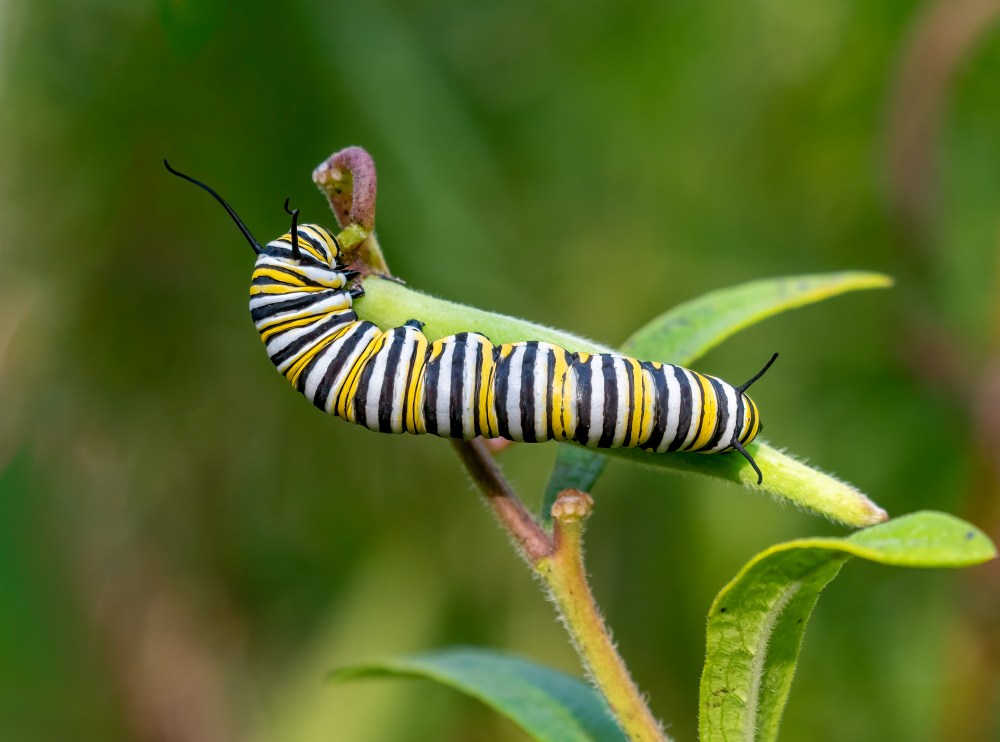
The monarch is one of North America’s most recognizable butterflies. Adults have vivid orange wings outlined in black, with white spots along the margins. Caterpillars are boldly striped in black, yellow, and white, while the chrysalis appears jewel-green, dotted with metallic gold flecks.
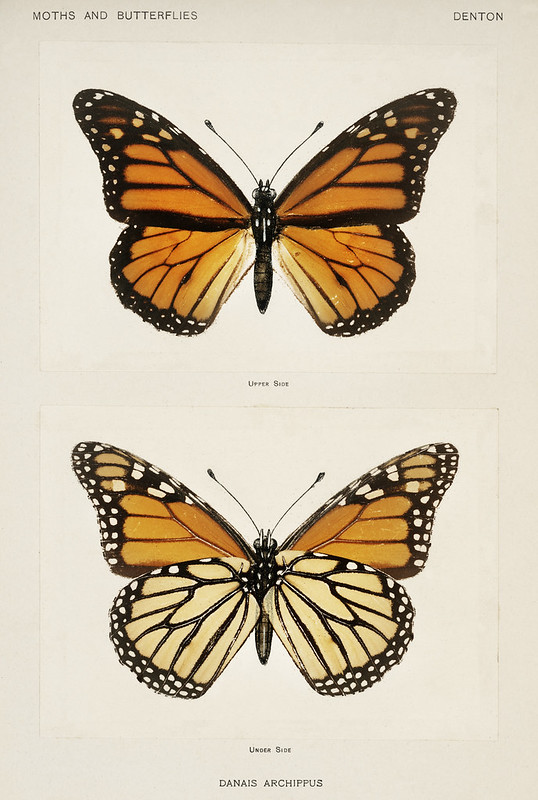
Sexual dimorphism is subtle but visible. Males have a small black spot on each hindwing—an androconial patch used to release courtship pheromones—while females lack these spots and have thicker black wing veins, giving their wings a darker appearance overall (U.S. Fish & Wildlife Service, n.d.).
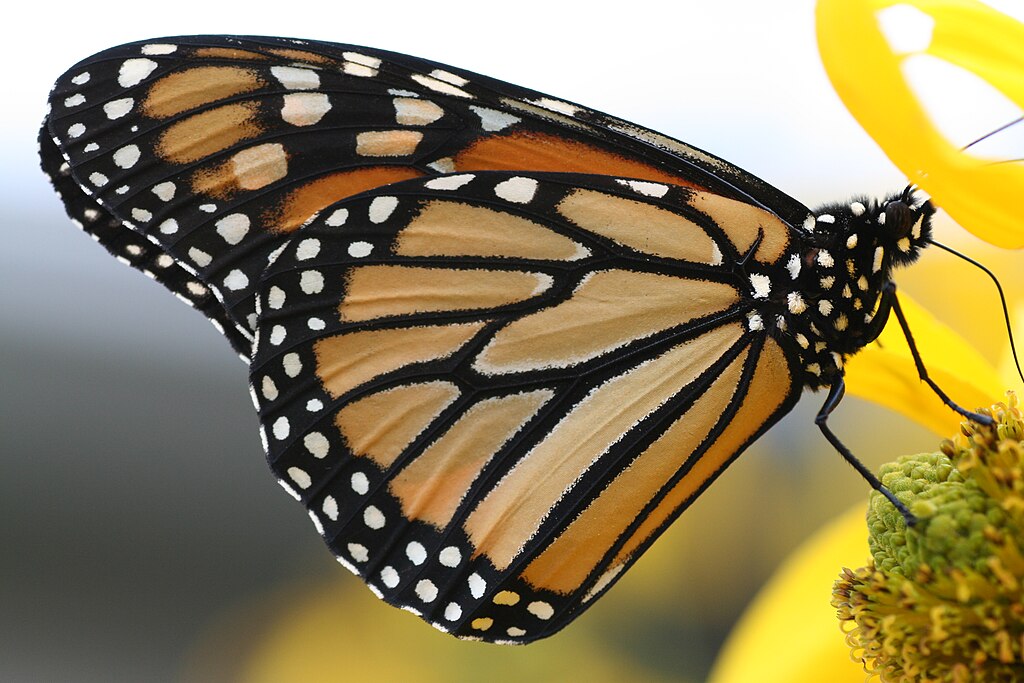
Eastern vs. Western Monarchs
Eastern and western monarchs are the same species (Danaus plexippus), but their journeys are very different. In North America, eastern monarchs—those east of the Rockies—undertake long migrations all the way to central Mexico, and their slightly larger, more elongated wings help them on the way. Western monarchs, like the ones you might spot in Washington, travel shorter distances and spend the winter along the California coast.
Genetic studies show little fixed difference between eastern and western monarchs; most variation reflects environmental conditions rather than distinct evolutionary lineages (Freedman et al., 2021).
In the Pacific Northwest, monarchs belong to the western population, but their distribution across Washington is uneven and closely tied to habitat availability and climate.
Monarch Presence in Washington and the PNW
In Washington State, monarchs occur on both sides of the Cascade Range, but they are most consistently found east of the Cascades, where open, sunny grasslands and shrubsteppe ecosystems support native milkweed and abundant nectar-rich wildflowers. These eastern habitats—particularly those containing showy milkweed (Asclepias speciosa), the state’s most common native milkweed—form the core of monarch breeding activity in Washington (U.S. Fish & Wildlife Service, n.d.; Washington Department of Fish & Wildlife, n.d.). Narrowleaf milkweed (Asclepias fascicularis) also occurs in these habitats and can support monarchs, though it is less abundant.
West of the Cascades, monarchs are less common and more localized. They may breed during warm years or where milkweed is present in gardens, restoration sites, or remnant habitats, but populations there tend to be smaller and more variable from year to year. Many monarchs observed in western Washington are likely migrants passing through rather than part of stable, long-term breeding populations.
Monarchs born in Washington migrate south in late summer and early fall, eventually reaching overwintering sites along the California coast.
Monarch Lifecycle in WA / PNW
In Washington, monarch butterflies follow the same remarkable life cycle seen across North America, but with regional nuances. Most monarchs born during spring and summer live only a few weeks, feeding, mating, and laying eggs before dying. The final generation of the season—often emerging in late August or September—enters a state of reproductive diapause, delaying reproduction and conserving energy for migration.
These long-lived adults, sometimes referred to as the “overwintering generation,” can survive for several months, traveling to coastal California to spend the winter before returning north the following spring. While individual monarchs rarely live a full year, this migratory strategy allows populations associated with Washington to persist across generations, linking the seasonal rhythms of the state’s grasslands, shrubsteppe, and riparian habitats.
| Lifecycle Stage | Approximate Time of Year in WA / PNW | Duration of Stage | Host / Important Plants / Notes |
|---|---|---|---|
| Egg | Late spring–early summer (May–July) | 3–5 days | Laid singly on milkweed leaves (native species like Asclepias speciosa, A. fascicularis) |
| Larva (caterpillar) | Late spring–summer | ~10–14 days | Feeds exclusively on milkweed; quality of plant affects growth |
| Pupa (chrysalis) | Summer | ~10 days | Hangs from vegetation; needs sheltered, stable microclimate |
| Adult (breeding) | Summer–early fall | ~2–4 weeks | Needs nectar-rich wildflowers; may breed or start migration |
| Overwintering / Migratory | Fall–winter | Several months | Western monarchs overwinter mostly in California; habitats require mild climate and shelter |
Timing can shift year to year depending on weather.
In Washington, western monarchs breed primarily in central and eastern regions, then migrate south to overwinter along the California coast.
Range
Monarch butterflies are widespread across much of the continental United States during spring and summer wherever milkweed is present. Eastern monarchs migrate to central Mexico for the winter, while western monarchs primarily overwinter along the California coast. Monarchs are rare visitors to Alaska, and Hawaii supports non-migratory populations.
In Washington State, monarchs are most often associated with grassland and shrubsteppe ecosystems east of the Cascade Range, where milkweed and nectar plants occur naturally and in greater density. These open habitats help explain why monarchs are not evenly distributed across the state and are absent from some counties.
Status
Federally, the monarch is under consideration for protection as a threatened species under the U.S. Endangered Species Act. The U.S. Fish & Wildlife Service has documented significant long-term declines in both eastern and western monarch populations (U.S. Fish & Wildlife Service, n.d.).
In Washington, monarchs are listed as a state candidate species, meaning they are being evaluated for potential classification as Endangered, Threatened, or Sensitive. This status reflects growing concern over declining western monarch populations, including those that breed in or pass through Washington (Washington Department of Fish & Wildlife, 2024).
***** Status References: WA State: WDFW North America: NatureServe Global: IUCN Red List *****
Conservation
Monarchs in Washington face mounting pressures from habitat loss due to development and agriculture, pesticide exposure, climate extremes, and the widespread loss of milkweed. Conservation efforts in the state focus on restoring native milkweed and nectar plants, reducing pesticide use, protecting migration corridors, and supporting overwintering habitats along the California coast.
Citizen science—such as tagging monarchs, monitoring populations, and reporting sightings—also plays a vital role in tracking trends and informing conservation strategies (Washington Department of Fish & Wildlife, 2024).
What You Can Do in Your Own Backyard
Even small actions matter. Plant native milkweed (e.g. Showy Milkweed, Asclepias speciosa ) and nectar plants, reduce or eliminate pesticide use, provide sheltered spaces for eggs and chrysalises, and participate in local habitat restoration or citizen science projects. Every patch of monarch-friendly habitat helps, especially in a state where populations are declining.
Monarch butterflies in Washington are quiet reminders of how interconnected our ecosystems truly are. While eastern and western monarchs differ slightly in migration distance and wing shape, their survival in the Pacific Northwest depends on habitat, climate, and collective care. By planting milkweed, restoring native landscapes, and paying attention to these orange travelers, we can help ensure that monarchs continue to pass through Washington’s skies for generations to come.
Nature Art
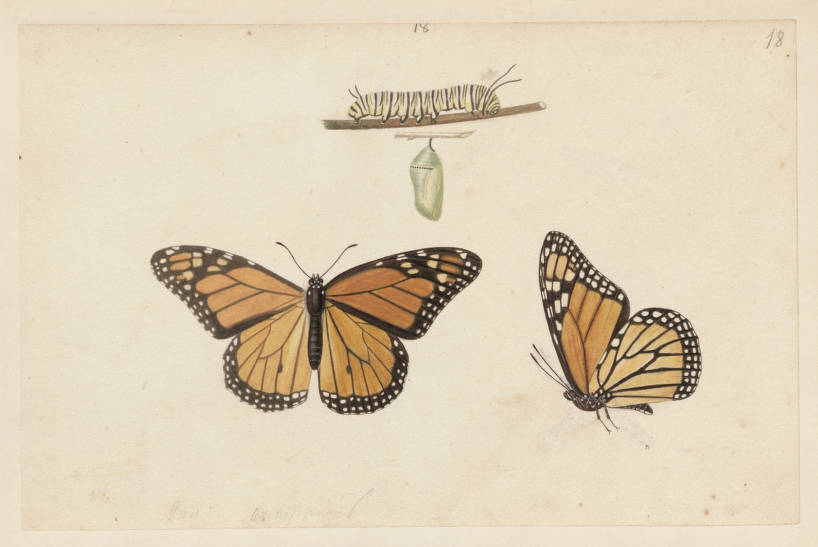
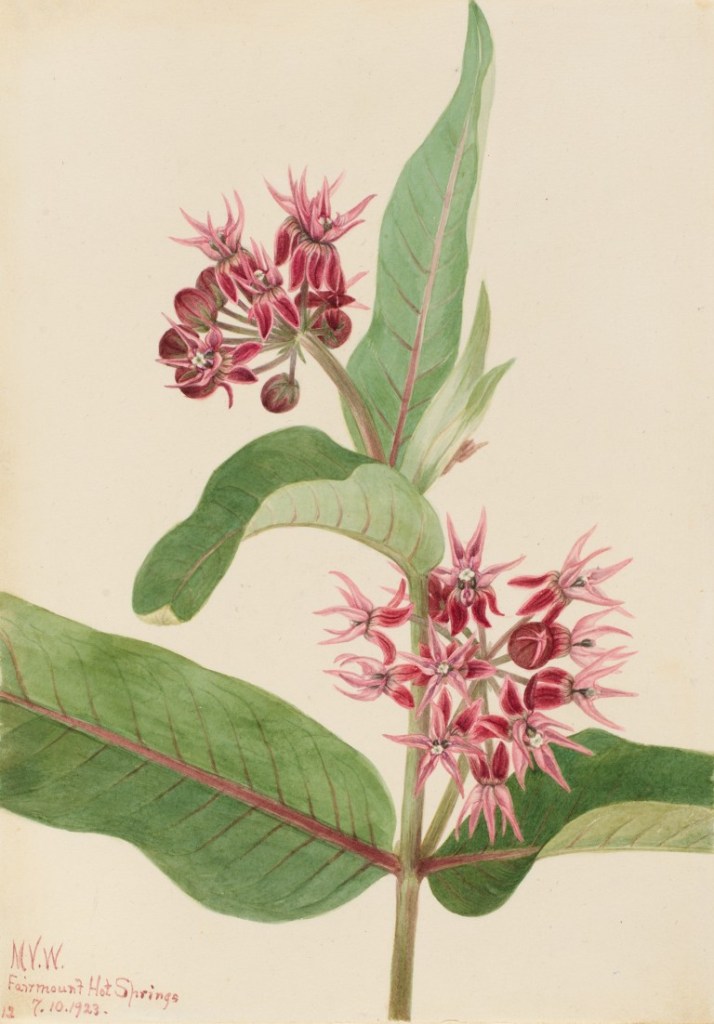
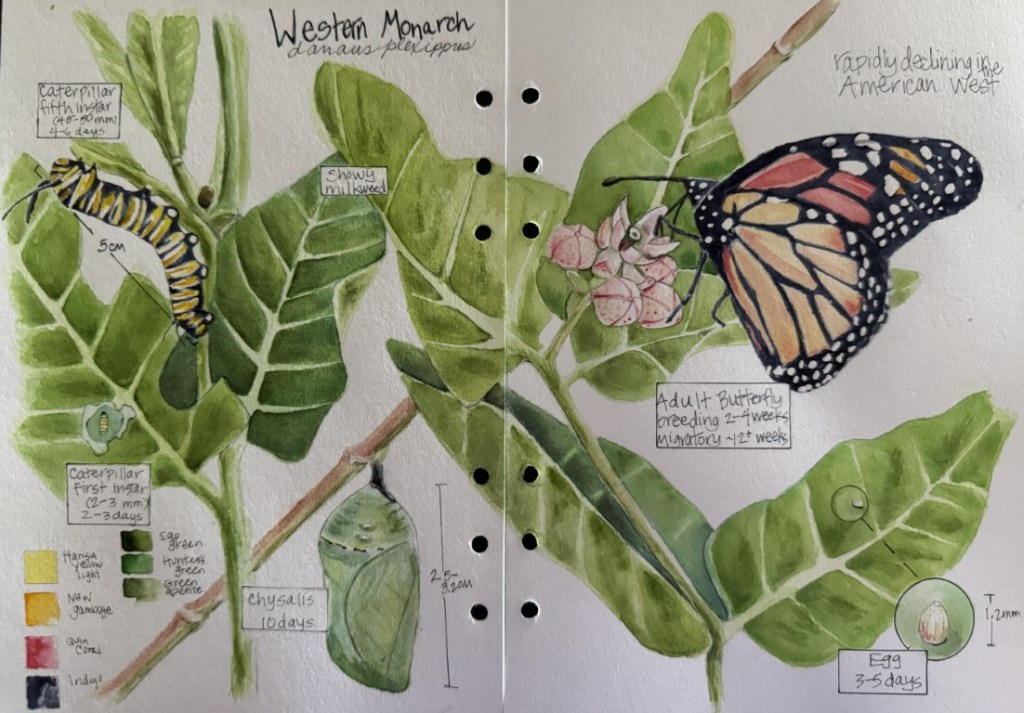
These historical illustrations document the monarch’s story from multiple angles. Abbot’s 1797 work depicts the butterfly across its full lifecycle, Denton’s 1900 illustration emphasizes wing color and sexual dimorphism, and Walcott’s 1923 rendering of showy milkweed (Asclepias speciosa) highlights the plant that makes the monarch’s life cycle possible. Smith’s (2026) painting traces the western monarch’s full life cycle—from egg to caterpillar, chrysalis, and butterfly—arranged like quiet field notes rather than a linear diagram.
Cover photo credit: Monarch butterfly (Hisgett, 2011)
References
Abbot, J. (1797). Monarch [Hand-colored engraving]. In J. E. Smith (Ed.), The natural history of the rarer lepidopterous insects of Georgia (Vol. 1, Plate 1). Published by the author. Retrieved September 17, 2025, from https://digital.tcl.sc.edu/digital/collection/abbot/id/99/?utm_source=chatgpt.com
Denton, S. F. (1856–1937). Monarch butterfly (Danaus Archippus) from Moths and Butterflies of the United States (1900) [Illustration]. Flickr. Digitally enhanced from our own publication. Free download under CC Attribution (CC BY 4.0). Please credit the artist and rawpixel.com. Retrieved September 17, 2025, from https://www.flickr.com/photos/vintage_illustration/32493533688
Freedman, M., Dingle, H., & Strauss, S. (2021). Are eastern and western monarch butterflies distinct populations? Conservation Science and Practice, 3(1), e383. https://doi.org/10.1111/csp2.383
Smith (2026). Western Monarch Lifecycle Sketch. Shared with permission.
U.S. Fish & Wildlife Service. (n.d.). Monarch (Danaus plexippus). Retrieved September 17, 2025, from https://www.fws.gov/species/monarch-danaus-plexippus
Walcott, M. V. (1923). Showy milkweed (Asclepias speciosa) [Watercolor on paper; digital image]. Public domain (via Artvee). Retrieved December 7, 2025, from https://artvee.com/dl/showy-milkweed-asclepias-speciosa-2/
Washington Department of Fish & Wildlife. (n.d.). Monarch butterfly (Danaus plexippus). Retrieved September 17, 2025, from https://wdfw.wa.gov/species-habitats/species/danaus-plexippus
Washington Department of Fish & Wildlife. (2024). Washington State listed and candidate species list. https://wdfw.wa.gov/sites/default/files/2024-03/wa-state-listed-and-candidate-species-list.pdf

 wild sprout
You must be logged in to post a comment.