
The Oregon silverspot butterfly (Speyeria zerene hippolyta) is a striking species native to the Pacific Northwest. Historically, its range extended from Westport in Grays Harbor County, Washington, south to Del Norte County, California. In Washington, the butterfly was once found along the Long Beach Peninsula in Grays Harbor county, but it has not been observed in the state since 1998 and is now considered extirpated (Washington Department of Fish & Wildlife, n.d.). Currently, the butterfly’s populations are limited to a few isolated areas in Oregon and California, including Cascade Head and Mount Hebo in Oregon, and Lake Earl in California (U.S. Fish and Wildlife Service, 2018).
“The butterfly is a flying flower, the most elegant of all insects.”
–John James Audubon, The Birds of America (1827–1838)
Status
The Oregon silverspot butterfly is listed as Threatened under the U.S. Endangered Species Act (U.S. Fish and Wildlife Service, 2018). In Washington, it is listed as Endangered by the Washington Department of Fish and Wildlife, though it is considered extirpated from the state (Washington Department of Fish & Wildlife, n.d.). The decline of this species is primarily due to habitat loss caused by coastal development, invasive plant species, and fire suppression, which have degraded the coastal prairie ecosystems on which it depends (U.S. Fish and Wildlife Service, 2018).
***** Status References: WA State: WDFW North America: NatureServe Global: IUCN Red List *****
Conservation
Conservation efforts focus on habitat restoration and reintroduction programs. For example, the Oregon Zoo has been actively involved in releasing Oregon silverspot butterfly larvae into native habitats such as Saddle Mountain, where the species had not been observed since 1972 (Oregon Zoo, 2025). The U.S. Fish and Wildlife Service has also designated critical habitat areas and collaborates with local partners to implement recovery plans, including restoring coastal prairie habitats and maintaining populations of the butterfly’s larval host plant, early blue violet (Viola adunca) (U.S. Fish and Wildlife Service, 2018).
Description
The Oregon silverspot butterfly (Speyeria zerene hippolyta) is a medium-sized butterfly with a wingspan of approximately 5 to 5.5 centimeters. Its forewings are bright orange-brown with dark spots and lines, while the underside of the hindwings is muted tan to reddish-brown and marked with distinctive metallic silver spots—features that give the butterfly its common name (WDFW, 2021).
| Life Stage | Key Plant(s) or Habitat Feature | Role & Detail |
|---|---|---|
| 1. Egg-laying | Viola adunca (early blue violet) | Eggs are laid on or near this host plant, especially on leaves, stems, or within a few centimeters in moss or duff. |
| 2. Hatchling (Sep) | Native mosses (e.g., Racomitrium spp.), Native grasses: Festuca rubra (red fescue), Deschampsia cespitosa (tufted hairgrass), Danthonia californica (California oatgrass) | Hatchlings do not feed. They crawl into protective microhabitats like curled grass bases, moss mats, and beneath dead violet or aster leaves. |
| 3. Diapause (Winter) | Leaf litter from: Viola adunca, Symphyotrichum subspicatum (Douglas aster), Eriophyllum lanatum (common woolly sunflower) Ground cover: Festuca rubra, Deschampsia | Diapause occurs in moist, sheltered litter under these plants. Grasses form insulating tussocks; fallen violet/aster leaves and dead forbs create low-lying cover. |
| 4. Larval Feeding | Viola adunca only | Sole larval food source. Larvae feed on leaves and petioles, sometimes climbing short distances. |
| 5. Larval Growth | Viola adunca | Continues feeding through 5–9 instars. Dense violet patches support faster growth. |
| 6. Pupation | Leaf litter from: Viola adunca, Achillea millefolium (yarrow), Solidago canadensis (Canada goldenrod) Base of grass clumps (Festuca rubra, Deschampsia) | Pupae attach to curled leaves, grass stems, or detritus low to ground—often in shaded areas. Require undisturbed litter layer. |
| 7. Adult | Nectar plants: Achillea millefolium (common yarrow), Solidago canadensis, Symphyotrichum subspicatum, Cirsium brevistylum (short-styled thistle) | Adults nectar on a mix of late-summer forbs. These plants must be within flying distance of violet patches. |
Lifecycle
The Oregon silverspot butterfly (Speyeria zerene hippolyta) has a single annual generation, with a highly specialized and seasonal life cycle. Females lay eggs in late summer near or on the host plant—early blue violet (Viola adunca). After about two to three weeks, the larvae hatch and immediately enter diapause, a state of dormancy that lasts through the winter. In early spring, they awaken and begin feeding on violet leaves. The larvae go through several molts before pupating in a well-camouflaged chrysalis. After about two to three weeks in the pupal stage, adult butterflies emerge in midsummer, typically from July to early September. Adults live only a few weeks, during which they feed on nectar, mate, and complete the cycle (U.S. Fish & Wildlife Service, 2021).
Photo credit: Oregon silverspot butterfly on early blue violet (U.S. Fish and Wildlife Service, n.d.)
What You Can Do: Help in Your Backyard
Even if you don’t live near the coast, you can help support native butterflies like the Oregon silverspot in your own yard. Here are some practical actions:
- Plant native nectar sources – Early blue violet (Viola adunca) is the larval host for the Oregon silverspot, and adult butterflies feed on nectar from flowers such as yarrow, milkweed, and native asters. Including these plants in your garden can provide food and breeding opportunities (U.S. Fish and Wildlife Service, 2018).
- Create butterfly-friendly microhabitats – Leaving patches of native grasses and flowering meadows, avoiding pesticide use, and providing sunny open areas will encourage butterfly activity.
- Participate in citizen science – Organizations such as iNaturalist and local conservation groups track butterfly sightings. Your backyard observations help scientists monitor populations and habitat health.
- Support local conservation efforts – Donations or volunteer work with local prairie restoration projects can directly aid Oregon silverspot habitat restoration (Oregon Zoo, 2025).
By making small, mindful changes in your backyard, you can contribute to the long-term survival of this beautiful and rare butterfly.
Nature Art
Mary Vaux Walcott’s delicate watercolor illustrations of yarrow (Achillea lanulosa) and early blue violet (Viola adunca) capture the intricate beauty of these native plants with remarkable detail and botanical accuracy. Her work highlights the fine textures of the fern-like yarrow leaves and the soft, graceful petals of the violet, making these paintings timeless references for both art and science in documenting North American wildflowers. No historic illustrations of the Oregon silverspot butterfly are currently known to be in the public domain.
Smith’s (2025) illustration depicts the life cycle of the Oregon silverspot butterfly, highlighting each stage’s close relationship with specific native plants. From delicate eggs and chrysalis placed on early blue violets, to adult nectar foraging among late-summer wildflowers, the image emphasizes the butterfly’s dependence on an intact coastal grassland ecosystem.
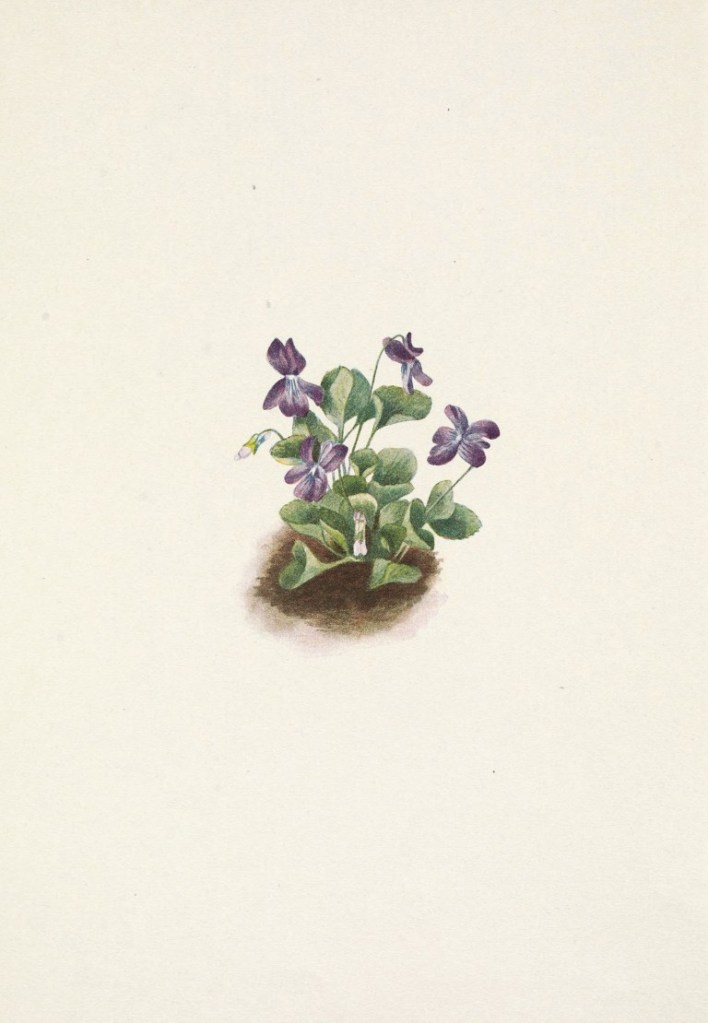
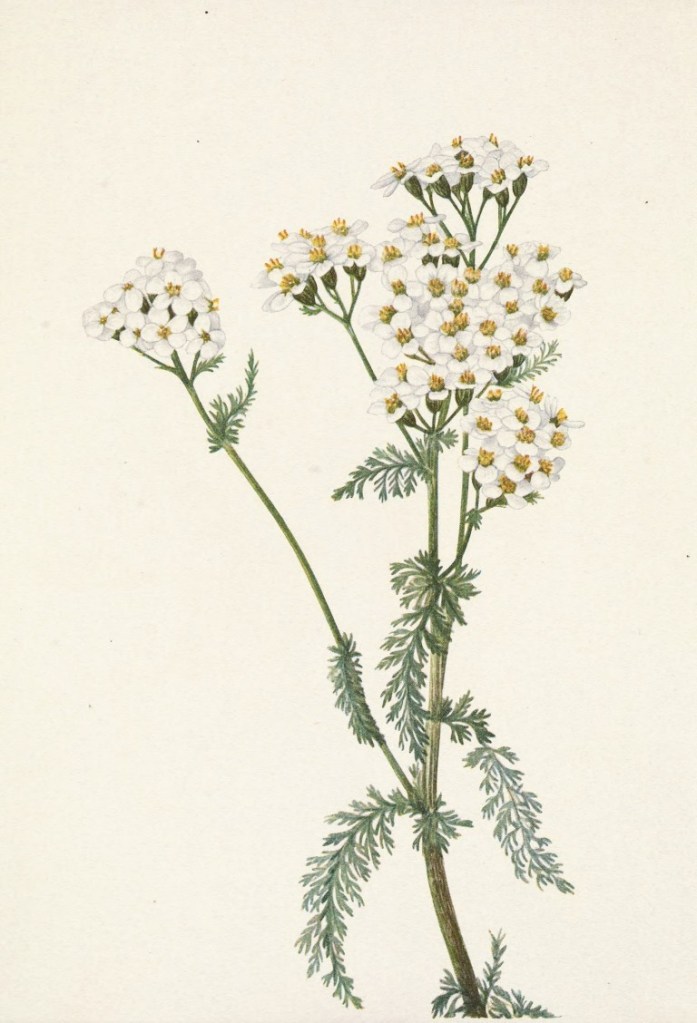
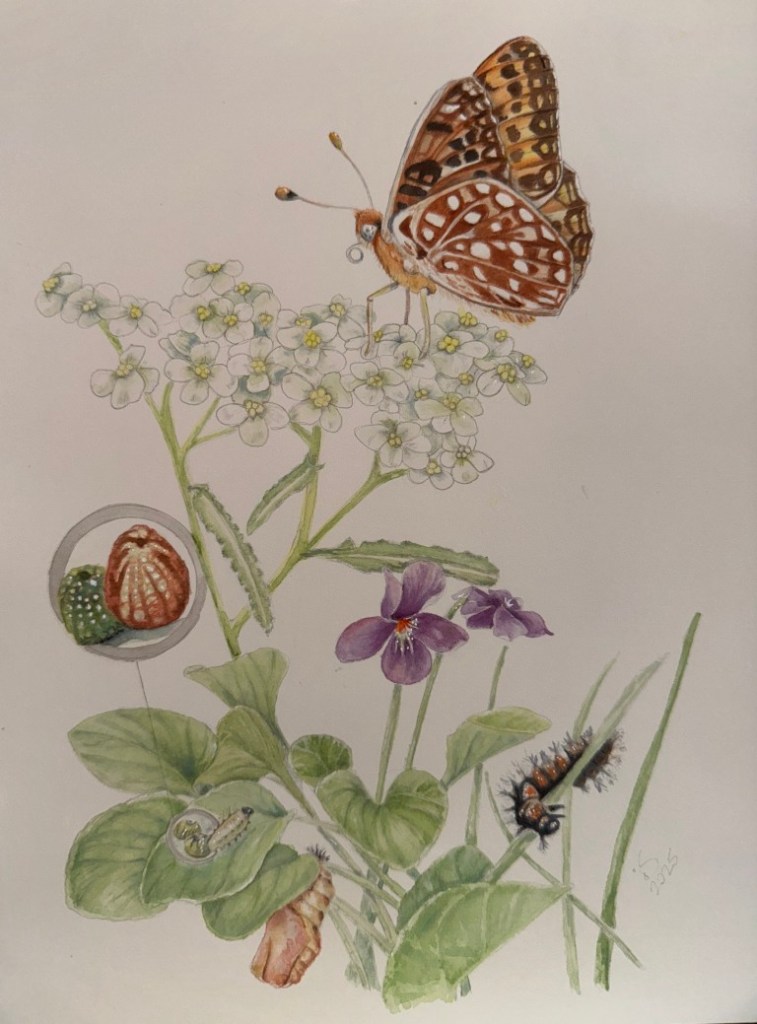
Cover photo credit: Oregon silverspot butterfly on early blue violet (U.S. Fish and Wildlife Service, n.d.)
References
NatureServe. (n.d.). Argynnis zerene. NatureServe Explorer. https://explorer.natureserve.org/Taxon/ELEMENT_GLOBAL.2.111503/Argynnis_zerene
Oregon Zoo. (2025, July 3). Oregon Zoo reintroduces silverspot butterflies to native habitat. OPB. https://www.opb.org/article/2025/07/03/oregon-silverspot-butterfly-saddle-mountain/
Smith, I (2025). Oregon Silverspot Lifecycle [illustration]. Shared with permission.
U.S. Fish and Wildlife Service. (2018, April). Oregon silverspot butterfly. https://www.fws.gov/story/2018-04/oregon-silverspot-butterfly
U.S. Fish & Wildlife Service. (2021). Oregon silverspot butterfly (Speyeria zerene hippolyta). Retrieved June 28, 2025, from https://ecos.fws.gov/ecp/species/3240
U.S. Fish and Wildlife Service. (n.d.). Oregon silverspot butterfly on early blue violet [Photograph] (Public Domain). National Digital Library. Retrieved June 13, 2025, from https://digitalmedia.fws.gov/digital/collection/natdiglib/id/12693/rec/2
Walcott, M. V. (1925). Purple Mountain Violet (Viola adunca). Watercolor on paper. In North American Wild Flowers. Smithsonian Institution. Public domain. Retrieved June 2025, from Artvee: https://artvee.com/dl/purple-mountain-violet-viola-adunca
Walcott, M. V. (1925). Western Yarrow (Achillea lanulosa). Watercolor on paper. In North American Wild Flowers. Smithsonian Institution. Public domain. Retrieved June 2025, from Artvee: https://artvee.com/dl/western-yarrow-achillea-lanulosa/
Washington Department of Fish & Wildlife. (n.d.). Oregon silverspot butterfly (Argynnis zerene hippolyta). https://wdfw.wa.gov/species-habitats/species/argynnis-zerene-hippolyta
Washington Department of Fish and Wildlife. (2024, March). State listed and candidate species list. https://wdfw.wa.gov/sites/default/files/2024-03/wa-state-listed-and-candidate-species-list.pdf
Washington Department of Fish and Wildlife [WDFW]. (2021). Oregon silverspot butterfly – Speyeria zerene hippolyta. Retrieved June 28, 2025, from https://wdfw.wa.gov/sites/default/files/publications/02083/wdfw02083.pdf

 wild sprout
You must be logged in to post a comment.