
Wetlands are some of the most dynamic and life-sustaining ecosystems in Washington, filtering water, storing floodwaters, and supporting a remarkable variety of species. Among the creatures that depend on these habitats, the Oregon spotted frog (Rana pretiosa) is both a symbol of biodiversity and a reminder of the fragility of freshwater ecosystems. Once widespread across the Pacific Northwest, its range has significantly contracted, leaving it one of the most imperiled amphibians in the region (U.S. Fish and Wildlife Service [USFWS], 2014).
Most of Washington’s human population lives within freshwater and riparian ecosystems, particularly in the Puget Sound lowlands and river valleys. This means the health of wetlands directly affects not only wildlife like the Oregon spotted frog, but also the daily lives of people who depend on clean water, flood protection, and thriving landscapes.
Description
The Oregon spotted frog is a medium-sized amphibian, typically measuring 1.75–4 inches in length (Washington Department of Fish and Wildlife [WDFW], n.d.-a). Its most distinctive feature is the scattered, irregular black spots across its back and legs, which range in color from reddish-brown to olive or dark gray, often becoming redder in adults. The underside is creamy white, transitioning to yellow or orange in the groin and hind legs. Relatively smooth skin, prominent dorsolateral folds, and upturned eyes allow the frog to see underwater, while partially webbed hind feet support a semi-aquatic lifestyle.
“The croaking of the frogs—one of the most ancient sounds in nature—makes the marsh ring with a pure wildness.”
–Henry David Thoreau, Journal, 1852
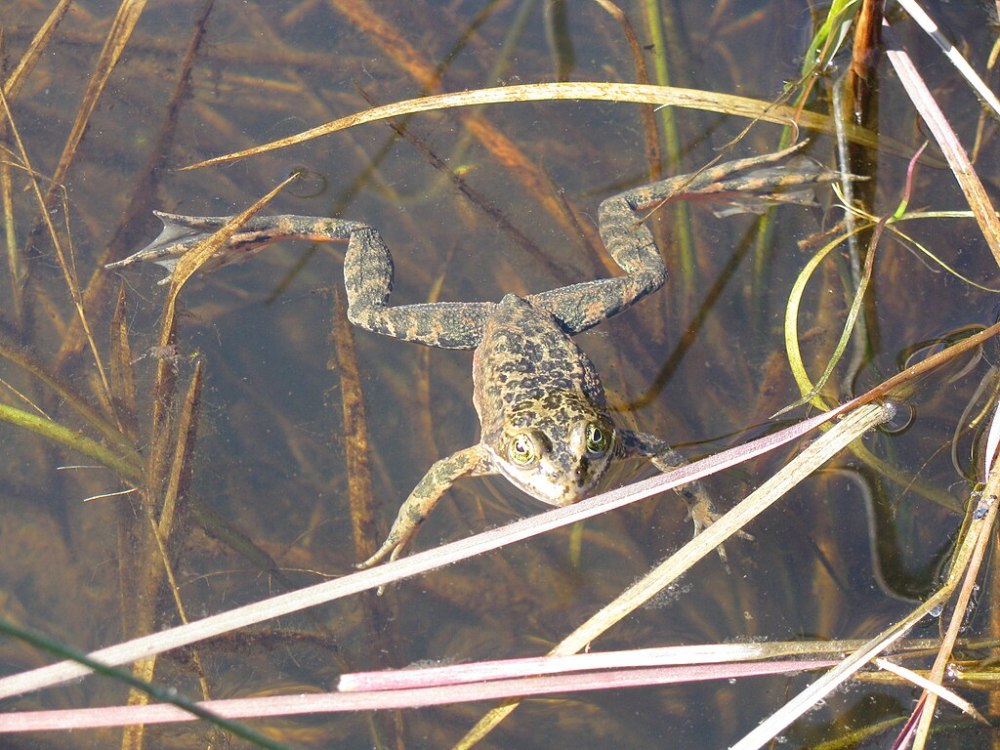
Sexual dimorphism is evident in this species. Females are generally larger and heavier, supporting greater egg production, whereas males develop specialized structures during the breeding season to aid in amplexus. As frogs age, their spots often increase in size and number, and the orange or red wash on the underbelly becomes more pronounced, making them easily recognizable in their freshwater and riparian habitats.
| Male | Female | |
| Average Length | 2.2 in (57 mm) | 3 in (75 mm) |
| Average Weight | 16.3 – 18.6 grams | 24.5 – 30.8 grams |
| Seasonal nuptial pads | Yes | No |
| Seasonal forearm musculature | Yes | No |
Wetland Specialist
Oregon spotted frogs are highly aquatic, rarely straying far from permanent water. They thrive in marshes, ponds, and slow-moving streams with abundant emergent vegetation, which provide cover from predators and nursery grounds for eggs and tadpoles. Their life cycle is tightly linked to wetland rhythms: they breed in shallow, sunlit pools in early spring, with egg masses sometimes numbering in the hundreds (Hayes et al., 1997). Because they rely so heavily on wetlands, their populations are particularly vulnerable to habitat loss and changes in water flow.
Why They Matter
Amphibians like the Oregon spotted frog are often called “sentinel species” because their health reflects the condition of their environment. With permeable skin and dual aquatic-terrestrial life stages, they are highly sensitive to pollutants, invasive species, and habitat changes. A decline in spotted frog numbers signals broader ecological challenges, including wetland degradation and water quality issues that also affect people, birds, and fish (Pearl & Hayes, 2004). Protecting this frog means protecting entire ecosystems that countless species—and communities—depend on.
Status
The Oregon spotted frog is listed as Threatened under the U.S. Endangered Species Act (USFWS, 2014). In Washington, it is considered a state-endangered species, with only a handful of isolated populations remaining. Historically, the frog ranged widely across Puget Sound, the Columbia Basin, and parts of Oregon and British Columbia. Today, its distribution is greatly reduced, and many historical breeding sites have been lost (WDFW, n.d.-a).
State
Endangered
🔶
North America
Imperiled
🔶
Global
Vulnerable ↓
🔶
***** Status References: WA State: WDFW North America: NatureServe Global: IUCN Red List *****
Conservation
Several factors have contributed to the Oregon spotted frog’s decline. The most significant threat is wetland loss and degradation due to urban development, agriculture, and water management that alters natural flooding cycles. Invasive species, such as the American bullfrog (Lithobates catesbeianus) and non-native fish, prey on tadpoles and compete for habitat. Climate change also poses risks, with altered precipitation patterns and drought reducing the shallow wetlands critical for breeding. Because these frogs are highly dependent on stable, high-quality aquatic habitats, even small changes in water availability can have dramatic effects on survival (Pearl & Hayes, 2004).
How You Can Help
Conservation of the Oregon spotted frog requires a community effort, but there are also things you can do at home:
- Choose small, shallow water features (less than 18 inches deep) to favor native frogs over bullfrogs.
- Avoid stocking fish, even goldfish or koi, which will eat frog eggs and tadpoles.
- Plant native vegetation around water features to create hiding spots.
- Keep ponds seasonal or ephemeral to exclude bullfrogs.
- Never relocate or release frogs, which can spread disease or introduce non-native species.
Beyond your yard:
- Reduce chemical runoff by using natural fertilizers and limiting pesticide use.
- Conserve water through rain barrels and native landscaping.
- Respect sensitive wetlands during recreation.
- Volunteer with local wetland restoration projects.
By mimicking natural wetland conditions while discouraging invasive species, communities can give amphibians like the Oregon spotted frog a safer future.
🐸 Frog-Friendly Pond Tips
💧 Shallow water – Keep pools under 18″ deep to mimic natural breeding habitat.
🌿 Native plants – Plant rushes, sedges, and wildflowers along pond edges for shelter.
❌ No fish – Goldfish or koi eat eggs and tadpoles; fish-free ponds are safer.
☀️ Ephemeral ponds – Temporary pools dry in summer, keeping bullfrogs away.
🧴 Limit chemicals – Avoid pesticides and chemical fertilizers to protect water quality.
👀 Observe only – Never move frogs; let them thrive where they naturally occur.
Even a small pond can create a safe space for Oregon spotted frogs and other wetland wildlife!
Nature Art
Charles Girard’s 1858 illustration of Rana pretiosa presents a delicate, hand-colored rendering that captures the frog’s defining features with scientific precision. Published as part of his herpetological survey for the U.S. Army’s Great Salt Lake expedition, the plate shows the frog in profile with subtle spotting across its limbs and back, alongside related species such as Rana aurora and Rana draytoni.
Smith’s 2025 illustration of an Oregon spotted frog perched on a variegated sunflower highlights the frog in its riparian environment, emphasizing both its distinctive markings and the wetland-edge plants that sustain it, connecting the species’ biology with the natural beauty of the Pacific Northwest.
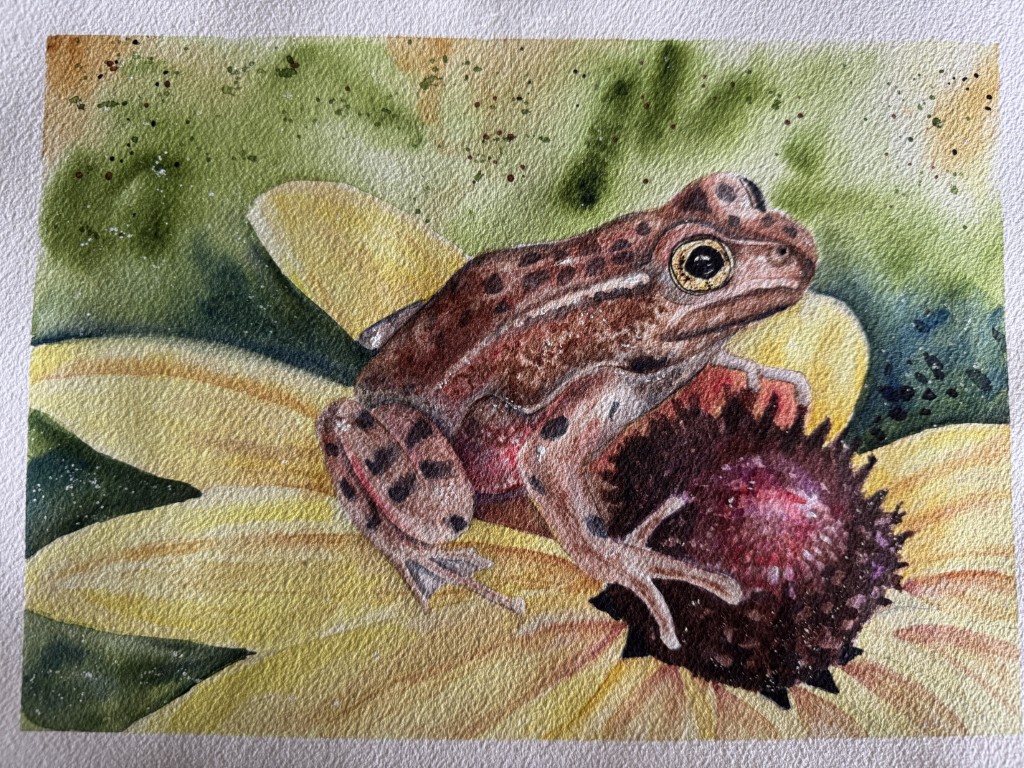
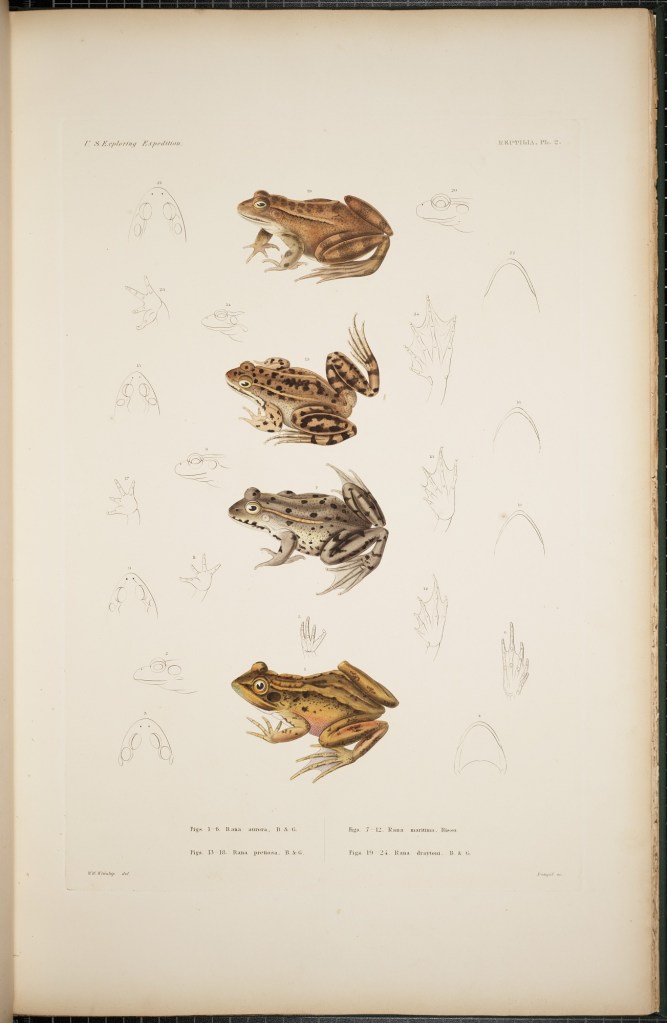
Cover photo credit: At Conboy Lake National Wildlife Refuge, Glenwood, Washington (cricketsblog, 2021)
References
Click here to view all of the references used for this post
cricketsblog. (2021). At Conboy Lake National Wildlife Refuge, Glenwood, Washington [Photograph]. CC BY 2.0. https://creativecommons.org/licenses/by/2.0, via Wikimedia Commons. Retrieved March 19, 2025, from https://commons.wikimedia.org/wiki/File:Oregon_spotted_frog.jpg
Hayes, M. P., Pearl, C. A., & Kelly-Ringel, B. L. (1997). Behavior and habitat use by Oregon spotted frogs (Rana pretiosa) in the Oregon Cascade Range. Northwestern Naturalist, 78(2), 61–69. https://doi.org/10.2307/3536828
Mid-Columbia River Refuges. (2012). Oregon Spotted Frog [Photograph]. CC BY 2.0. https://creativecommons.org/licenses/by/2.0, via Wikimedia Commons. Retrieved March 19, 2025, from https://commons.wikimedia.org/wiki/File:Oregon_Spotted_Frog_%28Rana_pretiosa%29_%288895523540%29.jpg
Pearl, C. A., & Hayes, M. P. (2004). Oregon spotted frog (Rana pretiosa) conservation and management plan. U.S. Fish and Wildlife Service. Public domain. Retrieved September 11, 2025, from https://www.fws.gov
Smith, I. (2025). Oregon Spotted Frog on Sunflower [photograph of watercolor illustration]. Posted with permission.
Smithsonian Libraries and Archives. (1858). Reptilia, Plate II: Rana pretiosa, R. aurora, R. maritima, R. draytoni [Illustration]. In C. Girard, Herpetology (Exploration and Survey of the Valley of the Great Salt Lake of Utah, U.S. Army). Smithsonian Institution. Public domain. Retrieved June 7, 2025, from https://library.si.edu/image-gallery/99631
U.S. Fish and Wildlife Service. (2014). Endangered and threatened wildlife and plants; threatened species status for Oregon spotted frog. Federal Register, 79(142), 42374–42398. Public domain. Retrieved September 11, 2025, from https://www.federalregister.gov
Washington Department of Fish and Wildlife. (n.d.-a). Oregon spotted frog (Rana pretiosa) [Webpage]. Public domain. Retrieved September 11, 2025, from https://wdfw.wa.gov

 wild sprout


You must be logged in to post a comment.