
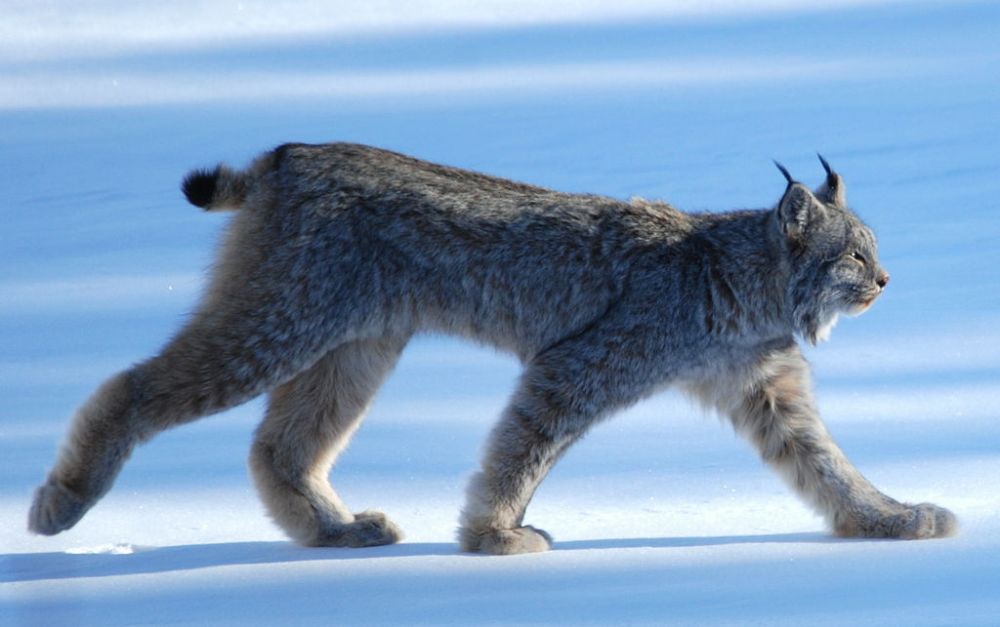
The Canada lynx (Lynx canadensis) is a medium-sized wild cat native to boreal and high-elevation forests. Recognizable by its tufted ears, oversized snowshoe-like paws, and short black-tipped tail, the lynx is highly specialized for hunting snowshoe hares. While populations thrive across much of Canada, in Washington they are rare and isolated, existing at the southern edge of their range (Washington Department of Fish & Wildlife [WDFW], n.d.-a). Historically, lynx occupied forests from Okanogan to Chelan Counties and eastward into Idaho, but today their range is limited to the western half of Okanogan County (WDFW, n.d.-a).
“Climb the mountains and get their good tidings. Nature’s peace will flow into you as sunshine flows into trees.”
-John Muir
Description
Adult lynx typically weigh 18–30 pounds, with long legs and thick fur that allow them to travel in deep snow. They favor dense coniferous forests, usually above 4,600 feet in elevation, where snowshoe hares are abundant. In Washington, they are most often associated with lodgepole pine, Engelmann spruce, and subalpine fir forests (WDFW, n.d.-a). Because their survival depends heavily on snowshoe hare abundance, lynx populations fluctuate with prey availability (Northwest Climate Adaptation Science Center [NW CASC], 2020).
| Male | Female | |
| Weight | 6-17 kg (13-37 lb) | 5-12 kg (11-26 lb) |
| Height at shoulder | 48-56 cm (19-22 inches) | 48-56 cm (19-22 inches) |
(USFWS, n.d.)
Status
The Canada lynx is federally listed as Threatened under the Endangered Species Act and Endangered at the state level. It is also identified as a Species of Greatest Conservation Need in Washington’s State Wildlife Action Plan (WDFW, n.d.-a). Fewer than 50 individuals are believed to remain in the state, scattered across the North Cascades, Kettle River Range, and Selkirk Mountains (WDFW, n.d.-a; Washington State University [WSU] News, 2020).
Camera trap surveys covering more than 4,300 square miles of northeastern Washington detected lynx at only 20% of sites, reflecting a sharp decline in occupied habitat (NW CASC, 2020). Climate change, wildfire, and habitat fragmentation threaten the deep-snow forests critical for hunting success (WSU News, 2020). Roads and snowmobile trails also increase access for competitors like bobcats and predators such as cougars and coyotes, further straining lynx populations (Conservation Northwest, n.d.).
State
Endangered
🔶
North America
Secure
🟢
Global
Least Concern →
🟢
***** Status References: WA State: WDFW North America: NatureServe Global: IUCN Red List *****
Conservation – Washington’s Conservation Efforts
Washington agencies, Tribes, and conservation groups are working together to slow population decline and restore habitat:
- Connectivity: Conservation groups are maintaining wildlife corridors that connect populations in Washington, British Columbia, and Montana (Conservation Northwest, n.d.).
- Legal protections: Hunting and trapping of lynx have been banned in Washington since 1991 (WDFW, n.d.-a).
- Habitat management: Efforts include protecting subalpine forests and reducing wildfire risk in lynx management zones (WDFW, n.d.-a).
- Research and monitoring: Since 2005, WDFW and partners—including universities and the U.S. Forest Service—have tracked lynx through camera traps, hair snares, and snow-tracking surveys (WDFW, n.d.-b; NW CASC, 2020).
- Reintroductions: The Confederated Tribes of the Colville Reservation, along with federal and nonprofit partners, have released nearly 20 lynx translocated from British Columbia. Early monitoring shows signs of survival and reproduction (Confederated Tribes of the Colville Reservation [CTCR], n.d.; Conservation Northwest, 2023).
Together, these actions represent a hopeful step toward stabilizing one of Washington’s most imperiled carnivores.
How you Can Help
The future of Washington’s Canada lynx depends not only on scientists and policymakers but also on community support. You can help by:
- Caring for habitat: Protect and plant native trees and shrubs that support biodiversity, and reduce wildfire risk near your property through fire-wise practices.
- Being wildlife-friendly: Keep domestic cats indoors to reduce stress and competition for native species.
- Getting involved: Support conservation groups, report wildlife sightings to WDFW, and spread awareness through art, storytelling, or education.
Small, local actions ripple outward—helping ensure that this rare forest cat has a place in Washington’s wild landscapes for generations to come.
Nature Art
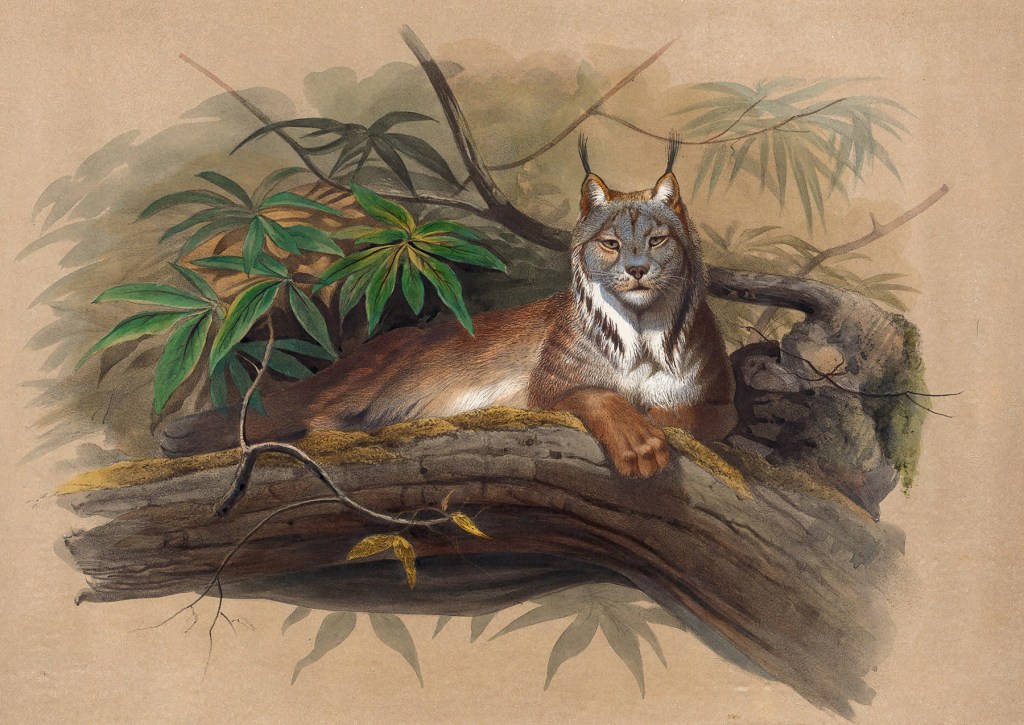
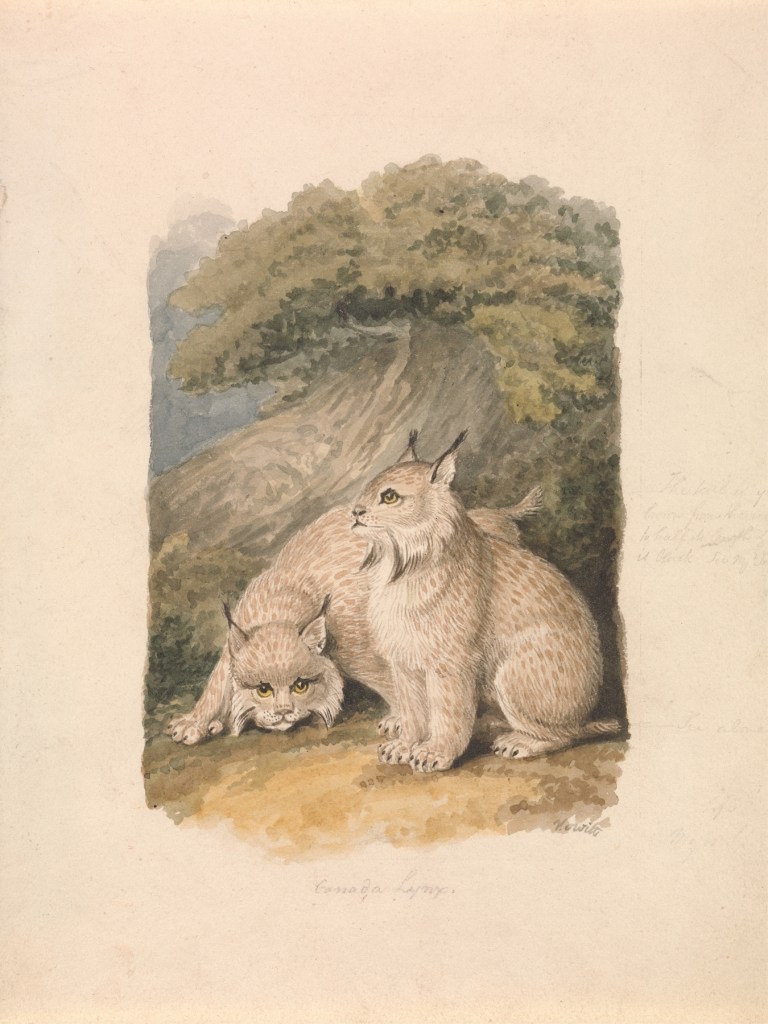
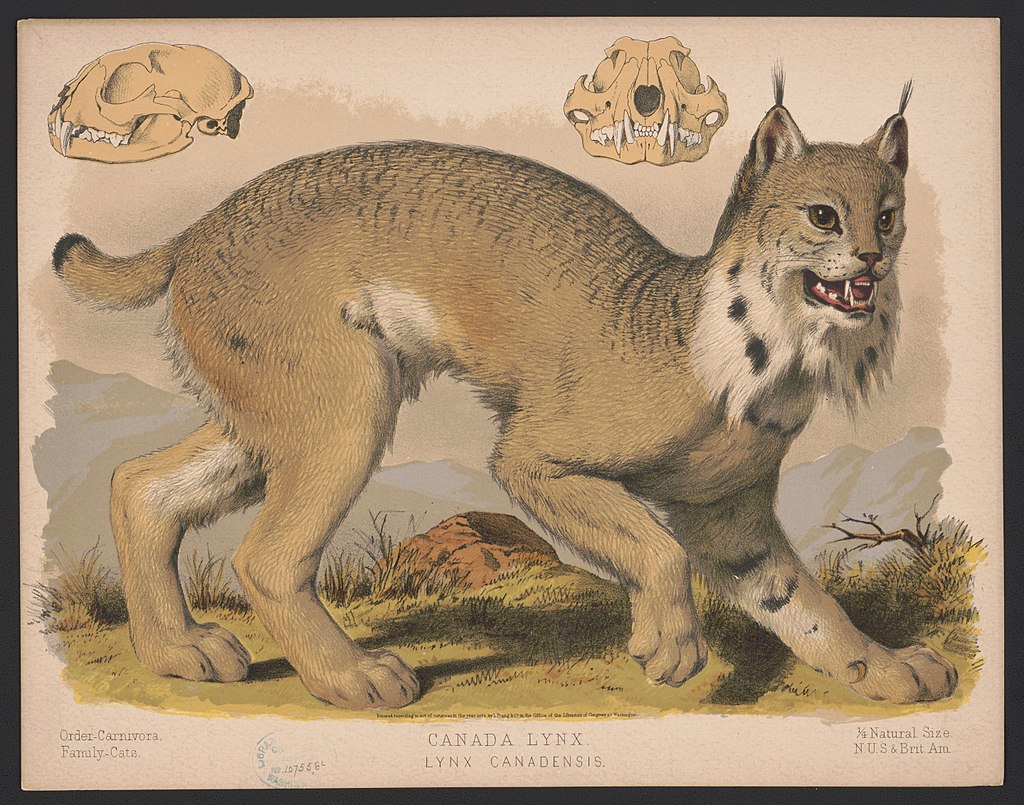
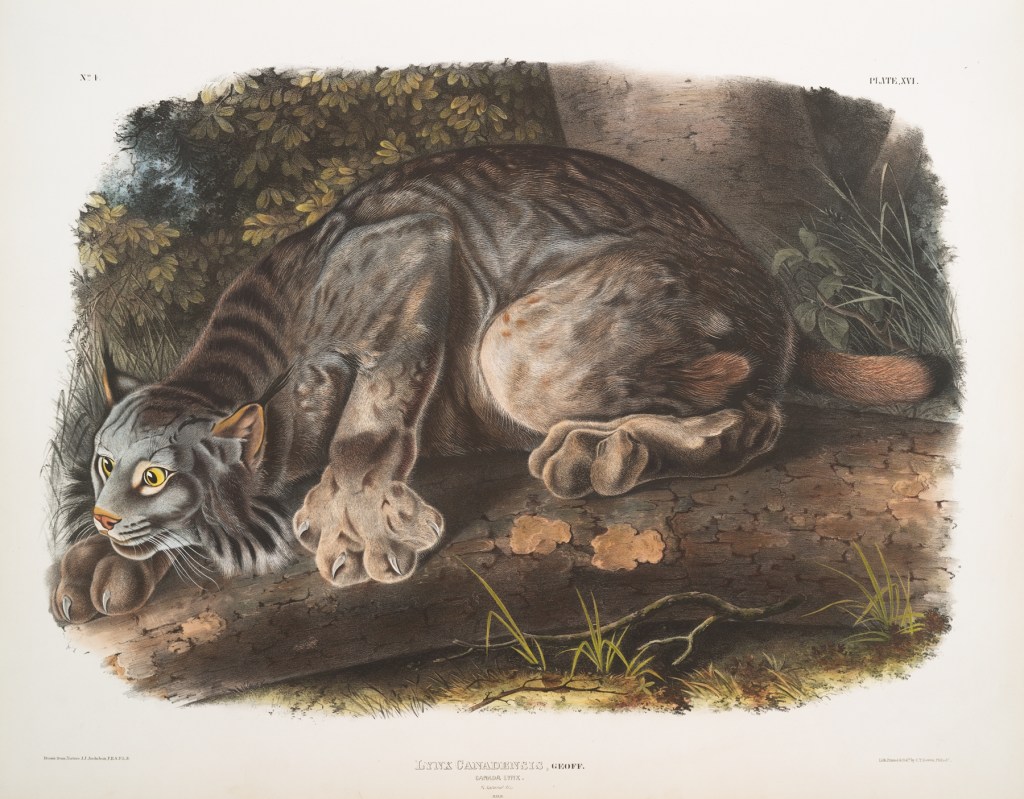
Historical illustrations reflect shifting perspectives on the lynx’s mystique. John Woodhouse Audubon’s Lynx Canadensis (1845–1848) emphasizes muscular anatomy and realism, while Samuel Howitt’s The Canada Lynx from the Life (ca. 1817) adopts a more stylized pose. L. Prang & Co.’s chromolithograph Canada Lynx (1874) blends scientific accuracy with artistic appeal, and Joseph Wolf’s The Canadian Lynx (1861–1867) captures fluid motion and lifelike vitality.
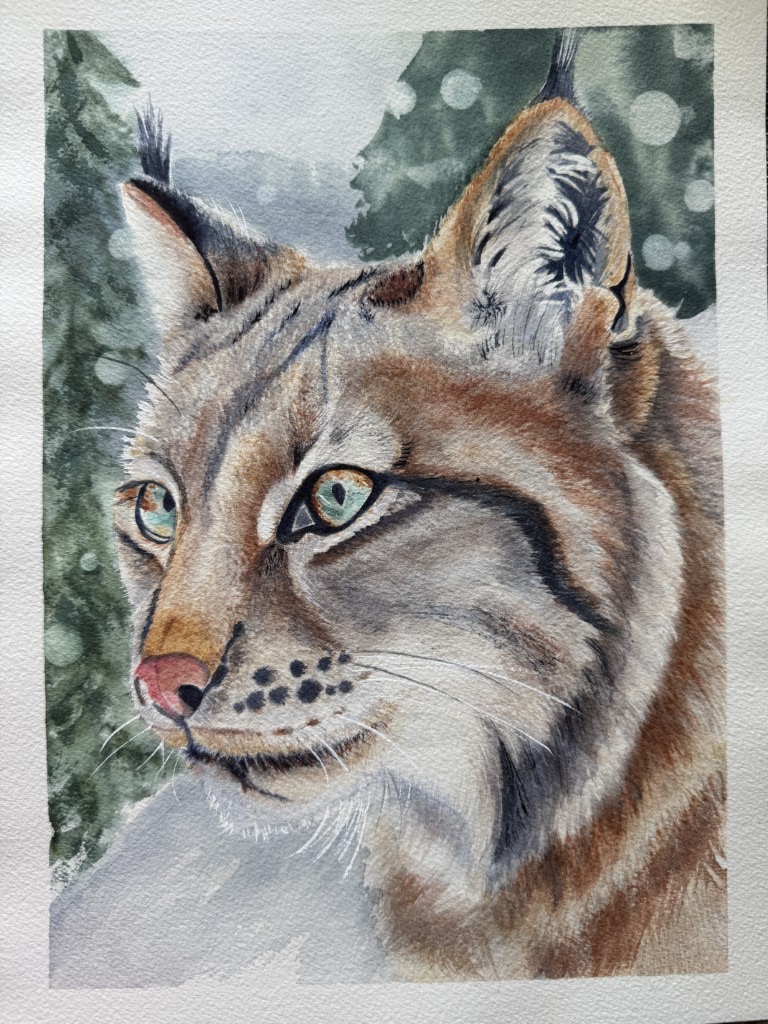
Smith’s (2025) illustration portrays a lynx portrait against the snowy mountains full of evergreens, reminiscent of Okanogan County—one of the few regions in Washington where they survive.
Cover photo credit: Candian Lynx (Art, 2008)
References
Click here to view all of the references used for this post
Art, G. (2008). Canadian Lynx [Photograph]. Wikimedia Commons. CC BY 2.0. Retrieved March 19, 2025, from https://commons.wikimedia.org/wiki/File:Canadian_Lynx.jpg
Audubon, J. W. (1845–1848). Lynx Canadensis, Canada Lynx. Male [Lithograph]. Artvee. Retrieved August 23, 2025, from https://artvee.com/dl/lynx-canadensis-canada-lynx-male/
Confederated Tribes of the Colville Reservation. (n.d.). Canada lynx reintroduction project [Webpage]. Retrieved September 11, 2025, from https://www.colvilletribes.com
Conservation Northwest. (n.d.). Canada lynx [Webpage]. Retrieved September 11, 2025, from https://www.conservationnw.org
Conservation Northwest. (2023). Canada lynx return to the Kettle Range [Webpage]. Retrieved September 11, 2025, from https://www.conservationnw.org
Howitt, S. (ca. 1817). The Canada Lynx from the Life [Etching]. Artvee. Retrieved August 23, 2025, from https://artvee.com/dl/the-canada-lynx-from-the-life/
Northwest Climate Adaptation Science Center. (2020). Canada lynx and climate change [Webpage]. U.S. Geological Survey. Public domain. Retrieved September 11, 2025, from https://nwcasc.uw.edu
Prang, L, & Co. (1874). Canada lynx – Lynx Canadensis [Photograph]. Public Domain. Retrieved March 19, 2025, from https://www.loc.gov/pictures/item/2017660722/
Smith, I. J. (2025). Canada lynx in Okanogan County [Watercolor illustration]. Shared with permission.
Washington Department of Fish & Wildlife. (n.d.-a). Canada lynx in Washington [Webpage]. Washington Department of Fish & Wildlife. Public domain. Retrieved September 11, 2025, from https://wdfw.wa.gov
Washington Department of Fish & Wildlife. (n.d.-b). Lynx research and monitoring [Webpage]. Washington Department of Fish & Wildlife. Public domain. Retrieved September 11, 2025, from https://wdfw.wa.gov
Washington State University News. (2020, February 5). Camera traps show decline in Washington’s Canada lynx [News article]. Washington State University. Retrieved September 11, 2025, from https://news.wsu.edu
Williams, K. (2010). Lynx Canadensis [Photograph]. CC BY 2.0, via Wikimedia Commons. Retrieved March 19, 2025, from https://flickr.com/photos/46306125@N03/4464643075
Wolf, J. (1861–1867). The Canadian lynx [Illustration]. Artvee. Retrieved August 23, 2025, from https://artvee.com/dl/the-canadian-lynx/

 wild sprout

You must be logged in to post a comment.