
The upland sandpiper (Bartramia longicauda) is a bird that nests in grasslands and plains. They are a migratory bird, breeding in North America and wintering in South America. They eat predominately insects and occasionally seeds. Unlike other shorebirds, they tend to avoid wetlands — though upland sandpipers in Alaska and northwestern Canada nest in elevated ridges in wetlands (Cornell, n.d.). Originally, upland sandpipers bred in the Spokane Valley and in Turnbull National Wildlife Refuge, though the majority of the habitat in Spokane Valley has been lost due to development (WDFW, n.d.).
“When we try to pick out anything by itself, we find it hitched to everything else in the universe.”
-John Muir
Description
The Upland Sandpiper (Bartramia longicauda) is a slender, medium-sized shorebird with long yellow legs, a small dove-like head, and a gracefully elongated neck. Its plumage is a mottled mix of buff, brown, and black, providing excellent camouflage in grassland habitats. A short, straight bill and large, dark eyes give it a curious, alert expression, while its upright posture and long tail help distinguish it from other shorebirds (Cornell Lab of Ornithology, n.d.).
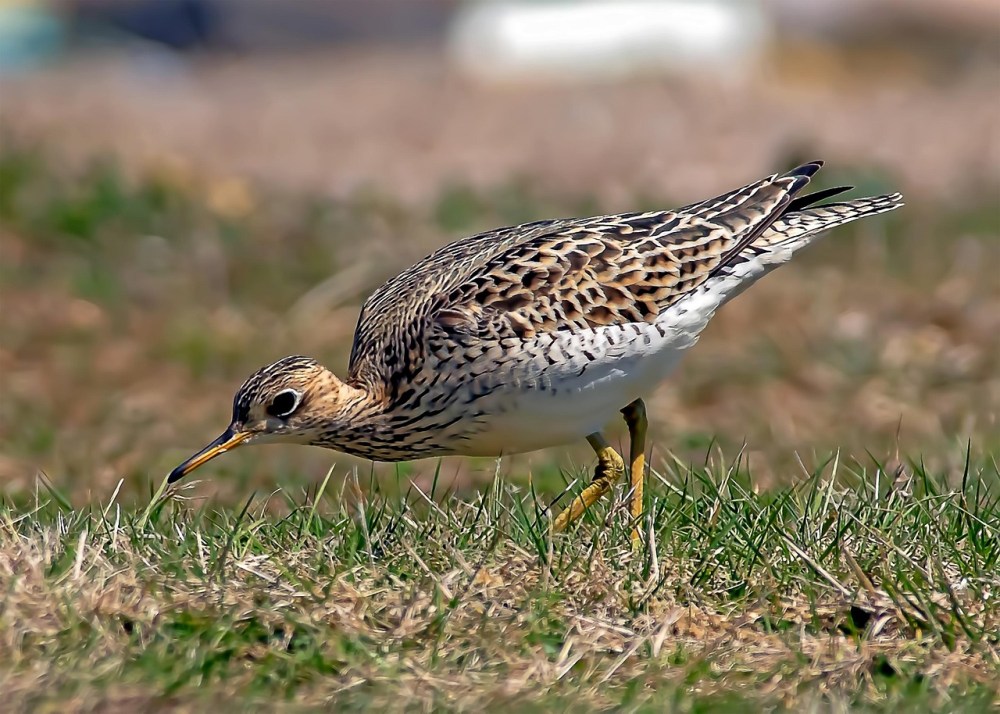
Male and female Upland Sandpipers are similar in appearance and size, with only slight variation between sexes.
| Length | 11–12 inches (28–30 cm) |
| Wingspan | 18–20 inches (46–51 cm) |
| Weight | 4.4–7.5 ounces (125–213 grams) |
There is no significant sexual dimorphism in this species, meaning males and females look alike and fall within the same size range (Cornell Lab of Ornithology, n.d.).
Status
State
Endangered
🔶
North America
Secure
🟢
Global
Least Concern ↑
🟢
***** Status References: WA State: WDFW North America: NatureServe Global: IUCN Red List *****
Despite upland sandpipers being a species of low concern globally, their populations are decreasing in parts of Canada and in the United States (Cornell, n.d.). In Washington, upland sandpipers are considered endangered. That being said, information on the species distribution in Washington is incomplete and research is lacking (WDFW, n.d.).
Conservation
Due to insufficient information on whether the upland sandpiper still breeds in Washington, no state-level conservation strategies have been developed for the species. Research into this species’ range is vital in order to reassess conservation need (WDFW, n.d.).
Nature Art
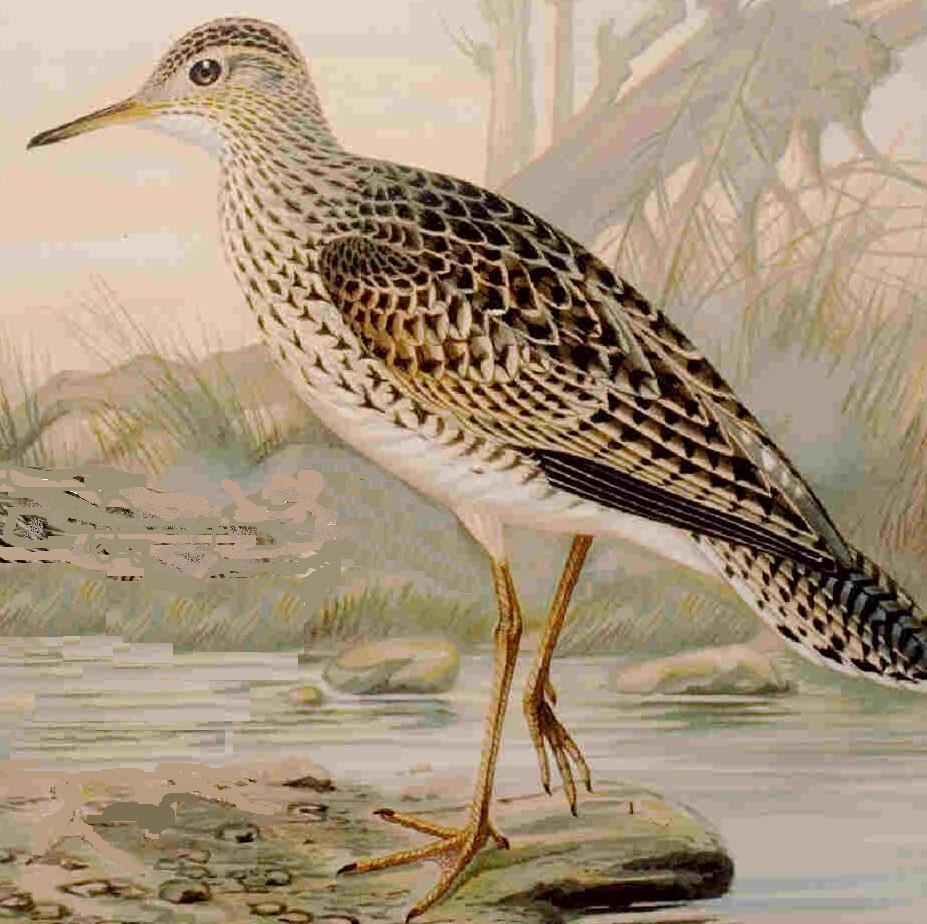
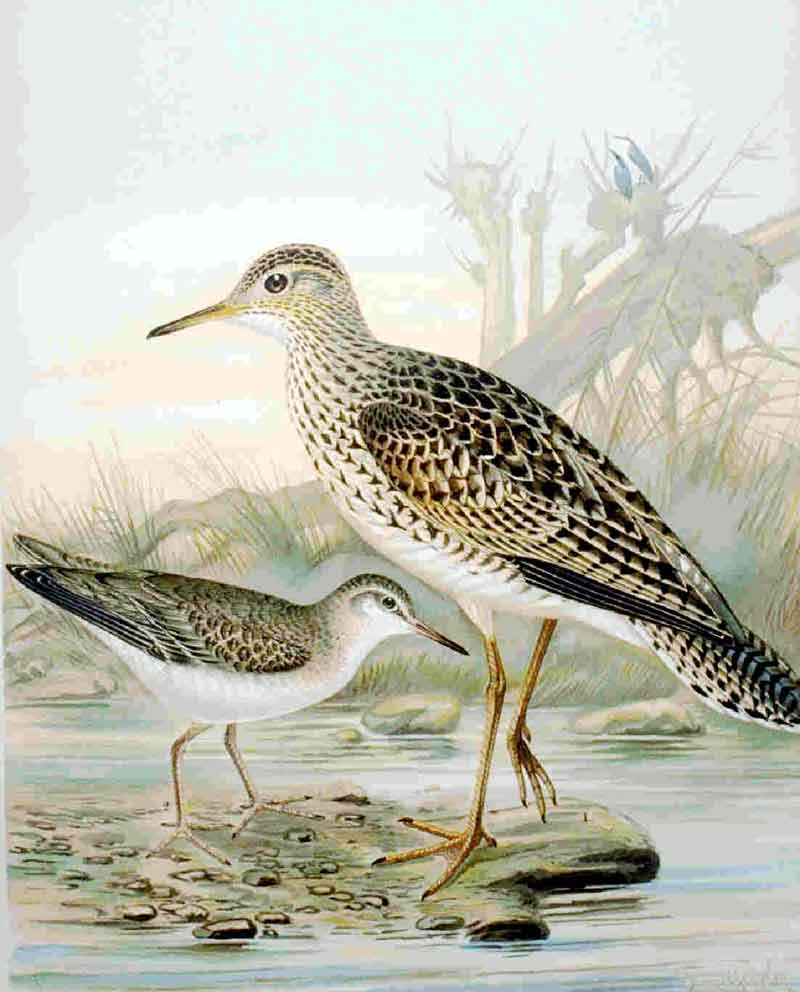
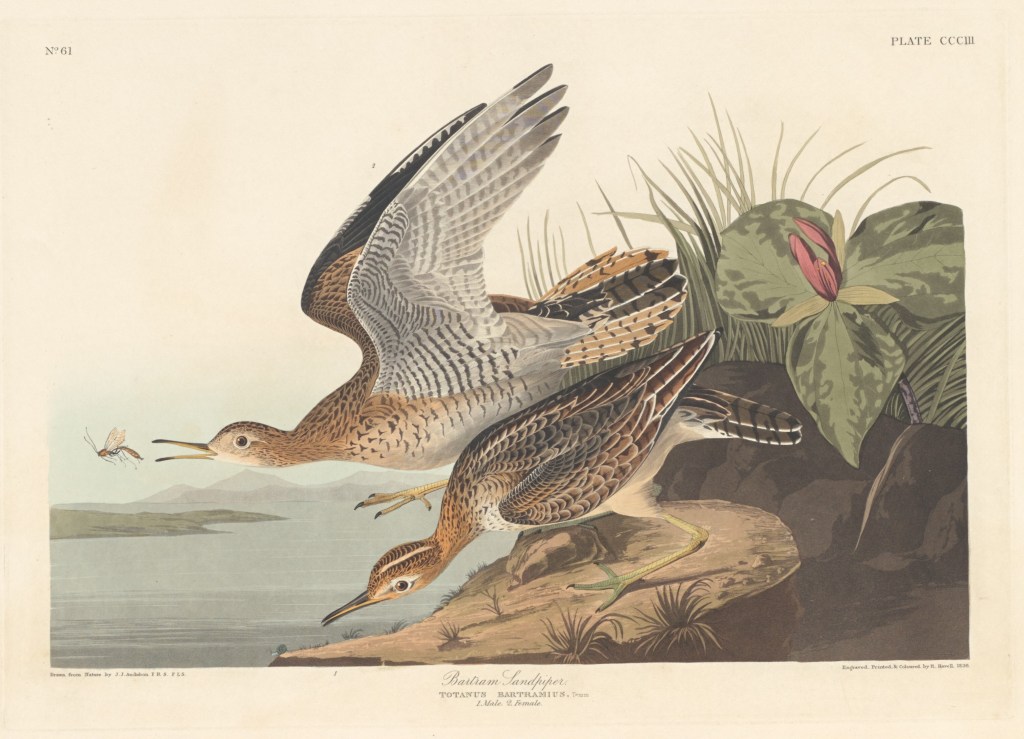
Three historic illustrations offer a glimpse into how early naturalists documented the upland sandpiper and its relatives. In John James Audubon’s 1836 illustration titled Bartram Sandpiper, two upland sandpipers (Bartramia longicauda) are depicted on a riverbank. Both birds lean forward in lifelike postures—one poised to snatch a flying insect from the air. The scene captures not only the birds’ graceful, elongated forms but also a fleeting moment of foraging behavior. In contrast, Johann Friedrich Naumann’s 1830 works, labeled Bartramia longicauda and Actitis macularius, present finely rendered shorebirds in more stylized natural surroundings. While Bartramia longicauda represents the upland sandpiper, Actitis macularius refers to the spotted sandpiper, a distinct species still recognized today. Together, these illustrations reflect early scientific efforts to observe, name, and artistically render the avian life of North America.
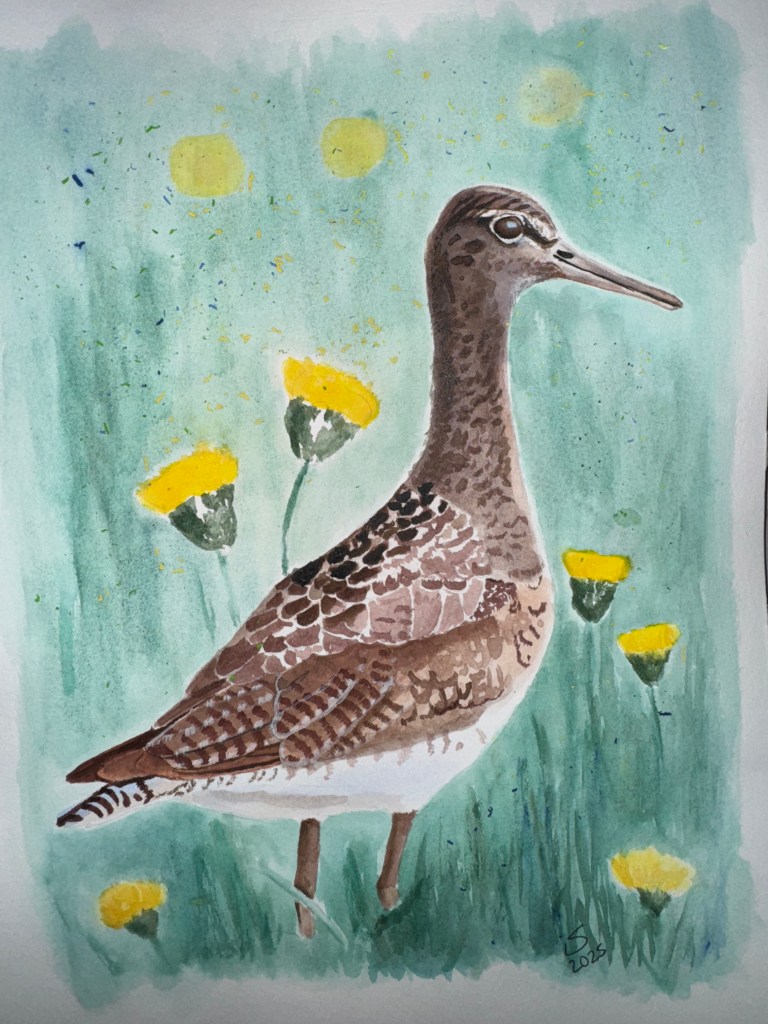
Smith’s 2025 illustration portrays an Upland Sandpiper standing alert in a field dotted with blooming dandelions. The bird’s slender form and upright posture echo its quiet presence on the grasslands it once frequented in Washington. Surrounding it, the dandelions—often overlooked—play an important ecological role, supporting pollinators and the insects that make up the sandpiper’s primary diet. Together, bird and bloom evoke the delicate balance of a disappearing habitat and the small wonders that help sustain it.
Cover photo credit: Upland sandpiper (Toom, H., 2022)
References
Click here to view all of the references used for this post
Audubon, J. J. (1836). The Birds of America: Plate CCCIII; Bartram Sandpiper [Photograph of colored engraving]. National Gallery of Art. Public domain. Retrieved March 19, 2025, from https://www.nga.gov/collection/art-object-page.32444.html
BirdLife International. (2021). Bartramia longicauda. In IUCN Red List of Threatened Species 2021: e.T22693203A190253009 [Data set]. IUCN. Retrieved May 27, 2025, from https://dx.doi.org/10.2305/IUCN.UK.2021-3.RLTS.T22693203A190253009.en (Public Domain).
Cornell Lab of Ornithology. (n.d.). Upland Sandpiper Overview, All About Birds. Retrieved May 23, 2025, from https://www.allaboutbirds.org/guide/Upland_Sandpiper/overview
NatureServe. (2024). Bartramia longicauda – Upland Sandpiper. NatureServe Explorer. Retrieved May 23, 2025, from https://explorer.natureserve.org/Taxon/ELEMENT_GLOBAL.2.102059/Bartramia_longicauda.
Naumann, J. (1830). Bartramia longicauda [Photograph]. Wikimedia Commons. Public Domain. Retrieved March 19, 2025, from https://commons.wikimedia.org/wiki/File:Bartramia_longicauda.jpg
Smith, I. (2025). Upland Sandpiper (photograph of painting). Posted with permission.
Toom, H. (2022). Upland sandpiper, bird, avian [Photograph]. Pixabay. Public Domain. Retrieved March 19, 2025, from https://pixabay.com/photos/upland-sandpiper-bird-avian-7005358/
Toom, H. (2022). Upland sandpiper, shorebird, bird [Photograph]. Pixabay. Public Domain. Retrieved March 19, 2025, from https://pixabay.com/photos/upland-sandpiper-shorebird-bird-7074800/
Upland sandpiper life history, All About Birds, Cornell Lab of Ornithology. All About Birds, Cornell Lab of Ornithology. (n.d.). Retrieved August 12, 2025, from https://www.allaboutbirds.org/guide/Upland_Sandpiper/lifehistory
Upland sandpiper. Washington Department of Fish & Wildlife. (n.d.). Retrieved August 12, 2025, from https://wdfw.wa.gov/species-habitats/species/bartramia-longicauda

 wild sprout

You must be logged in to post a comment.