
The moss-draped forests of the Pacific Northwest hold more than towering conifers and rain-soaked ferns—they also shelter elusive insects whose lives are tightly bound to ancient forest dynamics. Yet unlike more heavily studied ecosystems, Washington’s temperate rainforest has received relatively little insect-focused research. The Johnson’s hairstreak, featured here, is the only insect currently listed as a state candidate species from this region (WDFW, 2024). But this likely reflects data gaps more than true security. With its dependence on mature conifer canopy and a rare parasitic plant, the hairstreak may be just the first visible thread in a web of understudied and potentially imperiled insect life.
“Butterflies may be better indicators of the health of our environment than birds.”
–Peterson (1976).
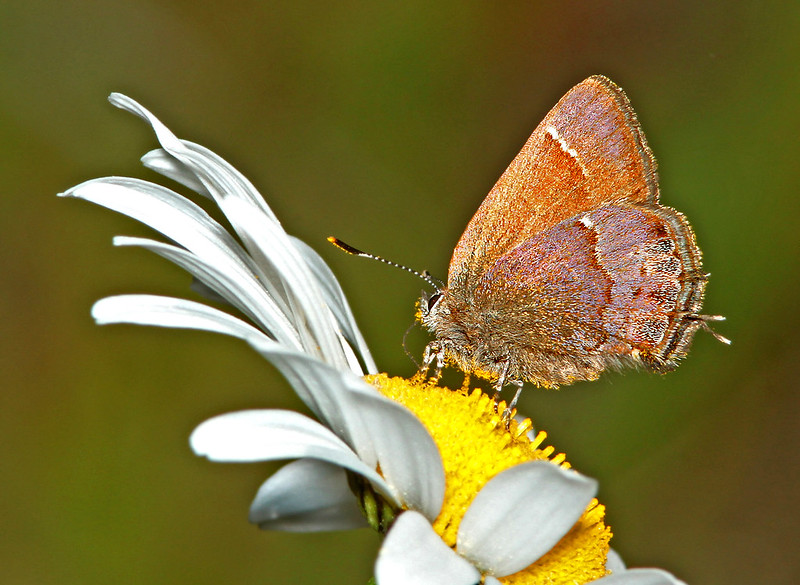
Johnson’s Hairstreak (Callophrys johnsoni)
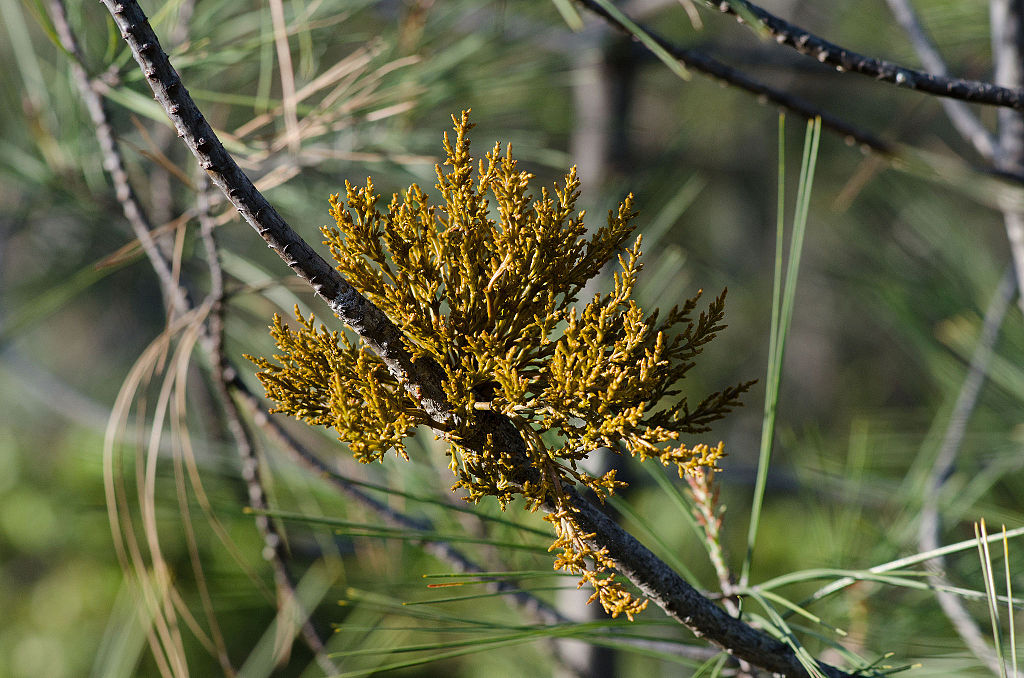
This small butterfly, about 1 to 1.25 inches (25–32 mm) in wingspan, has dusky brown upperwings and intricate reddish-brown underwings marked by a faint white line and short tail-like projections. Closely tied to old-growth coniferous forests, its larvae feed exclusively on Arceuthobium tsugense—hemlock dwarf mistletoe—a parasitic plant found high in the canopy of mature western hemlocks. Adults are rarely seen but may forage at forest edges on flowers such as wild strawberry and Oregon grape. Because both mistletoe and suitable forest structure are lost in logging and fragmentation, the presence of Johnson’s hairstreak reveals intact canopy layers, rich epiphyte communities, and long-unbroken forest succession (WDFW, 2025a).
Why This Insect Matters
Though only one insect is featured here, its ecological significance is inportant:
- Plant–insect specialization: Its larvae feed exclusively on a parasitic plant tied to mature forest canopies.
- Old-growth forest indicator: Its survival depends on the vertical complexity and persistence of undisturbed forest.
- Pollination and foraging behaviors: Though elusive, adults may contribute to edge-flower pollination, linking forest and meadow habitats.
- The hairstreak’s presence signals healthy canopy systems and long-term forest continuity—but its rarity raises questions about what other insects may be quietly disappearing, unnoticed. Washington’s rainforest insects are vastly understudied, particularly in the canopy and epiphyte-rich zones. Johnson’s hairstreak may not be an exception—it may be a warning.
What You Can Do in Your Own Backyard
Temperate rainforest insects need large, intact habitats, but there are still ways to support their survival:
- Advocate for old-growth protections. Support policies and land trusts that preserve mature forests and limit industrial logging.
- Support forest connectivity. Fragmentation is one of the biggest threats—supporting wildlife corridors helps maintain genetic flow.
- Plant native flowering species. Even forest-edge butterflies like the hairstreak rely on nectar plants such as wild strawberry and thimbleberry.
- Share their story. The Johnson’s hairstreak may be tiny, but its message is vital: forest time runs long—and recovery takes even longer.
Nature Art
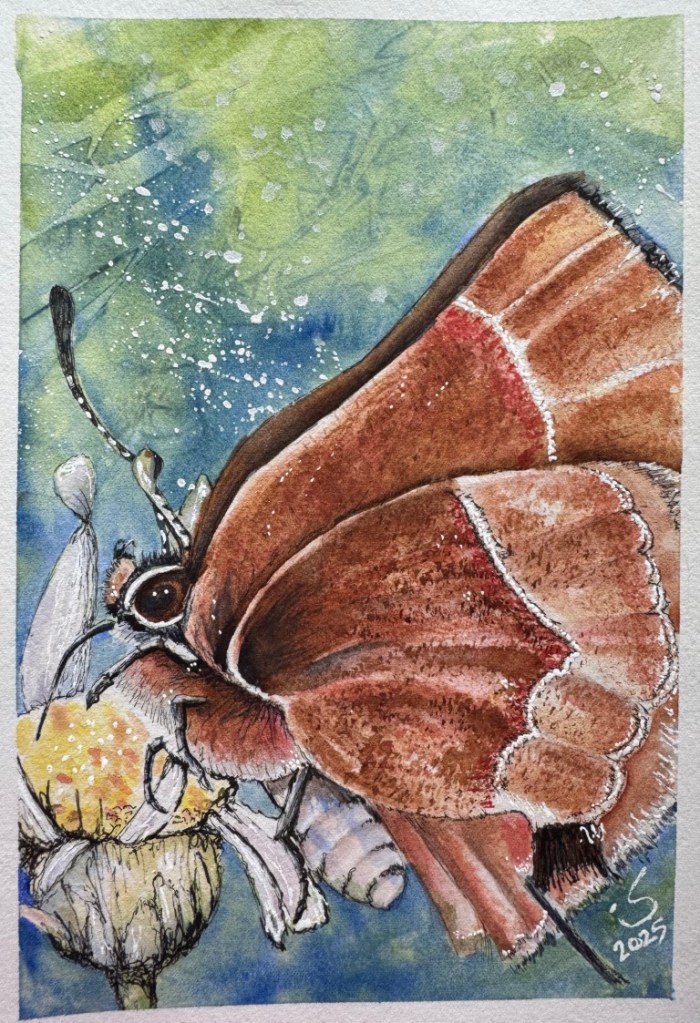
In Smith’s 2025 illustration, the Johnson’s Hairstreak (Callophrys johnsoni) is perched on what appears to be an aged daisy. The close-up view highlights the subtle warm tones of of its wings as it forages, offering a quiet glimpse into the life of this elusive, old-growth-associated butterfly.
Cover photo credit: Hairstreak, Johnson’s (Callophrys johnsoni) (Schmierer, 2014-a)
References
Folini, F. (2013). Dwarf Mistletoe (Arceuthobium) [Photograph]. Wikimedia Commons. CC BY-SA 2.0. Retrieved September 12, 2025, from https://commons.wikimedia.org/wiki/File:Dwarf_Mistletoe_%28Arceuthobium%29_%288918814701%29.jpg
Holland, S. (2007). Callophrys johnsoni (Johnson’s hairstreak) [Photograph]. Wikimedia Commons. Public domain. Retrieved August 4, 2025, from https://commons.wikimedia.org/wiki/File:Callophrys_johnsoni.jpg
Peterson, R. T. (1976). Roger Tory Peterson’s dozen birding hot spots. Houghton Mifflin.
Schmierer, A. (2014-a). Hairstreak, Johnson’s (Callophrys johnsoni) (6-10-2014) 2600 ft, Rte 58 west of Oakridge, Lane Co, Oregon — 03 [Photograph]. Flickr. Public domain. Retrieved September 12, 2025, from https://flickr.com/photos/sloalan/14434807629/in/photolist-WEPrtT-2m3Sr3y-2m3JWCV-2m3NBCb-JkH4im-4ZabJL-nZyapB-oiNHFt-uGY2b2-uEpm7b-nZy7Bw-uEpz1N-uGY1oR-9UF6nB-tKGVcG-bggv5H-4WMLdY-2m94Qqu-2g8WijY-a44gVy-2npRXno
Schmierer, A. (2014-b). Hairstreak, Johnson’s (Callophrys johnsoni) (6-10-2014) 2600 ft, rte 58 west of oakridge, lane co, oregon -01b [Photograph]. Flickr. Public domain. Retrieved September 12, 2025, from https://flickr.com/photos/sloalan/14434798228/in/photolist-WEPrtT-2m3Sr3y-2m3JWCV-2m3NBCb-JkH4im-4ZabJL-nZyapB-oiNHFt-uGY2b2-uEpm7b-nZy7Bw-uEpz1N-uGY1oR-9UF6nB-tKGVcG-bggv5H-4WMLdY-2m94Qqu-2g8WijY-a44gVy-2npRXno/
Smith, I. (2025). Johnson’s hairstreak nature journal [painting]. Posted with permission.
Washington Department of Fish & Wildlife. (2024). Washington state listed and candidate species list. Public domain. Retrieved July 29, 2025, from https://wdfw.wa.gov/sites/default/files/2024-03/wa-state-listed-and-candidate-species-list.pdf
Washington Department of Fish & Wildlife. (2025a). Johnson’s hairstreak (Callophrys johnsoni) [Species profile]. Public domain. Retrieved July 29, 2025, from https://wdfw.wa.gov/species-habitats/species/callophrys-johnsoni

 wild sprout


You must be logged in to post a comment.