
The Leatherback sea turtle (Dermochelys coriacea) has the widest global distribution of any reptile, with their range including open tropic, temperate, and subpolar oceans (NOAA, n.d.). They migrate vast distances between feeding and nesting sites. Along the west coast of North America, including Washington, the leatherback turtles observed foraging offshore are believed to nest as far away as New Guinea or Indonesia (WDFW, n.d.).
“Turtles are living testaments to the endurance of life.”
-David Attenborough
Description
The leatherback sea turtle is the largest of all sea turtles, with a streamlined, barrel-shaped body that can reach over six feet in length. Unlike other turtles, it lacks a hard shell and instead has a leathery, ridged back that’s dark gray or black with white speckles. Graceful in the water, this powerful swimmer can travel vast distances. When spotted off the coast of Washington, usually in summer and fall, it often appears solitary, gliding through cold coastal waters in search of jellyfish—its primary prey. Despite its size, it moves with surprising agility, a striking sight against the gray-blue swells of the Pacific Northwest.
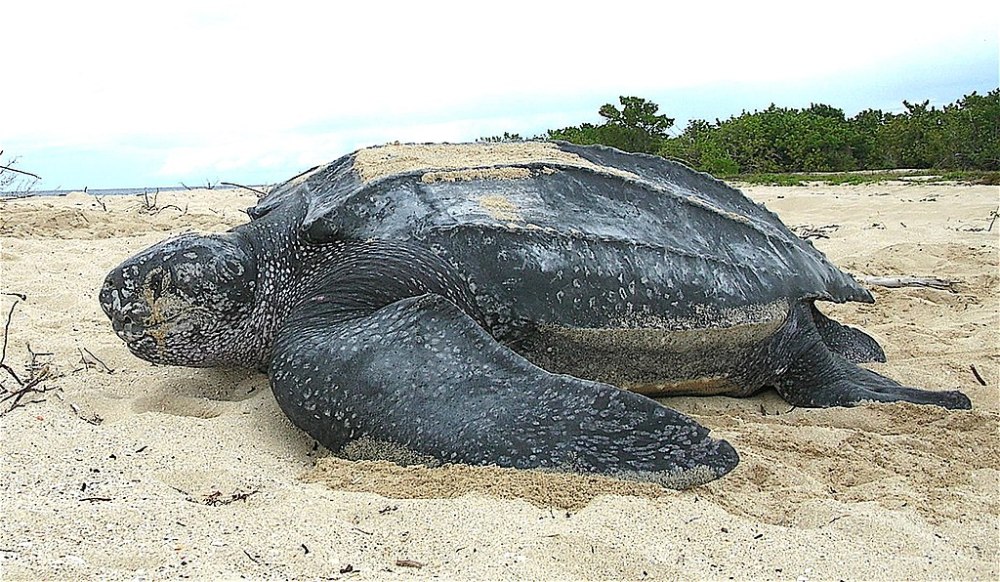
Both male and female are similar size (Source: SeaWorld Parks & Entertainment, n.d.)
| Average | Maximum recorded | |
| Length | 4-6 ft (1.2 – 1.8 m) | 7.2 ft (2.2 m) |
| Width | 2.5-3.3 ft (.75-1 m) | — |
| Weight | 550-1540 lbs (250-700kg) | 2000 lbs (900+ kg) |
Status
State
Endangered
🔶
North America
Imperiled
🔶
Global
Vulnerable ↓
🔶
***** Status References: WA State: WDFW North America: NatureServe Global: IUCN Red List *****
Leatherback turtles are listed as endangered both federally and in Washington state. Their populations are declining across their entire range, with a global decline estimated at 40% (WDFW, n.d.). In the Pacific Ocean, these turtles face an especially high risk of extinction. Nesting activity has dropped sharply in both the eastern and western Pacific populations—by approximately 90% in the Eastern Pacific and over 80% in the largest nesting population of the Western Pacific (NOAA, 2025). This decline is driven by multiple threats, including bycatch in commercial fisheries, direct hunting, egg harvesting, habitat loss, vessel strikes, and marine pollution (NOAA, 2025).
Conservation
NOAA Fisheries and the U.S. Fish and Wildlife Service have designated critical habitat for leatherback turtles along the U.S. West Coast and in the waters surrounding St. Croix in the U.S. Virgin Islands. These designations require federal agencies to consult with NOAA or FWS before undertaking any actions that might affect these areas. In addition, NOAA Fisheries runs programs to reduce bycatch (the unintentional capture of non-target species during fishing), respond to stranded or entangled turtles, and collaborates with international partners to support global conservation efforts (NOAA, 2025).
While the leatherback sea turtle can be found in Washington’s coastal waters, its conservation is a global effort due to the species’ role in marine ecosystems worldwide. Leatherbacks help control jellyfish populations, supporting the balance of ocean food webs across multiple oceans (World Wildlife Fund, n.d.).
Nature Art
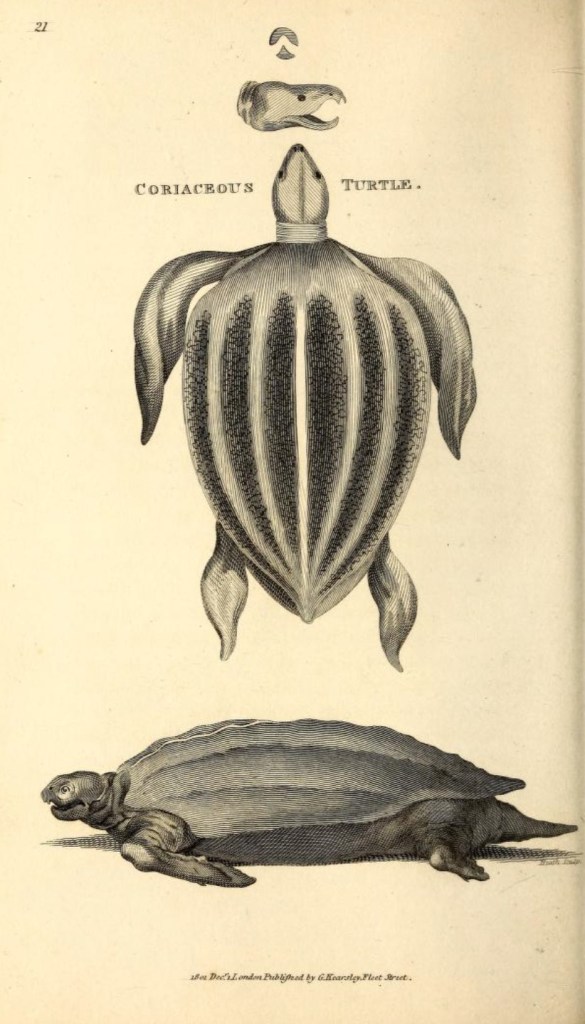
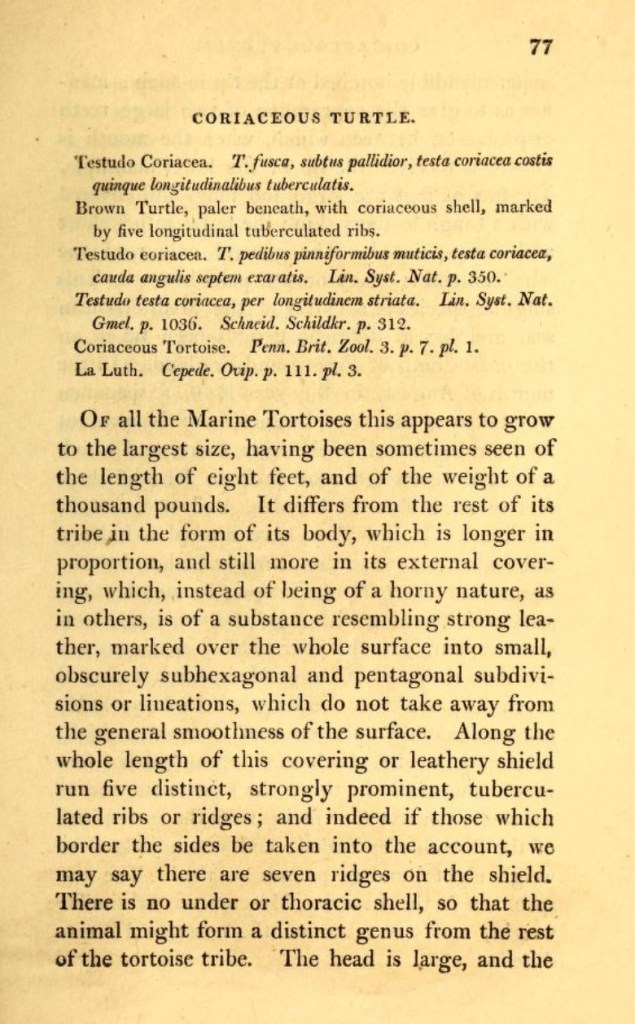
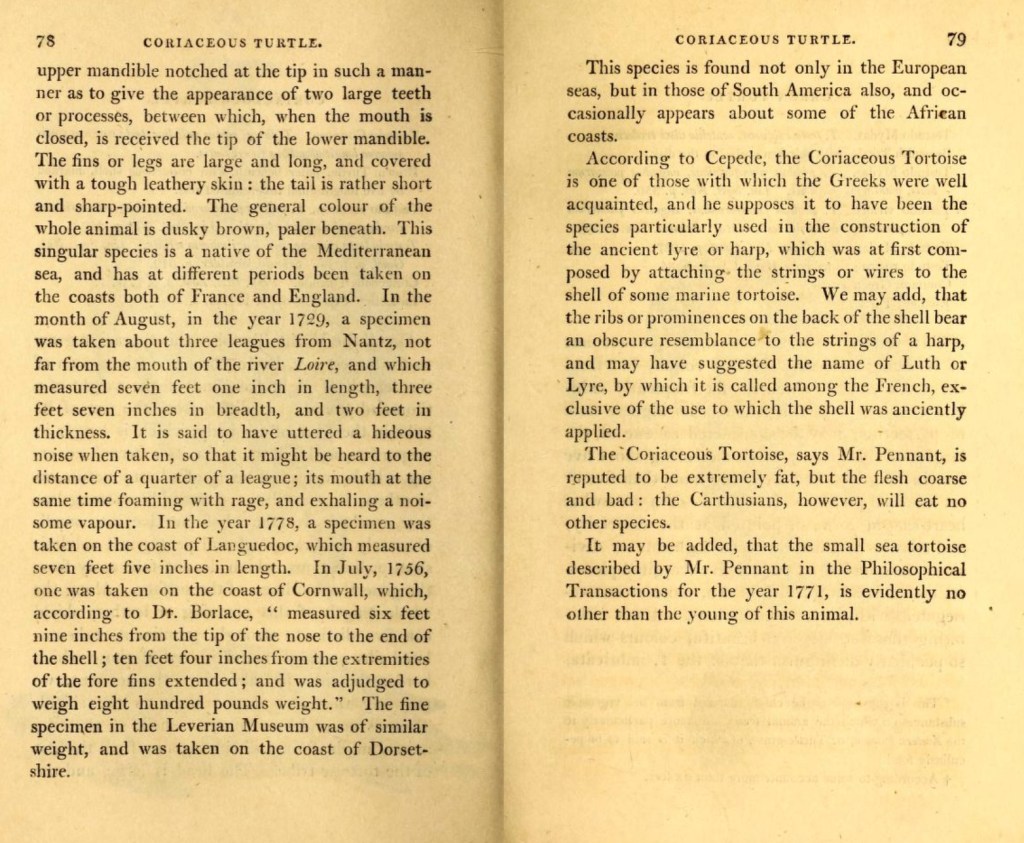
In Shaw’s General Zoology (1802), the leatherback sea turtle (Dermochelys coriacea) is depicted with a sculpted, almost armored appearance—its ridged back and elongated flippers rendered with striking anatomical precision. The illustrations highlight the turtle’s immense size and unique leathery shell texture, distinguishing it from hard-shelled species common in earlier natural history works.
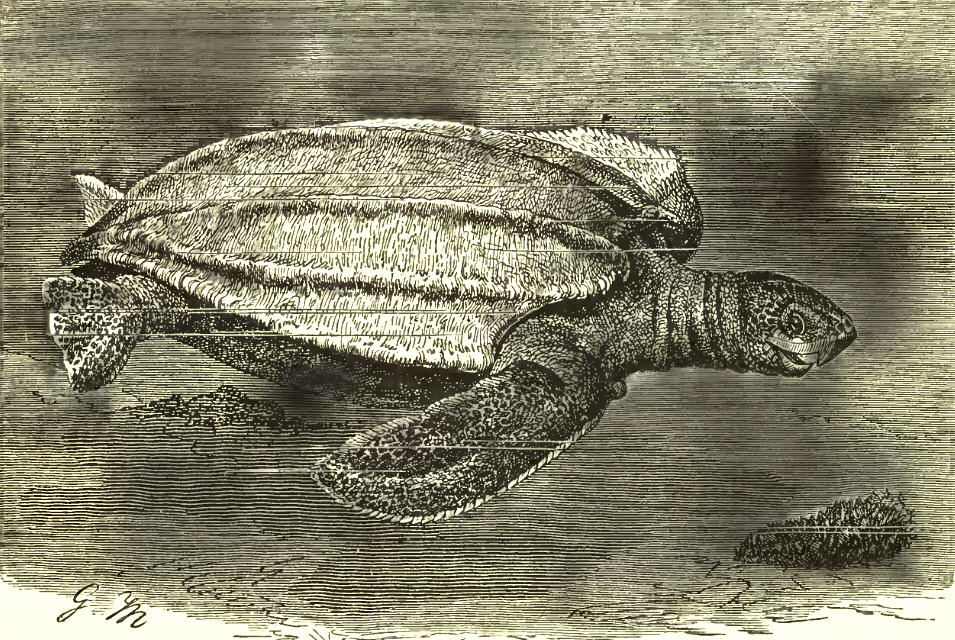
In 1896, British naturalist Richard Lydekker described the leatherback sea turtle, noting its unique leathery shell and enormous size—features that set it apart from all other sea turtles. His early work helped lay the groundwork for how scientists classify and understand this remarkable ocean traveler today.
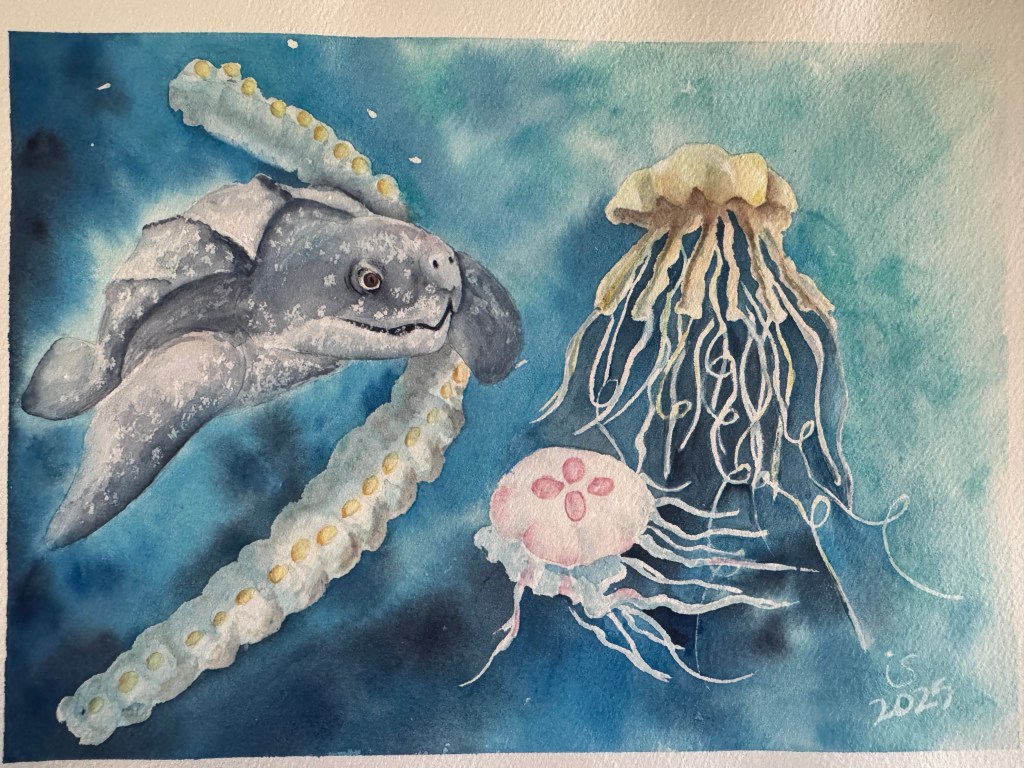
In Smith’s 2025 watercolor illustration, a leatherback sea turtle glides through the ocean, eyes fixed on a lion’s mane jellyfish. Nearby, a shimmering salp chain and a translucent moon jelly float in the current—three of the soft-bodied creatures that make up the bulk of the leatherback’s diet.
Cover photo credit: Close up of Dermochelys coriacea leatherback turtle (Rabon, D./U.S. Fish and Wildlife Service, 2007).
References
Click here to view all of the references used for this post
Fisheries, N. (2025, May 29). Leatherback Turtle. Retrieved July 16, 2025, from https://www.fisheries.noaa.gov/species/leatherback-turtle
Leatherback Sea Turtle. Washington Department of Fish & Wildlife. (n.d.). Retrieved July 16, 2025, from https://wdfw.wa.gov/species-habitats/species/dermochelys-coriacea
Lydekker, R. A. (1896). Leatherback sea turtle (Dermochelys coriacea) [Illustration]. Wikimedia Commons. Public domain. Retrieved March 19, 2025, from https://commons.wikimedia.org/wiki/File:LeatherbackLyd.jpg
Lombard, C., USFWS . (2011). Leatherback sea turtle Tinglar, USVI (5839996547) [Photograph]. Wikimedia Commons. CC BY 2.0. https://commons.wikimedia.org/wiki/File:Leatherback_sea_turtle_Tinglar,_USVI_(5839996547).jpg
NatureServe. (2025). Dermochelys coriacea – Leatherback Sea Turtle. NatureServe Explorer. https://explorer.natureserve.org/Taxon/ELEMENT_GLOBAL.2.103708/Dermochelys_coriacea
Rabon, D., U.S. Fish and Wildlife Service. (2007). Close up of Dermochelys coriacea leatherback turtle [Photograph]. Wikimedia Commons. Public Domain. Retrieved March 19, 2025, from https://commons.wikimedia.org/wiki/File:Close_up_of_dermochelys_coriacea_leatherback_turtle.jpg
SeaWorld Parks & Entertainment. (n.d.). Sea turtle characteristics. SeaWorld.org. Retrieved May 13, 2025, from https://seaworld.org/animals/all-about/sea-turtles/characteristics/
Shaw, G. (1802). General zoology, or systematic natural history: Vol. III, Part I: Amphibia (pp. 77–79) [Digitized book]. G. Kearsley. Retrieved July 31, 2025, from https://archive.org/details/generalzoology3121802shaw/page/78/mode/2up
Shaw, G. (1802). Leatherback sea turtle engraving by Heath, after George Shaw [Illustration], from General zoology, or, Systematic natural history: Vol. 3, Part 1 (pp. 76-79). G. Kearsley. Retrieved March 19, 2025, from https://archive.org/details/generalzoology3121802shaw/page/n131/mode/2up
Smith, I. (2025). Leatherback sea turtle, on the hunt [illustration]. Posted with permission.
Wallace, B.P., Tiwari, M. & Girondot, M. (2013). Dermochelys coriacea. The IUCN Red List of Threatened Species 2013: e.T6494A43526147. Retrieved May 13, 2025, from https://dx.doi.org/10.2305/IUCN.UK.2013-2.RLTS.T6494A43526147.en.
World Wildlife Fund. (n.d.). Leatherback turtle. WWF. Public domain. Retrieved July 11, 2025, from https://www.worldwildlife.org/species/leatherback-turtle

 wild sprout

.jpg)

You must be logged in to post a comment.