
The marbled murrelet (Brachyramphus marmoratus) is a small seabird native to the west coast of North America, rangin from Alaska to sourthern California. (U.S. Fish and Wildlife Service, n.d.). Although they forage in water, they uniquely nest in forests and in regions such as Washington, they nest in old-growth conifer forests (Washington Department of Fish and Wildlife, n.d.). Murrelets only lay one egg when reproducing and will frequently make trips to forage for food at night to feed the chick once hatched (Burger, 2002).
“Tame birds sing of freedom. Wild birds fly.”
-John Lennon
Description
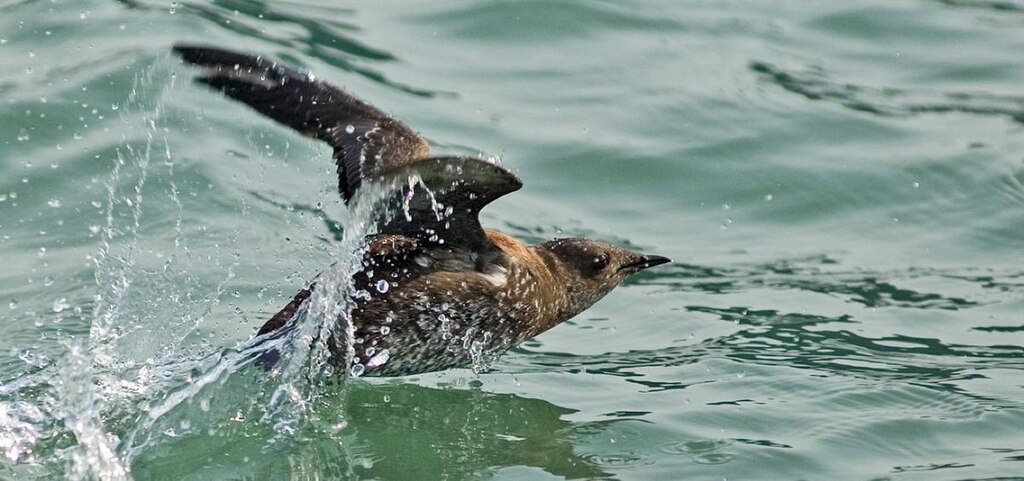
The marbled murrelet is a small, chunky seabird with a short neck, narrow pointed wings, and a slender black bill. During the breeding season, its plumage is a mottled mix of brown and black, providing camouflage among the mossy branches of old-growth forests where it nests. In the nonbreeding season, it transitions to a more contrasting look with a white underside and dark gray-black upperparts. Adapted for life at sea, the murrelet has webbed, dark-colored feet positioned far back on its body, making it an agile swimmer and diver but awkward on land. This elusive bird spends most of its life in coastal waters, diving to catch small fish and invertebrates, but it returns inland to nest—often high in the branches of ancient conifers.
| (both male and female) | |
| Length | 9.4-9.8 in (24-25cm) |
| Weight | 9.1-12.6 oz (258-357 g) |
Status
State
Endangered
🔶
North America
Vulnerable
🔶
Global
Endangered ↓
🔶
***** Status References: WA State: WDFW North America: NatureServe Global: IUCN Red List *****
The marbled murrelet is considered threatened federally and endangered in Washington. The population in Washington is low, with a 44% population loss between 2001 to 2015, due to loss of old growth forests impacting their breeding habitat (WDFW, n.d.). Oil spills, marine contamination, and commercial fishing have also been the cause of marbled murrelet population loss throughout their range (Cornell, n.d.)
Conservation
The Washington Department of Fish and Wildlife (WDFW) currently oversees three distinct monitoring and research projects related to marbled murrelets. They have collaborated with multiple organizations and governmental and private researchers to track at-sea marbled murrelet population size and trends since 2000. In addition, marbled murrelets are tracked through WDFW’s survey flights to monitor marine birds, and WDFW collaborated (with U.S. Fish and Wildlife Service, USDA Forest Service, and University of Wisconsin) during 2017-2019 to research marbled murrelet diet (WDFW, n.d.).
Marbled murrelets are a compelling example of how scientific research drives conservation efforts. Their nesting habitat remained a mystery until the 1970s (Cornell, n.d.), and, as noted earlier, habitat loss—particularly of old-growth conifer forests—is a primary factor in their decline. Without the discoveries made through research, including their reliance on these specific forests for nesting, we would lack a critical understanding of the reasons behind their population decrease.
Nature Art
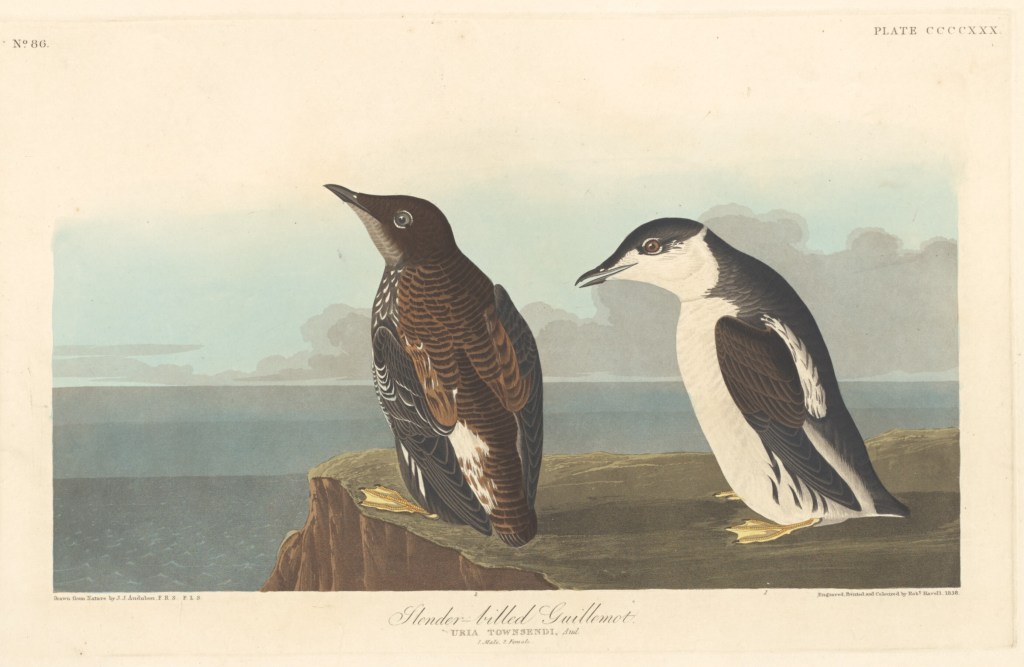
Audubon’s illustration labeled “Slender-billed Guillemot” in The Birds of America is actually an early depiction of the marbled murrelet (Brachyramphus marmoratus) (Audubon, 1838). The painting shows two birds perched on a rocky cliffside—one in dark mottled breeding plumage and the other in lighter, non-breeding coloration. Though marbled murrelets are now known to nest in old-growth forests, they forage at sea and are often depicted near coastal cliffs and open waters. The naming confusion in Audubon’s time reflected the limited understanding of this elusive species’ habits and range.
This engraving, Plate CCCCXXX (430), is typical of Audubon’s style, with lifelike poses and dramatic natural settings. One bird stands alertly on a rock in darker breeding plumage, while the other perches with wings slightly spread and lighter nonbreeding plumage, suggesting the bird’s low, rapid flight over the ocean (Audubon, 1838). Although the setting hints aprt the Pacific coastline, Audubon never traveled to the West Coast. He created the image using preserved specimens sent to him by fellow naturalists, including John Kirk Townsend. In his text description, Audubon candidly admitted, “Of the habits of this species nothing is known,” and noted the specimen was “presented to me by Mr. Townsend” (Audubon, 1840, p. 336). Despite relying on a lifeless model, Audubon’s rendering conveys remarkable vitality, capturing the mystery and grace of a bird he never encountered in the wild.
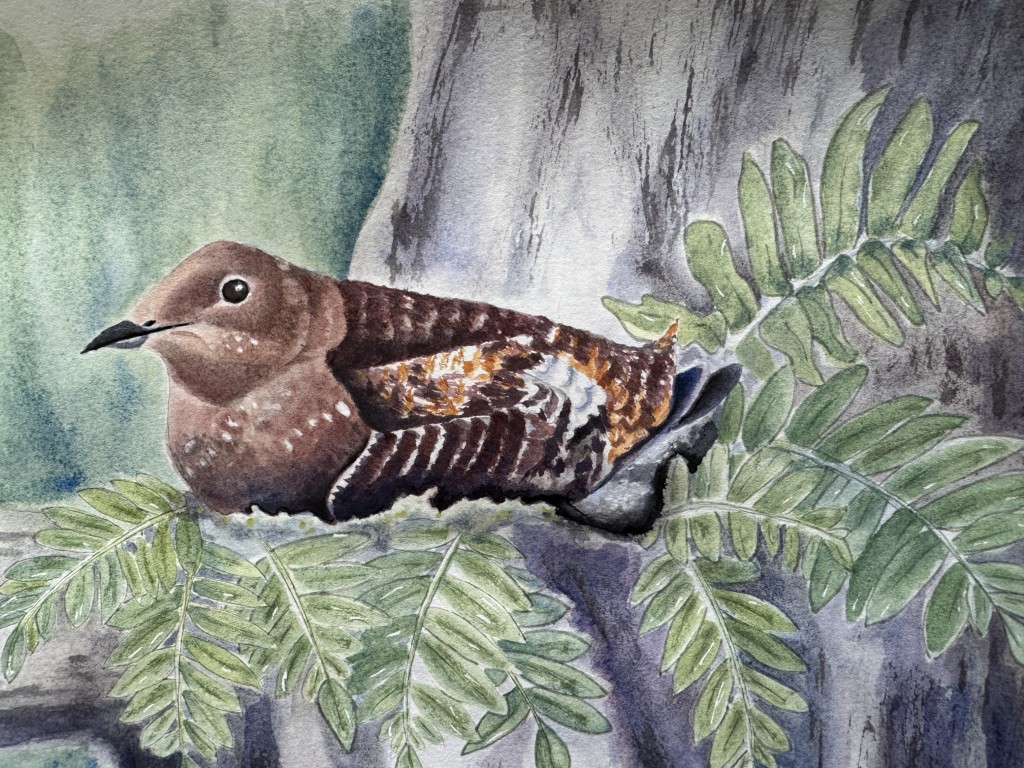
Smith’s 2025 illustration of a marbled murrelet nesting in an old-growth tree captures an adult bird resting in a moss- and fern-lined nook high on a forest limb. Inspired in part by a research image from Oregon State University’s AI-based murrelet monitoring program (Oregon State University News, 2024), the painting uses soft washes and fluid brushwork to evoke the delicate textures of feathers, bark, and understory plants.
Cover photo credit: A Marbled Murrelet floats on the sea (Raphael, M. / U.S. Forest Service, 2007)
References
Click here to view all of the references used for this post
Audubon, John James. (1838) The Birds of America, Plate CCCCXXX; Slender-billed Guillemot
[photograph of colored engraving]. Public domain. Retrieved September 13, 2024, from https://www.nga.gov/collection/art-object-page.32571.html
Audubon, John James (1840). The Birds of America (Vol. 7, p. 336). J.B. Chevalier. Retrieved May 26, 2025, from https://www.audubon.org/birds-of-america/marbled-murrelet
Burger, A. E. (2002). Conservation assessment of marbled murrelets in British Columbia: A review of the biology, populations, habitat associations, and conservation. Canadian Wildlife Service. Retrieved June 19, 2025, from https://www.canada.ca/en/environment-climate-change/services/species-risk-public-registry/cosewic-assessments-status-reports/marbled-murrelet-2002.html
IUCN. (n.d.). Marbled Murrelet. The IUCN Red List of Threatened Species 2020: e.T22694870A178976917. Retrieved September 13, 2024, from https://www.iucnredlist.org/species/22694870/178976917
Marbled murrelet (brachyramphus marmoratus): U.S. Fish & Wildlife Service. FWS.gov. (n.d.). Retrieved June 19, 2025, from https://www.fws.gov/species/marbled-murrelet-brachyramphus-marmoratus
Marbled murrelet identification, all about birds, Cornell Lab of Ornithology. , All About Birds, Cornell Lab of Ornithology. (n.d.). Retrieved June 19, 2025, from https://www.allaboutbirds.org/guide/Marbled_Murrelet/id
Marbled murrelet. Washington Department of Fish & Wildlife. (n.d.). Retrieved June 19, 2025, from https://wdfw.wa.gov/species-habitats/species/brachyramphus-marmoratus#desc-range
NatureServe Explorer. (n.d.). Marbled Murrelet. Retrieved September 13, 2024, from https://explorer.natureserve.org/Taxon/ELEMENT_GLOBAL.2.100239/Brachyramphus_marmoratus
Nelson, K. & Cushing, D./Oregon State University (2020). Marbled murrelet [photograph], CC BY-SA 2.0 https://creativecommons.org/licenses/by-sa/2.0, via Wikimedia Commons. Retrieved September 13, 2024, from https://commons.wikimedia.org/wiki/File:Marbled_murrelet.jpg
Oregon State University. (2024, April 16). Artificial intelligence enhances monitoring of threatened marbled murrelet [Photograph]. Oregon State University News. https://news.oregonstate.edu/news/artificial-intelligence-enhances-monitoring-threatened-marbled-murrelet (Retrieved June 22, 2025)
Raphael, M. / U.S. Forest Service (2007). A Marbled Murrelet floats on the sea [photograph]. CC BY 2.0 https://creativecommons.org/licenses/by/2.0, via Wikimedia Commons. Retrieved September 13, 2024, from https://commons.wikimedia.org/wiki/File:Marbled_Murrelet_mug.jpg
Sibley, D. (2003). The Sibley field guide to birds of Western North America. First edition. New York, Alfred A. Knopf.
Smith, I. (2025). Marbled Murrulet nesting in old growth tree [illustration]. Shared with permission.

 wild sprout


One Comment
Comments are closed.