
The sandhill crane (Antigone canadensis, formerly Grus canadensis) is a species of migratory bird that breed in wetlands, uplands (grassy and partially forested), and wet meadows. They nest within wet meadows, favoring areas with emergent vegetation, or semi-terrestrial plants that root near the edge of water. Their diet is various, ranging from insects to small reptiles, to waste grains while migrating (WDFW, n.d.).
There are three subspecies of sandhill crane: the lesser sandhill crane, the Canadian sandhill crane, and the greater sandhill crane. Washington’s Columbia Basin is a stop for the largest concentration of lesser sandhill crane migration, with over 35,000 lesser sandhill cranes migrating through Washington annually. While lesser sandhill cranes do not breed and nest in Washington, the same cannot be said for the other two subspecies. The Canadian sandhill crane historically have bred in Washington but are rare, with a nesting in 2020 being the first documented nesting in western Washington for over a hundred years. The greater sandhill crane historically nested in eastern Washington before being extirpated in 1941. More recently, the greater sandhill crane breeding population has been increasing, with 40 pairs now visiting Washington (WDFW, n.d.).
“The earth has its music for all who will listen.”
–William Shakespeare
Description
The Sandhill Crane is a striking bird recognized for its tall, slender build, long legs, and distinctive red crown. Among its three main subspecies, the Lesser Sandhill Crane is the smallest, measuring about 38 to 46 inches in length with a wingspan around 5 feet and weighing 5.5 to 7 pounds. The Greater Sandhill Crane is the largest, reaching lengths up to 53 inches, wingspans of 7 feet, and weights up to 12 pounds. The Canadian Sandhill Crane falls in between, with a moderate size and slightly lighter weight. Despite these size differences, all subspecies share similar gray plumage and strong, resonant calls that echo across wetlands and grasslands throughout North America. Their size and range variations reflect adaptations to their distinct breeding habitats, from Arctic tundra to temperate marshes (Sibley, 2003).
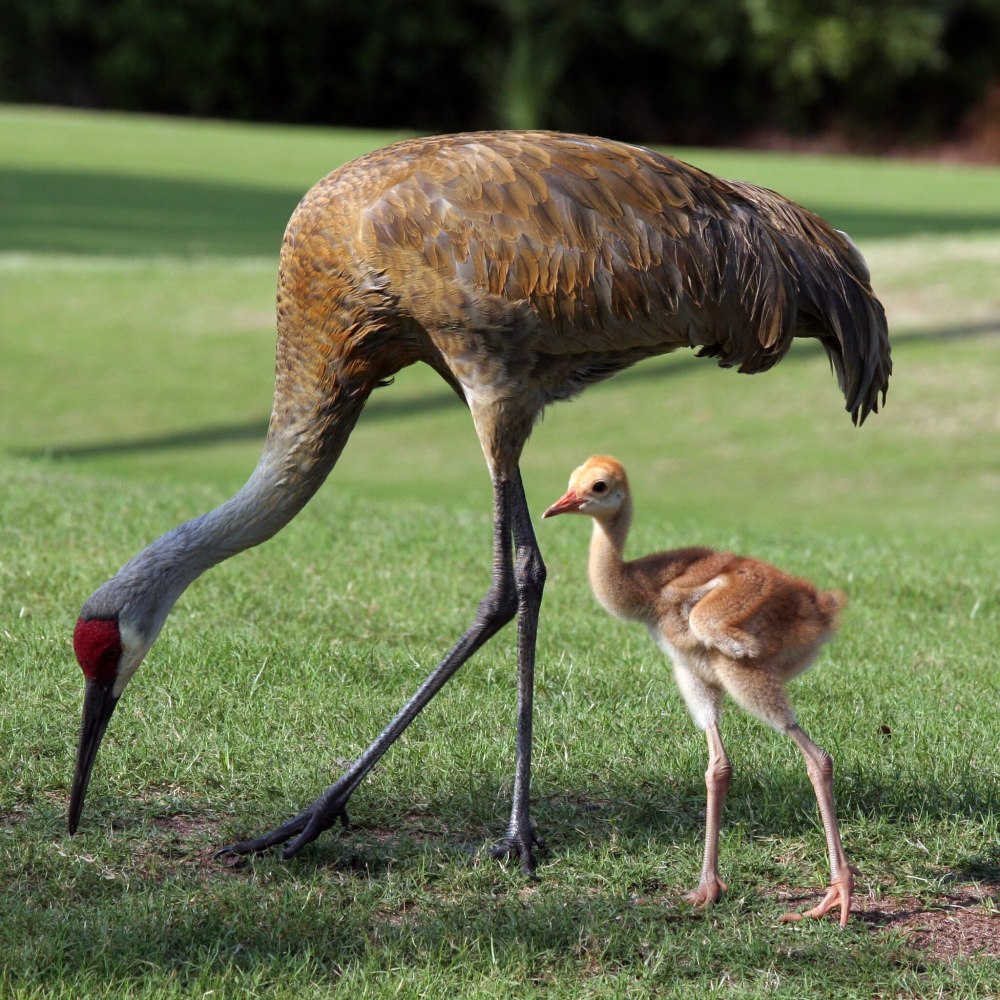
The Lesser, Greater, and Canadian Sandhill Cranes are all subspecies of the Sandhill Crane (Antigone canadensis), and they differ primarily in size, breeding range, and migration behavior:
Sandhill crane subspecies comparison
| Subspecies | Size | Washington | Breeding Range | Migration Distance |
|---|---|---|---|---|
| Lesser Antigone canadensis canadensis | Small | do not breed in WA; 35K migratory visitor Sunny-side Snake River Wildlife area | Arctic Canada, Alaska | Very long |
| Canadian Antigone canadensis rowani | Medium | rarely breeds in WA; 3-4K migratory visitor Ridgefield Natl Wildlife Refuge | Central Canada | Moderate/variable |
| Greater Antigone canadensis tabida | Large | Once exterpated, now 40 breeding pair in WA (klickitat and yakima counties) | Northern U.S., S. Canada | Moderate |
Source: Sibley Guide (2003), WDFW (n.d.)
Status
All three subspecies of crane are considered endangered in Washington (WDFW, n.d.).
***** Status References: WA State: WDFW North America: NatureServe Global: IUCN Red List *****
Threats
Though information on why they are endangered within Washington is scarce, the International Crane Foundation points to farmland development, afforestation (or the planting of forests), and conflicts with agriculture as general threats towards sandhill cranes (ICF, 2024). In addition, Cornell’s Lab of Ornithology describes the future of sandhill cranes as “mainly tied to the fate of their habitat” for both migratory and nonmigratory populations (Cornell, n.d.).
Washington’s Department of Fish and Wildlife considers only the greater sandhill crane a Species of Greatest Conservation Need, and while population is low it has been steadily increasing (WDFW, n.d.). The sandhill crane is also protected through the Migratory Bird Act of 1916, the Washington Forest Practices Act, and it is listed as a sensitive species under the Yakama Indian Reservation Forest Management Plan (nwcouncil, 2004).
Conservation
Conservation efforts for the Sandhill Crane (Antigone canadensis) must span nations and flyways, requiring collaboration across North America to protect breeding, migration, and wintering habitats (U.S. Fish and Wildlife Service, n.d.). Meanwhile, in Washington State, the Washington Department of Fish and Wildlife (WDFW) focuses on protecting and restoring key habitats, particularly at Conboy Lake National Wildlife Refuge in Klickitat County, which supports the state’s only known breeding population (U.S. Fish and Wildlife Service, n.d.). Restoration efforts also target former breeding sites in eastern Washington and prioritize migratory staging areas along the Columbia River to ensure safe passage during seasonal movements (Littlefield & Ivey, 2002; Stinson, 2017).
Nature Art
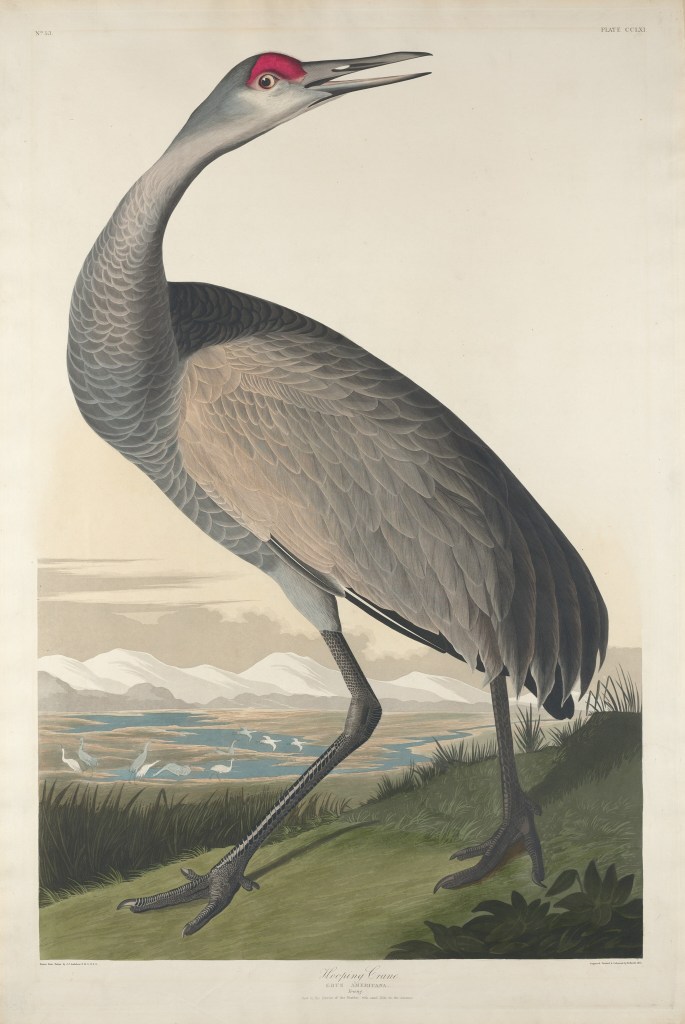
Audubon’s striking illustration, originally titled “Hooping Crane,” captures the elegant form of a large crane poised in naturalistic detail. Though historically labeled as a Whooping Crane (Grus americana), modern ornithologists have since determined that the bird depicted is actually a Sandhill Crane (Antigone canadensis). This misidentification likely arose because Audubon painted the specimen from a live bird he believed to be a juvenile Whooping Crane. The artwork remains a valuable and beautiful testament to Audubon’s skill and the rich history of American bird illustration, showcasing the distinctive gray plumage and red crown of the Sandhill Crane with remarkable accuracy.
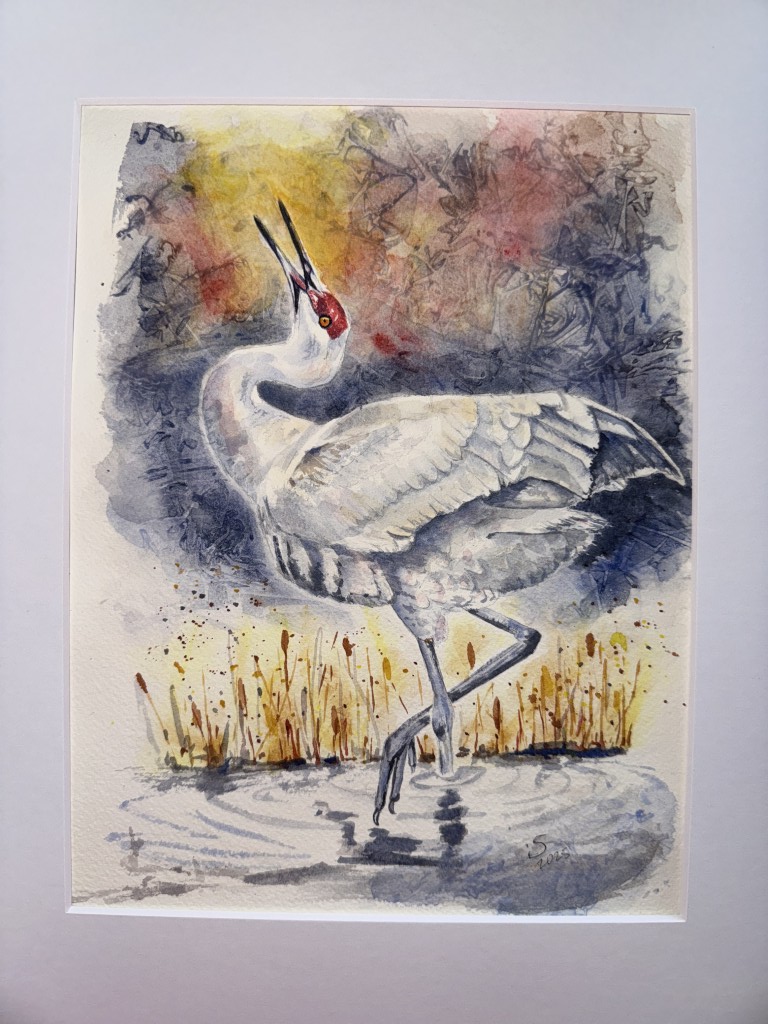
With robust and dramatic colors, Smith’s 2025 Sandhill Crane illustration depicts a male crane in his impressive mating dance — one can imagine the hopeful bird spreading his wings wide, bowing then leaping into the air, trumpeting loudly, hoping to entice a partner.
Cover page photo credit: Adult Sandhill Crane (Mike, 2009)
References
Click to see the amazing references that were used to create this post
Audubon, J. J. (1832–1833). Hooping Crane [Etching and aquatint by R. Havell Jr., after Audubon]. National Gallery of Art. Retrieved May 23, 2025, from https://www.nga.gov/artworks/32402-hooping-crane
BirdLife International. (2021). Grus canadensis. The IUCN Red List of Threatened Species 2021: e.T22692078A188597759. https://dx.doi.org/10.2305/IUCN.UK.2021-3.RLTS.T22692078A188597759.en. Retrieved May 27, 2025, from https://www.iucnredlist.org/species/22692078/188597759
Cornell Lab of Ornithology. (n.d.). Sandhill Crane overview. All About Birds. https://www.allaboutbirds.org/guide/Sandhill_Crane/overview
Dawn (2009). A adult Sandhill Crane with a chick [photograph]. CC2.0 Retrieved February 16, 2025, from https://commons.wikimedia.org/wiki/File:Grus_canadensis_-adult_and_chick-8.jpg
Littlefield, C. D., & Ivey, G. L. (2002). Washington State recovery plan for the Sandhill Crane. Washington Department of Fish and Wildlife. https://wdfw.wa.gov/publications/00396
Mike (2009). Adult Sandhill Crane, Grus c. canadensis. [photograph]. CC2.0 Retrieved February 16, 2025, from https://commons.wikimedia.org/wiki/File:Sandhill_crane.jpg
National Audubon Society. (n.d.). Sandhill Crane. Audubon. https://www.audubon.org/field-guide/bird/sandhill-crane
NatureServe. (n.d.). Antigone canadensis. NatureServe Explorer. Retrieved May 23, 2025, from https://explorer.natureserve.org/Taxon/ELEMENT_GLOBAL.2.104550/Antigone_canadensis
Northwest Power and Conservation Council. (n.d.). Sandhill cranes (Vol. III, Chapter 14). Retrieved June 18, 2025, from https://www.nwcouncil.org/sites/default/files/Vol._III_Ch._14__Sandhill_Cranes.pdf
Sandhill Crane Life History, all about birds, Cornell Lab of Ornithology. , All About Birds, Cornell Lab of Ornithology. (n.d.). https://www.allaboutbirds.org/guide/Sandhill_Crane/lifehistory
Sandhill Crane. International Crane Foundation. (2024, December 4). https://savingcranes.org/species/sandhill-crane/
Sandhill Crane. Washington Department of Fish & Wildlife. (n.d.). https://wdfw.wa.gov/species-habitats/species/antigone-canadensis#desc-range
Sibley, D. (2003). The Sibley field guide to birds of Western North America. First edition. New York, Alfred A. Knopf.
Smith, I. (2025). Sandhill Crane [illustration]. Posted with permission.
Stinson, D. W. (2017). Periodic status review for the Sandhill Crane in Washington. Washington Department of Fish and Wildlife. https://wdfw.wa.gov/publications/01854
Washington Department of Fish and Wildlife. (n.d.). Sandhill crane (Antigone canadensis). Retrieved June 4, 2025, from https://wdfw.wa.gov/species-habitats/species/antigone-canadensis#conservation

 wild sprout


You must be logged in to post a comment.