
The northern leopard frog (Lithobates pipiens, formerly Rana pipiens) is a semi-aquatic species of frog, living within shrub-steppe and riparian ecosystems. They rely on both aquatic and terrestrial habitats, requiring water for breeding and overwintering, shallow still water and deep oxygenated water respectively. Their diet includes insects and small frogs, and they forage in damp meadows, fields, and irrigation ditches (Washington Department of Fish and Wildlife, n.d.).
“The beauty of nature has been one of the great inspirations in my life“
–Jim Henson
Description
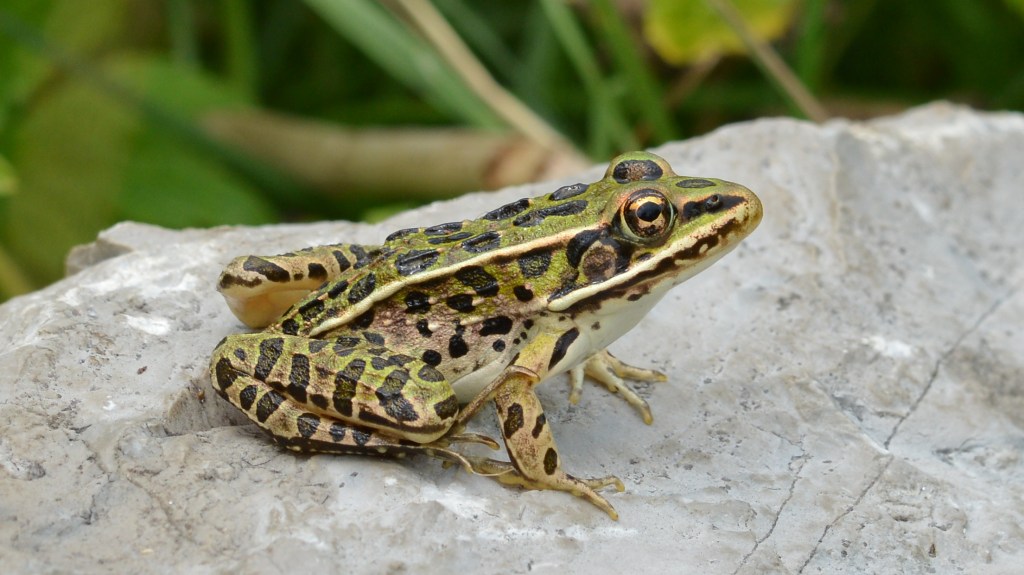
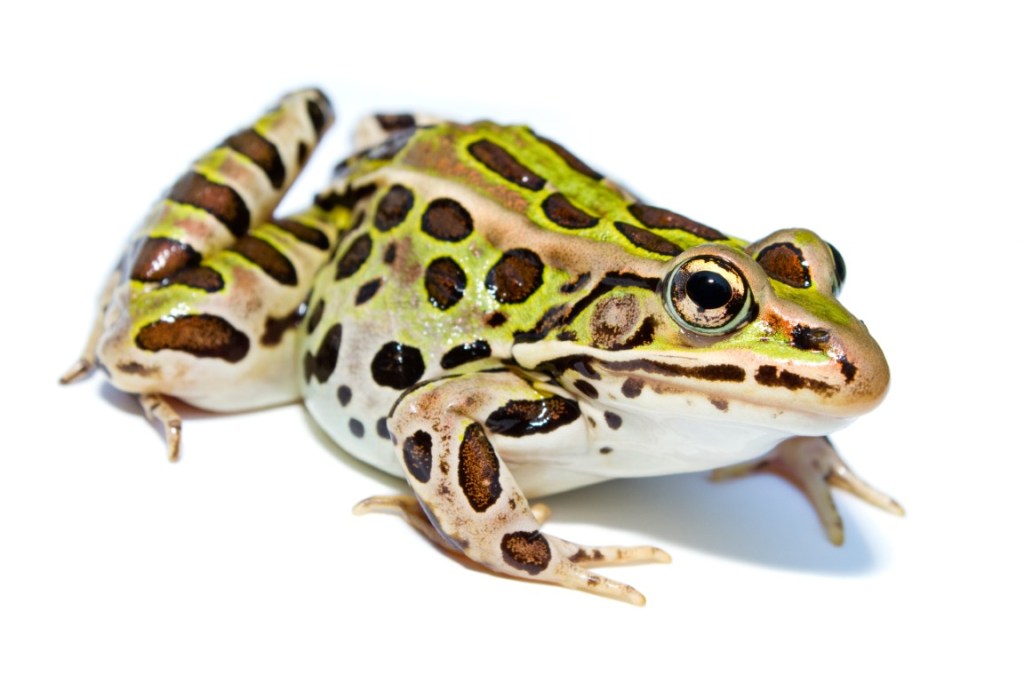
The northern leopard frog is a striking amphibian characterized by its vibrant green or brown skin adorned with dark, round spots bordered by lighter halos, which resemble the pattern of a leopard’s coat. It has a white to pale yellow underside and two prominent dorsolateral folds running down its back. The frog’s relatively large, upward-facing eyes are set on a flattened head, allowing it to spot predators and prey effectively. Its long, powerful legs are well-suited for jumping and swimming, making it an agile and efficient hunter in both terrestrial and aquatic environments.
Northern leopard frogs (Lithobates pipiens) show some sexual size dimorphism, with females generally being slightly larger than males.
Males often have thicker thumbs and enlarged vocal sacs, used for calling. Females are usually bulkier, especially during breeding season due to egg carrying.
| Male | Female | |
|---|---|---|
| Length | 5-9 cm (2-3.5 in) | 7-11 cm (2.75-4.3 in) |
| Weight | 28-40 g (1-1.4 oz) | 40-60 g (1.4-2.1 oz) |
(AmphibiaWeb, 2021)
Status
The northern leopard frog is considered endangered in Washington. There is currently one known population of northern leopard frog in Washington located in the Columbia Basin Wildlife area. Historically, they were found throughout eastern Washington (WDFW, n.d.).
Federally, environmental organizations petitioned for the northern leopard frog in western United States to be listed as endangered in 2006 (NPS, n.d.), but the US Fish and Wildlife Service determined that it did not need to be listed because the the species was not in danger of extinction throughout its range (U.S. Fish and Wildlife Service, 2011).
***** Status References: WA State: WDFW North America: NatureServe Global: IUCN Red List *****
Threats
There are a variety of reasons for the population decline, including habitat loss, introduction of exotic predators, disease and pesticides (U.S. Department of Interior, n.d.). The northern leopard frog is also predicted to be impacted by climate change, with potential increases in temperature causing earlier breeding and egg hatching, and drier conditions decreasing possible breeding habitat (WDFW, n.d.).
Conservation
The Washington Department of Fish and Wildlife has collaborated with multiple groups tracking the northern leopard frog population to improve survival through reintroducing the population to the Columbia National Wildlife Refuge and habitat conservation (WDFW, n.d.).
Nature Art
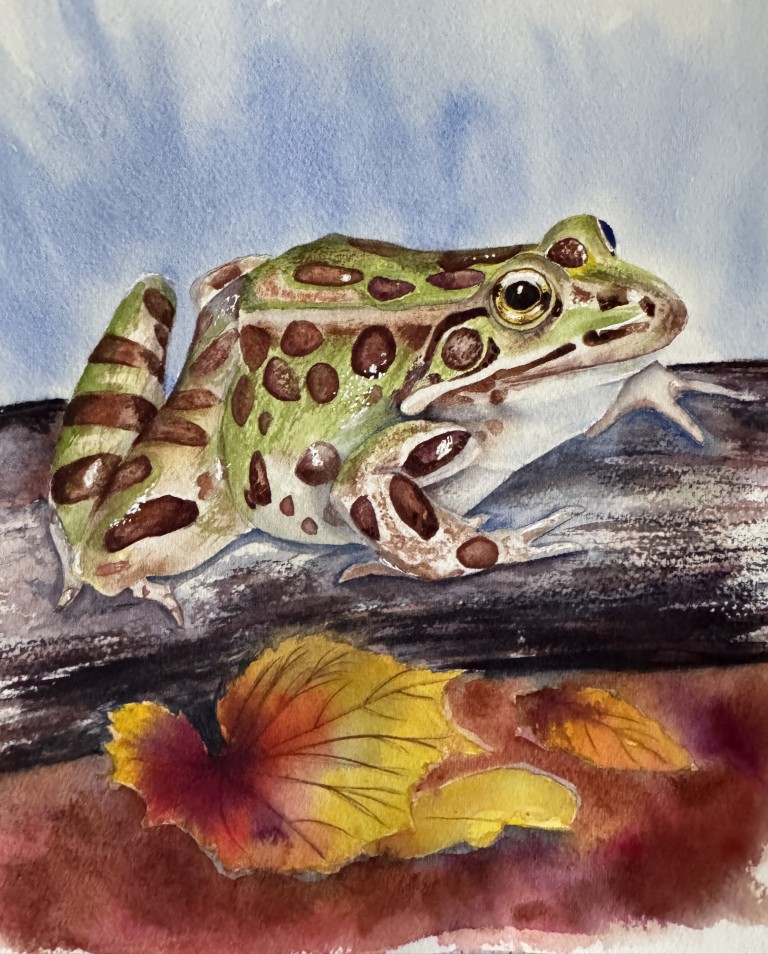
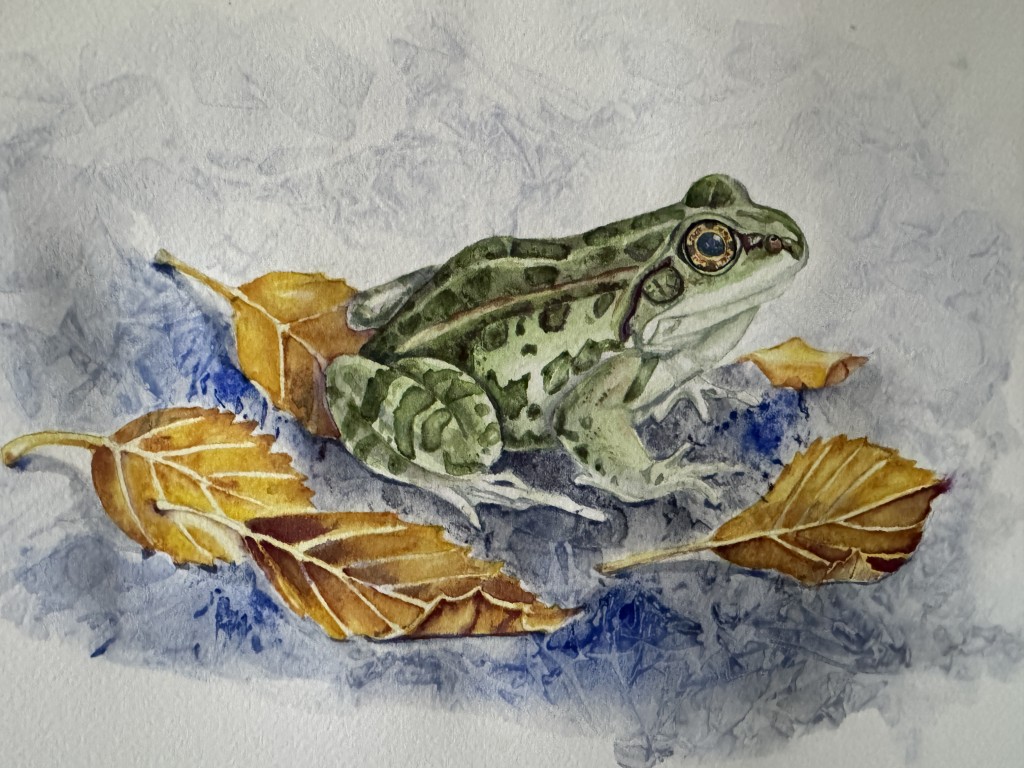
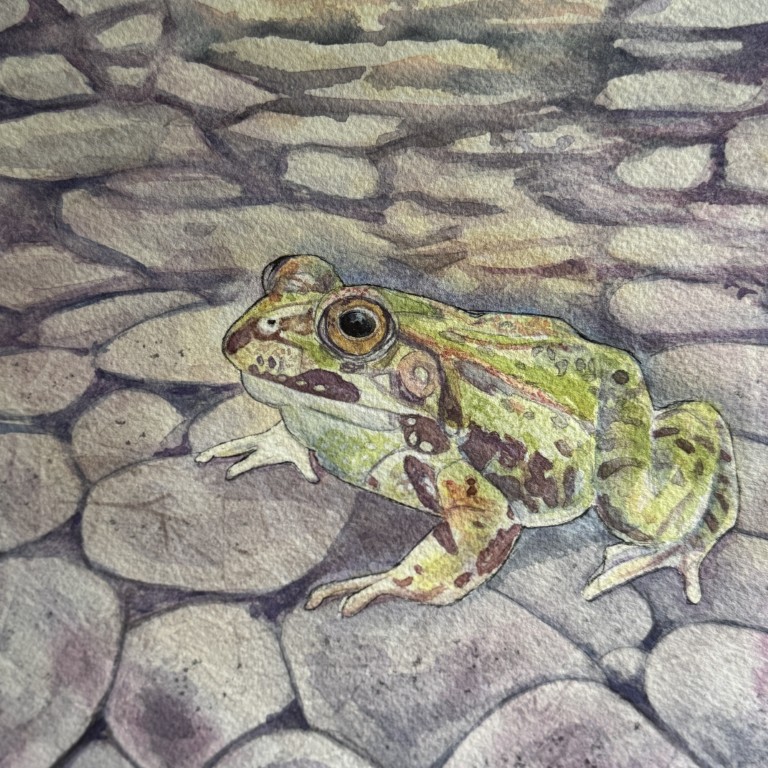
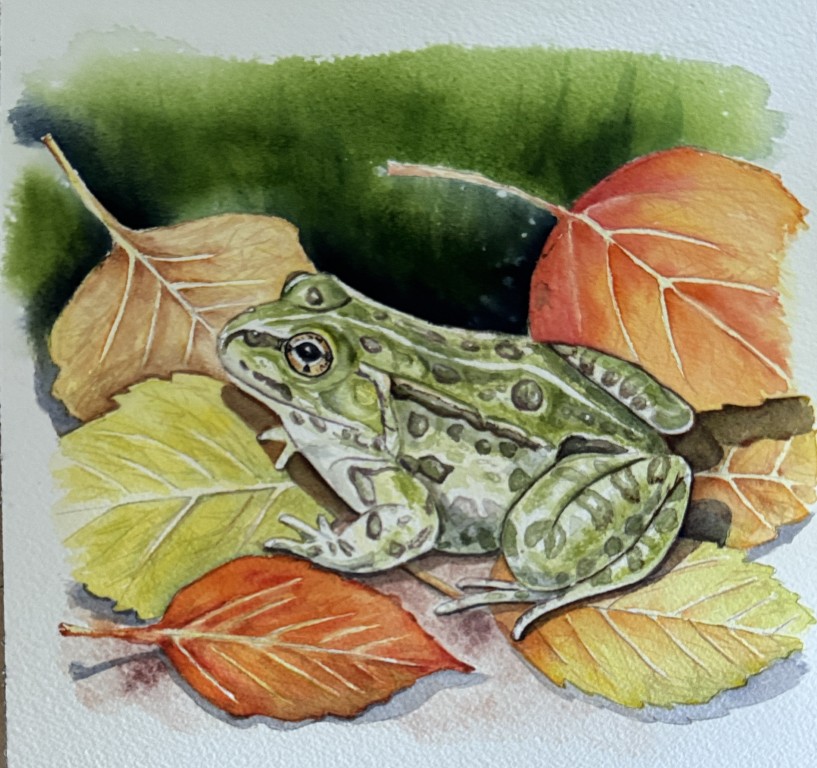
In four distinct watercolor illustrations, Smith (2025) captures the Northern Leopard Frog in a variety of natural habitats. Each piece highlights the frog’s vivid coloring and the intricate spot patterns that make this species so recognizable.
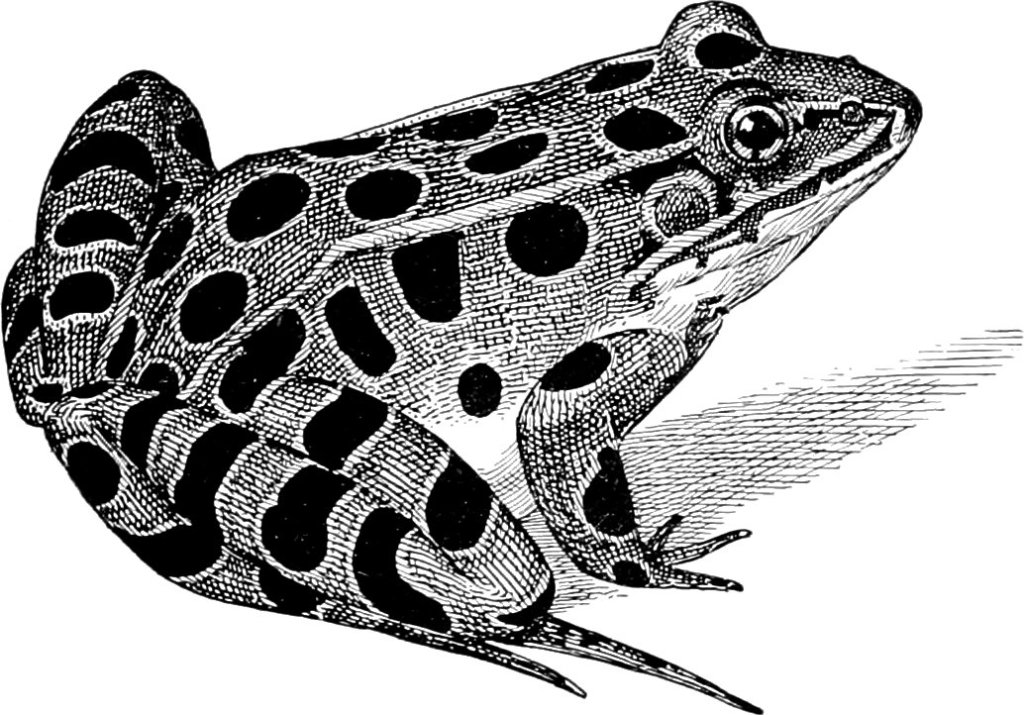
The “Leopard Frog” illustration by Knobel (1896) is a detailed, hand-colored lithograph depicting a leopard frog in a naturalistic style. Created during the late 19th century, the artwork exemplifies the scientific illustration techniques of the time, focusing on anatomical accuracy and vibrant coloration. The frog is shown in profile, highlighting its distinctive spotted pattern, slender limbs, and webbed feet, characteristic of the Rana pipiens species (now often referred to as Lithobates pipiens). This illustration was likely intended for educational or natural history purposes, combining art and science to document North American amphibian species. The composition and style reflect the period’s emphasis on cataloging biodiversity through precise, aesthetic renderings.
Cover page photo credit: Northern Leopard Frog (Lithobates pipiens) (Harder, 2011)
References
Click to see the amazing references that were used to create this post
AmphibiaWeb (2021). Lithobates pipiens species account. University of California, Berkeley. Retrieved March 20, 2025, from https://amphibiaweb.org/species/5160
Gratwicke, B. (2011). Northern Leopard Frog (Lithobates pipiens). Photo taken near Ottawa. [photograph]. CC BY 2.0, via Wikimedia Commons. Retrieved January 29, 2025, from https://commons.wikimedia.org/wiki/File:Lithobates_pipiens.jpg
Harder, D. (2011). Northern Leopard Frog (Lithobates pipiens) [photograph]. CC BY-SA 3.0, via Wikimedia Commons. Retrieved January 29, 2025, from https://commons.wikimedia.org/wiki/File:Northern_Leopard_Frog_(Lithobates_pipiens).jpg
Hodnett, H. (2018). Northern Leopard Frog (Lithobates pipiens) in Waterloo, Ontario, Canada [photograph]. CC BY-SA 4.0, via Wikimedia Commons. Retrieved January 29, 2025, from https://commons.wikimedia.org/wiki/File:Northern_Leopard_Frog_%28Lithobates_pipiens%29_-_Waterloo,_Ontario_02.jpg
IUCN SSC Amphibian Specialist Group. (2022). Lithobates pipiens. The IUCN Red List of Threatened Species 2022: e.T79079800A3072377. https://dx.doi.org/10.2305/IUCN.UK.2022-2.RLTS.T79079800A3072377.en. Retrieved May 27, 2025, from https://www.iucnredlist.org/species/79079800/3072377
Knobel, E. (Illustrator). (1896). Leopard Frog [Illustration]. In Turtles, snakes, frogs of North America (Plate 39). Wikimedia Commons. Public Domain. Retrieved March 20, 2025, from https://commons.wikimedia.org/wiki/File:Leopard_Frog-TSF_0039.jpg
NatureServe. (n.d.). Lithobates pipiens. NatureServe Explorer. Retrieved January 29, 2025, from https://explorer.natureserve.org/Taxon/ELEMENT_GLOBAL.2.101454/Lithobates_pipiens
Northern leopard frog. Washington Department of Fish & Wildlife. (n.d.). Retrieved March 20, 2025, from https://wdfw.wa.gov/species-habitats/species/lithobates-rana-pipiens
Smith, I. (2025). Northern Leopard Frog [photograph of painting]. Shared with permission.
Smith, I. (2025). Northern Leopard Frog alder leaves [photograph of painting]. Shared with permission.
Smith, I. (2025). Northern Leopard Frog on log [photograph of painting]. Shared with permission.
Smith, I. (2025). Northern Leopard Frog on rock bed [photograph of painting]. Shared with permission.
U.S. Department of the Interior. (n.d.). Northern leopard frog (U.S. National Park Service). National Parks Service. Retrieved March 20, 2025, from https://www.nps.gov/articles/northern-leopard-frog.htm
U.S. Fish and Wildlife Service. (2011, October 5). Endangered and threatened wildlife and plants; designation of critical habitat for the marbled murrelet (Federal Register Vol. 76, No. 193, pp. 61599–61621) [PDF]. U.S. Government Publishing Office. Retrieved May 22, 2025, from https://www.fws.gov/sites/default/files/federal_register_document/2011-25498.pdf

 wild sprout

.jpg)


One Comment
Comments are closed.