
The Ferruginous hawk (Buteo regalis) is a migratory species of hawk, and is the largest hawk in North America. They are found in prairies, deserts, and other open spaces in western North America (Cornell Lab of Ornithology, n.d.). The ferruginous hawk tends to breed and nest in the northern part of its range, then flies south for winter. Washington is a part of the hawk’s breeding range, where they nest on small rock outcrops or isolated trees, reusing old hawk and crow nests. In Washington, ferruginous hawks primarily hunt small to medium-sized mammals, as well as birds, reptiles, and insects. (WDFW, n.d.)
“We can never have enough of nature.”
–Henry David Thoreau
Description
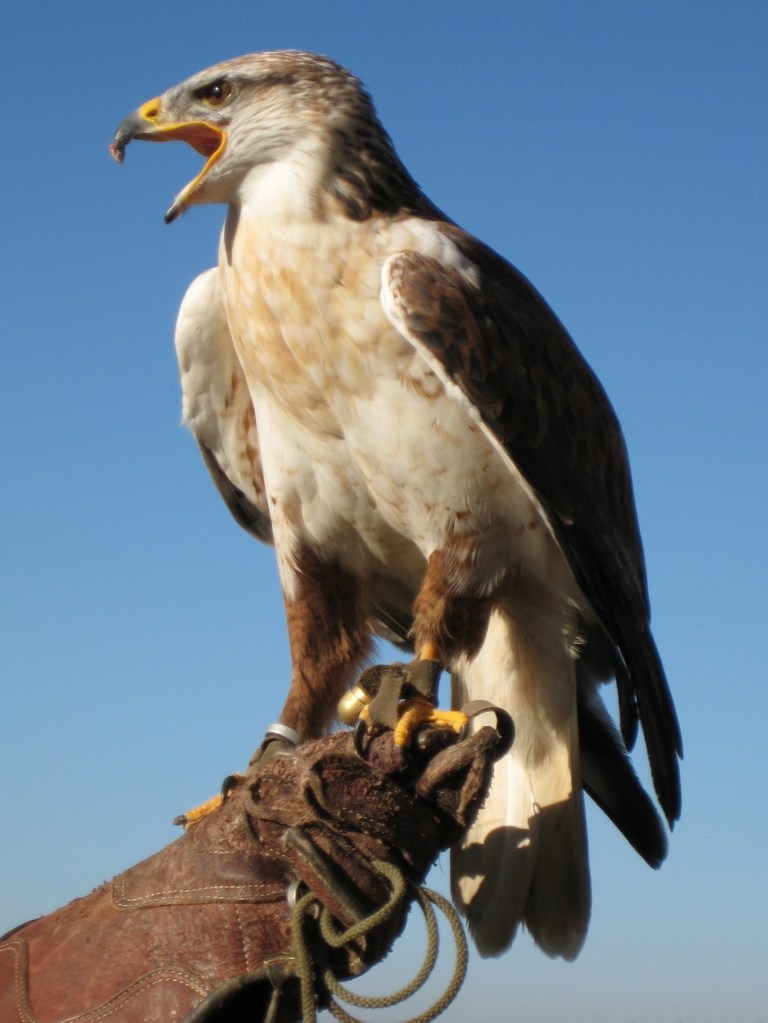
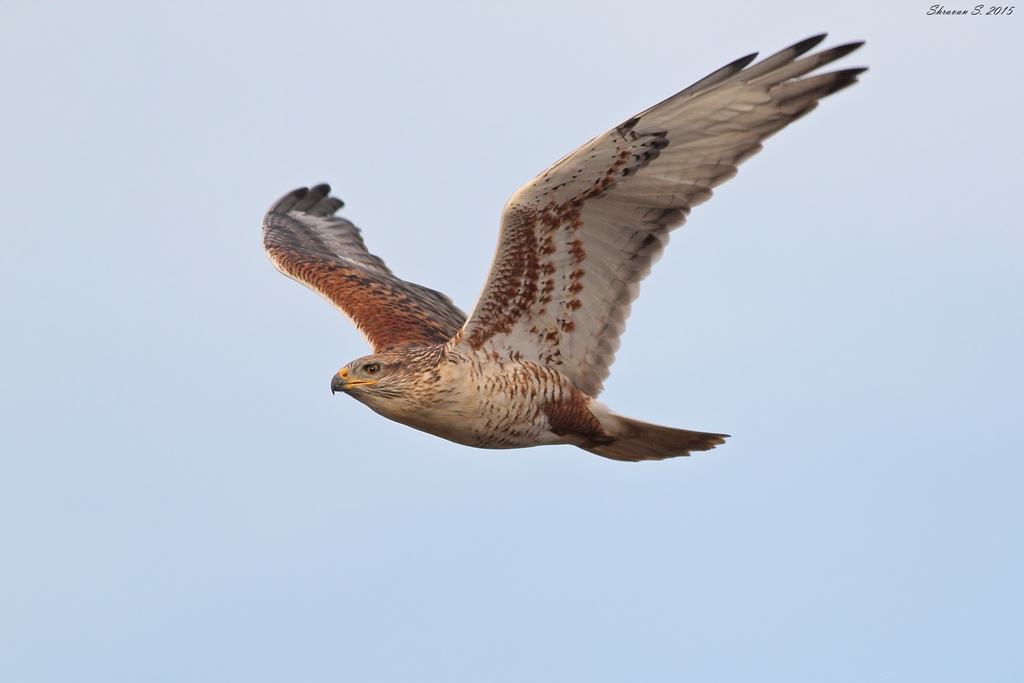
The Ferruginous Hawk is a large raptor with a robust build and broad wings. It is named for its rusty, reddish-brown plumage, especially on the shoulders and back. Adults have a pale, almost white underside with some rufous streaking and a distinctive V-shaped pattern on the legs when viewed from below. Their tails are typically pale with a light rufous wash. Males and females are similar in appearance, but females are generally larger and heavier than males. This size difference is common among many raptor species, where females tend to be larger to handle the demands of reproduction and to hunt larger prey (Cascades Raptor Center, n.d.).
| Male | Female | |
| Length | 20-26 in (51-66cm) | 22-27 in (56-69 cm) |
| Wingspan | 48-56 in (122-142 cm) | 53-60 in (135-152 cm) |
| Weight | 2.4 lbs (1.1kg) | 3-4 lbs (1.4-1.8 kg) |
Status
The Ferruginous hawk is considered endangered in Washington. The most recent comprehensive data from the Washington Department of Fish and Wildlife (WDFW) indicates that in 2021, there were 32 breeding pairs of ferruginous hawks in Washington State, reflecting a 42% decline from the average of 55 pairs surveyed between 1992 and 1995 (NWPB, 2021).
***** Status References: WA State: WDFW North America: NatureServe Global: IUCN Red List *****
Threats
Ferruginous hawks are impacted by shrubsteppe and grassland habitat loss, prey decline (jackrabbits and ground squirrels), and more direct causes of death such as illegal shooting, electrocution, and collisions (WDFW. n.d.).
Conservation
In response to these challenges, conservation efforts are underway, including the installation of artificial nest platforms to support breeding pairs. As of mid-2021, five pairs of ferruginous hawks have occupied these new platforms, indicating a positive impact on nesting opportunities (WDFW, 2021).
Ferruginous hawks are protected by the Migratory Bird Treaty Act (Audobon, n.d.), and the Washington Department of Fish and Wildlife has monitored the population and collaborates with the Woodland Park Zoo on further ecology research (Woodland Park Zoo, n.d.).
Nature Art
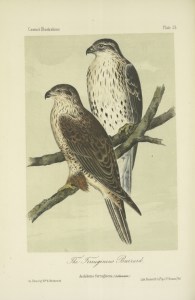
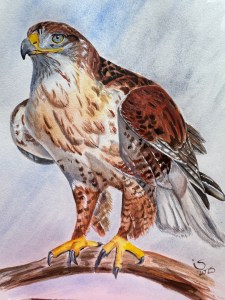
Cassin’s 1862 illustration of the Ferruginous Buzzard (left image below), featured in “Illustrations of the Birds of California, Texas, Oregon, British and Russian America,” captures male and female specimens in meticulous detail. The artwork showcases the hawk’s distinctive plumage and commanding presence. Smith’s 2025 illustration of the Ferruginous Hawk (right image below), inspired by the Rapture Center (n.d.), showcases the bird’s hunting stance.
Cover page photo credit: Ferruginous Hawk (Hisgett, 2009)
References
Click to see the amazing references that were used to create this post
Aconcagua (2008). Buteo regalis [photograph]. CC BY-SA 3.0, via Wikimedia Commons. Retrieved January 19, 2025, from https://commons.wikimedia.org/wiki/File:Buteo_regalis_02.jpg
Cascades Raptor Center. (n.d.). Ferruginous Hawk. Retrieved January 18, 2025, from https://cascadesraptorcenter.org/birds/ferruginous-hawk/?form=MG0AV3
Cassin, John (1862). Illustrations of the birds of California, Texas, Oregon, British and Russian America. Rare Book Division, The New York Public Library. (1862). The Ferruginous Buzzard (Archibuteo ferrugineus) [photograph of illustration]. Retrieved from https://digitalcollections.nypl.org/items/510d47d9-7772-a3d9-e040-e00a18064a99
Ferruginous Hawk Life History, all about birds, Cornell Lab of Ornithology. , All About Birds, Cornell Lab of Ornithology. (n.d.). https://www.allaboutbirds.org/guide/Ferruginous_Hawk/lifehistory
Ferruginous Hawk. (n.d.). Woodland Park Zoo. Retrieved June 12, 2025, from https://www.zoo.org/document.doc?id=3175
Ferruginous Hawk. Washington Department of Fish & Wildlife. (n.d.). https://wdfw.wa.gov/species-habitats/species/buteo-regalis
IUCN. (2024). The IUCN Red List of Threatened Species. Version 2024-2. Retrieved February 15, 2025, from https://www.iucnredlist.org/species/22695970/264598231
Hisgett, T. (2009).Ferruginous Hawk [photograph]. CC BY 2.0, via Wikimedia Commons. Retrieved January 19, 2025, from https://commons.wikimedia.org/wiki/File:Ferruginous_Hawk_%283863032876%29.jpg
NatureServe. (n.d.). Buteo regalis – Ferruginous Hawk. NatureServe Explorer. Retrieved February 15, 2025 from https://explorer.natureserve.org/Taxon/ELEMENT_GLOBAL.2.103222/Buteo_regalis
Northwest Public Broadcasting (NWPB). (2021, September 7). Ferruginous hawks in Washington deemed endangered. Retrieved February 15, 2025, from https://www.nwpb.org/2021/09/07/ferruginous-hawks-in-washington-deemed-endangered/
Raptor Center. (n.d.). Ferruginous hawk [photograph]. University of Minnesota. Retrieved January 29, 2025, from https://raptor.umn.edu/about-raptors/raptors-north-america/ferruginous-hawk
Shravans14 (2015). Ferruginous Hawk Flying [photograph]. CC BY-SA 4.0, via Wikimedia Commons. Retrieved January 19, 2025, from https://commons.wikimedia.org/wiki/File:Ferruginous_Hawk_Flying.jpg
Sibley, D. (2003). The Sibley field guide to birds of Western North America. First edition. New York, Alfred A. Knopf.
Smith, I. (2025). Ferruginous Hawk. Posted with permission.
Washington Department of Fish and Wildlife (WDFW, 2021). New nest platforms benefitting endangered hawks. Retrieved February 15, 2025, from https://wdfw.medium.com/new-nest-platforms-benefitting-endangered-hawks-623d2315ad20

 wild sprout


One Comment
Comments are closed.