
The pygmy rabbit (Brachylagus idahoensis) is the smallest rabbit in North America. They live in the Great Basin and in Washington, living entirely within and relying on sagebrush habitat for food and shelter. The pygmy rabbit’s diet in winter is primarily big sagebrush (Artemisia tridentata). The soil in sagebrush habitats allow them to dig burrow systems for shelter, temperature, and safety. In Washington, pygmy rabbits live only in two areas in the Columbia Basin–Douglas and Grant Counties.
For at least the last 10,000 years, the Columbia Basin pygmy rabbit has been isolated from the rest of the range of pygmy rabbits (WDFW, n.d.). This has caused limited gene flow between the populations and unique genetic markers for the Columbia Basin population (USFWS. n.d.). They are now considered a Distinct Population Segment (WDFW, n.d.), or a population that is separate from the rest of the species (NOAA, n.d.).
“A flower blooming in the desert proves to the world that adversity, no matter how great, can be overcome.”
-Matshona Dhliwayo
Description
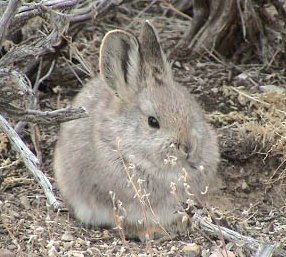
The Columbia Basin pygmy rabbit is a tiny, round-bodied rabbit with soft, grayish-brown fur, short ears, and a small, inconspicuous tail. It is the smallest rabbit species in North America, typically weighing under a pound and measuring around 9 to 12 inches in length. The Columbia Basin pygmy rabbit, like other pygmy rabbits, exhibits slight sexual dimorphism in size; females are slightly larger than males Hayes (2018).
| Male | Female | |
| Length | 9.1 to 11.3 inches (23.1 to 28.7 cm) | 9.3 to 11.6 inches (23.6 to 29.5 cm |
| Weight | 0.8 to 1.0 pounds (360 to 450 grams) | 0.8 to 1.1 pounds (360 to 500 grams) |
Status
The Columbia Basin pygmy rabbit population are endangered federally and in Washington (WDFW, n.d.).
***** Status References: WA State: WDFW North America: NatureServe Global: IUCN Red List *****
Threats
Their main cause of population decline are habitat loss and degradation of the shrubsteppe habitat. They are also predicted to decline further as wildfires become more frequent, which would kill both the rabbits and the habitat itself (WDFW, n.d.).
Conservation
Since 2007, the WDFW and USFWS have worked with multiple organizations to breed pygmy rabbits in captivity and release them into their habitat. Since 2011, there has been over 2,000 rabbits released, however current population estimates are around 250 rabbits. There was an attempt to establish a third population area in Central Douglas County through the captive breeding program, but the population was lost due to the wildfires in 2020 (WDFW, n.d.).
Nature Art
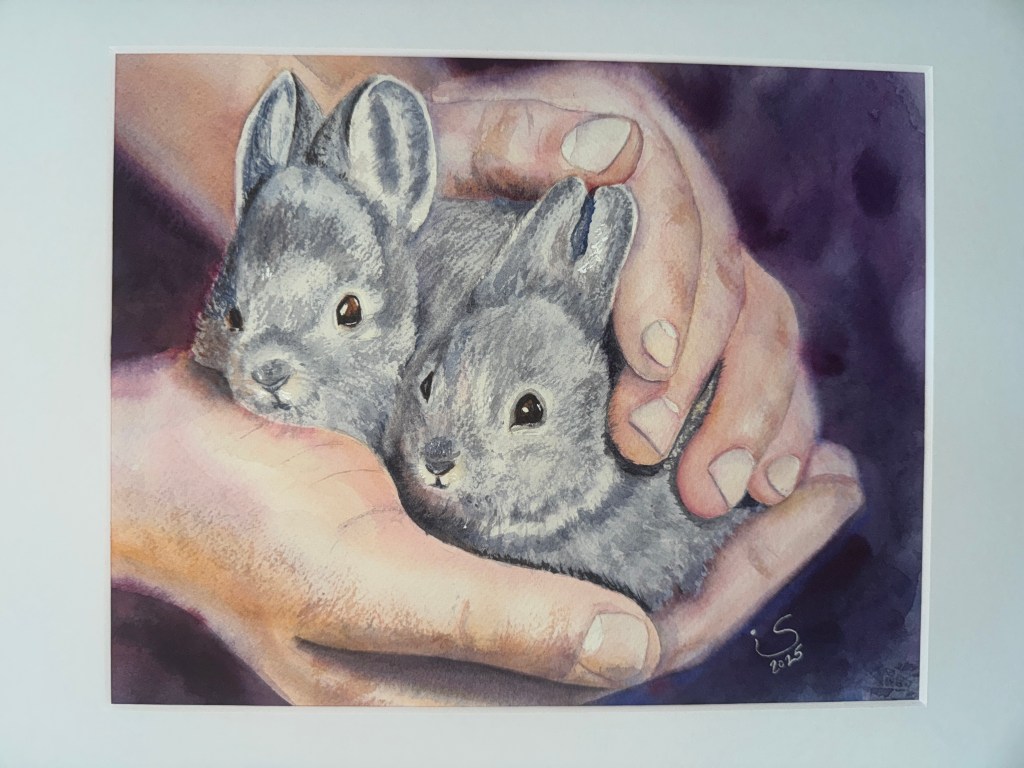
Several contemporary artists have been inspired by the pygmy rabbit, however no historic scientific illustrations have been found in public domain. Despite its ecological importance, the pygmy rabbit has been largely overlooked in historical nature art—likely due to its small size, elusive behavior, and restricted sagebrush habitat, which made it difficult for early naturalists and artists to observe or depict. Unlike more visible or charismatic species, it simply didn’t capture the attention of 19th-century illustrators.
Inspired by an Oregon Zoo photo of 20-day-old baby pygmy rabbits (Durham/Oregon Zoo, n.d.), Smith (2025) depicts two pygmy rabbits being held, showcasing the species’ diminutive size.
Cover page photo credit: Columbia Basin Pygmy Rabbit (Ulmscheider (BLM) & Dixon (IDFG), 2011)
References
Click to see the references that were used to created this post
ArcGIS StoryMaps (n.d.). Saving the Columbia Basin pygmy rabbit. Retrieved February 13, 2025, from https://storymaps.arcgis.com/stories/182b432545f14aed80ab514f44f9fe88
Atlas Obscura (n.d.). How Washington state saved its tiniest rabbit from extinction. Retrieved Retrieved February 13, 2025, from https://www.atlasobscura.com/articles/columbia-basin-pygmy-rabbits-washington
Durham, M., Oregon Zoo (n.d.). A pair of 20-day-old baby pygmy rabbits, five days after first emerging from the maternal den [photograph]. Retrieved February 13, 2025, from https://www.atlasobscura.com/articles/columbia-basin-pygmy-rabbits-washington
Fisheries, N. (2022, November 15). Glossary: Endangered species act. https://www.fisheries.noaa.gov/laws-and-policies/glossary-endangered-species-act#distinct-population-segment
Hayes, G. E. (2018). Periodic Status Review for the Pygmy Rabbit in Washington. Washington Department of Fish and Wildlife, Olympia, Washington. 19+ iii pp. Retrieved February 13, 2025, from https://wdfw.wa.gov/sites/default/files/about/commission/meetings/2018/06/jun_1318_11_review.pdf
International Union for Conservation of Nature (IUCN). (2019). Sylvilagus idahoensis (pygmy rabbit). The IUCN Red List of Threatened Species 2019: e.T2963A45176206. Retrieved September 27, 2024, from https://www.iucnredlist.org/species/2963/45176206
NatureServe Explorer. (n.d.). Sylvilagus idahoensis – pygmy rabbit. NatureServe Explorer. Retrieved September 27, 2024, from https://explorer.natureserve.org/Taxon/ELEMENT_GLOBAL.2.102656/Sylvilagus_idahoensis
Pygmy Rabbit (Columbia Basin population). Washington Department of Fish & Wildlife. (n.d.). https://wdfw.wa.gov/species-habitats/species/brachylagus-idahoensis
Smith, I. (2025). Pygmy Rabbits [photograph of painting]. Posted with permission.
Ulmscheider, H. (BLM) & Dixon, R.(IDFG) (2011). Columbia Basin Pygmy Rabbit [photograph]. Public domain, via Wikimedia Commons. Retrieved September 27, 2024, from https://commons.wikimedia.org/wiki/File:Columbia_Basin_Pygmy_Rabbit.jpg
U.S. Fish and Wildlife Service (USFWS) (n.d.). Pygmy rabbit (Brachylagus idahoensis). Retrieved from https://www.fws.gov/species/pygmy-rabbit-brachylagus-idahoensis
United States Bureau of Land Management (n.d.). Pygmy Rabbit (Brachylagus idahoensis) [photograph]. Public domain, via Wikimedia Commons. Retrieved September 27, 2024, from https://commons.wikimedia.org/wiki/File:BRACHYLAGUS_IDAHOENSIS.jpg
Washington Department of Fish and Wildlife (WDFW) (n.d.). Pygmy rabbit (Brachylagus idahoensis). Retrieved Retrieved February 13, 2025, from https://wdfw.wa.gov/species-habitats/species/brachylagus-idahoensis
Wyoming Game and Fish Department (WGFD) (n.d.). Pygmy rabbit (Brachylagus idahoensis). Retrieved Retrieved February 13, 2025, from https://wgfd.wyo.gov/sites/default/files/content/PDF/Habitat/SWAP/Mammals/Pygmy-Rabbit.pdf

 wild sprout

One Comment
Comments are closed.