
The greater sage-grouse (Centrocerus urophasianus) is the largest species of grouse in North America. They live in shrub-steppe habitats with sagebrush, though can winter in degraded shrub-steppe and can live in edges of wheat and alfalfa fields near shrub-steppe habitat. Their diet consists of insects, sagebrush, grasses, and non-woody flowering plants (or forbs), with the majority of their diet being sagebrush. In Washington, the greater sage grouse currently lives in about 8% of its historic range, which was originally half of the land east of the Cascade mountains. Their current range in Washington is two isolated areas: the Yakima Training Center and the Moses Coulee area of Douglas County. There was a reintroduced population in Lincoln County as of 2021, but fires in the area may have impacted the population (Washington Department of Fish and Wildlife, n.d.).
We still do not know one thousandth of one percent of what nature has revealed to us.”
-Albert Einstein
Description
Greater Sage Grouse
| Male | Female | |
|---|---|---|
| Length | 26-30 in (65-75 cm) | 19-23 in (48-58 cm) |
| Weight | 5.5-7.7 lbs (2.5-3.5 kg) | 2.2-4.0 lbs (1.0-1.8 kg) |
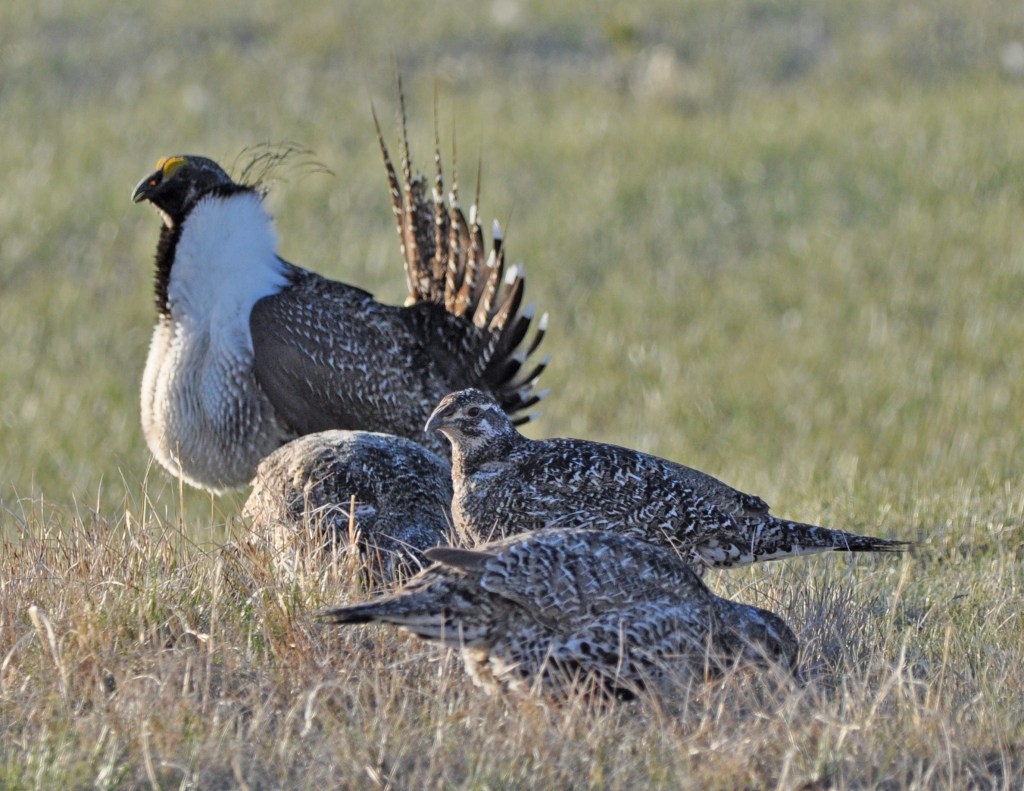
Male Greater Sage-Grouse are notably larger and more colorful than females. They have distinctive rounded tails, striking yellow air sacs on their chests, and a mix of grayish-brown plumage with intricate black and white markings. In contrast, females are smaller and exhibit more subdued coloration, primarily featuring mottled brown and tan feathers that provide effective camouflage against their sagebrush habitat.
Photo Credit. A greater sage-grouse male struts at a lek (Stafford/USFWS, 2010-a)
Status
***** Status References: WA State: WDFW North America: NatureServe Global: IUCN Red List *****
The greater sage-grouse is considered endangered in Washington (WDFW, n.d.). The Columbia Basin Distinct Population Segment, located in Washington, was considered a candidate for listing on the U.S. Endangered Species Act, but was not included since it does not meet the criteria for being a Distinct Population Segment (WDFW, n.d.). The main cause of population decline is habitat loss and fragmentation from established non-native invasive plants, altered wildfire cycles, and human development (U.S. Fish and Wildlife Service, n.d.). According to Cornell Lab, less than 5 percent of sagebrush habitat is more than 1.5 miles from a paved road, which impacts lek attendance (which is vital for the population reproducing) and population size (Cornell Lab of Ornithology, n.d.).
Conservation
According to the WDFW, both governmental and nongovernmental groups are attempting to conserve sage-grouse through land acquisition, habitat improvement, and conservation programs. Multiple groups have collaborated to translocate populations from other states to Washington in order to increase populations. Despite this, there are still serious concerns for the species and conservation must continue to evolve (WDFW, n.d.).
Nature Art
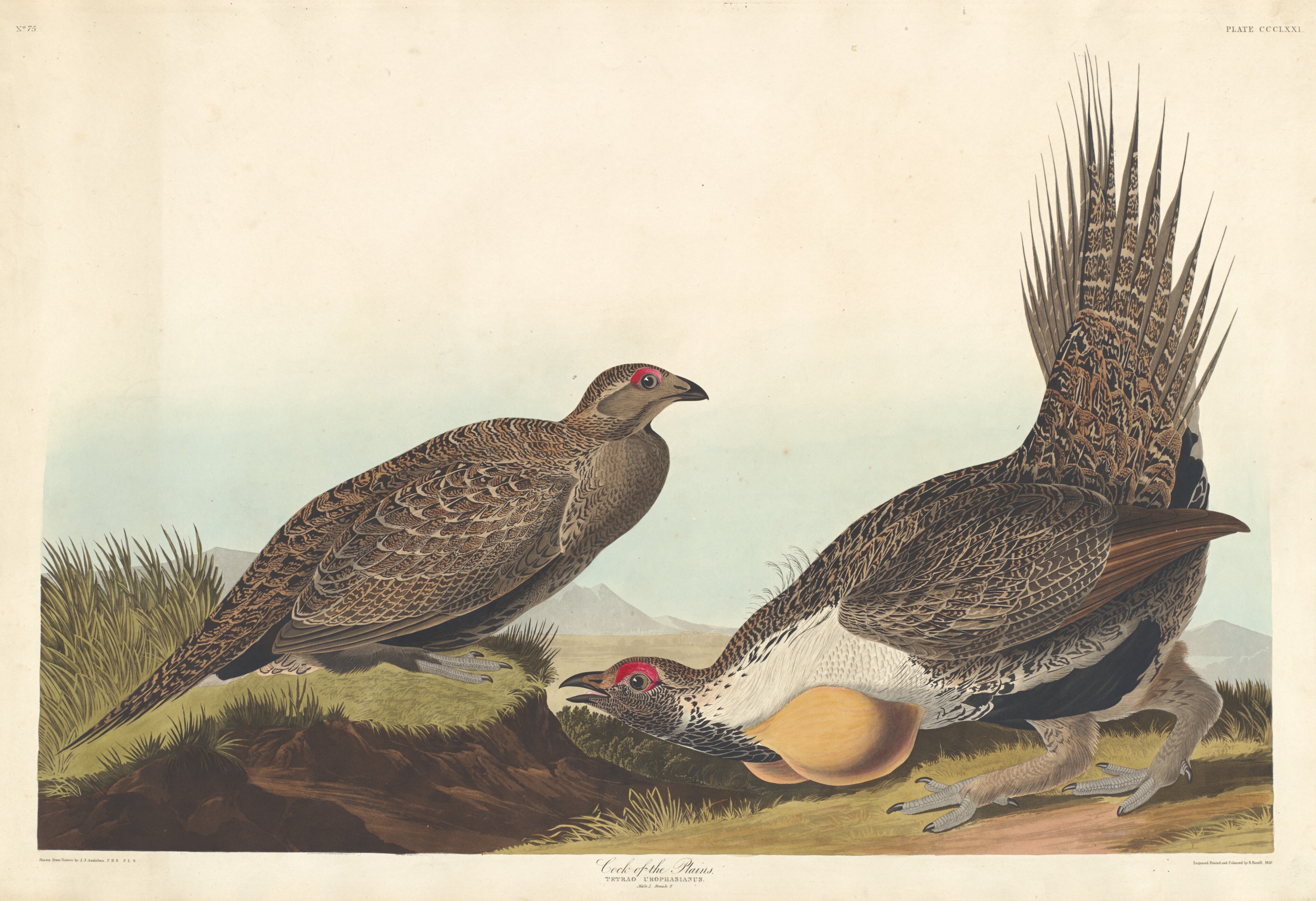
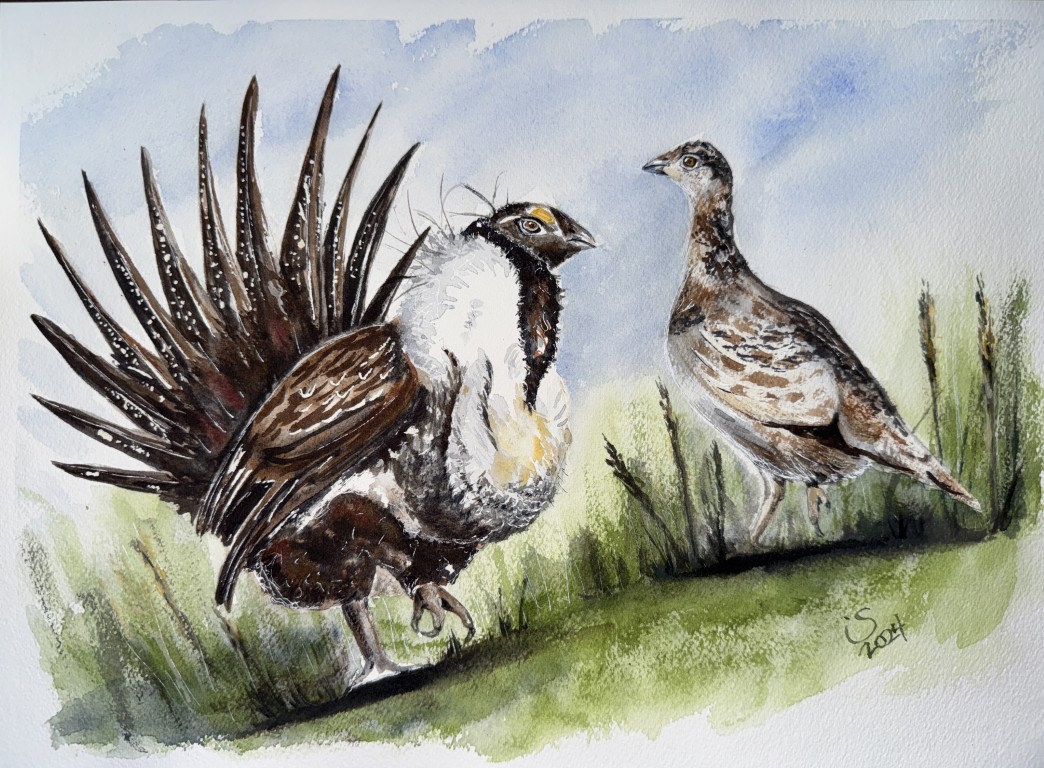
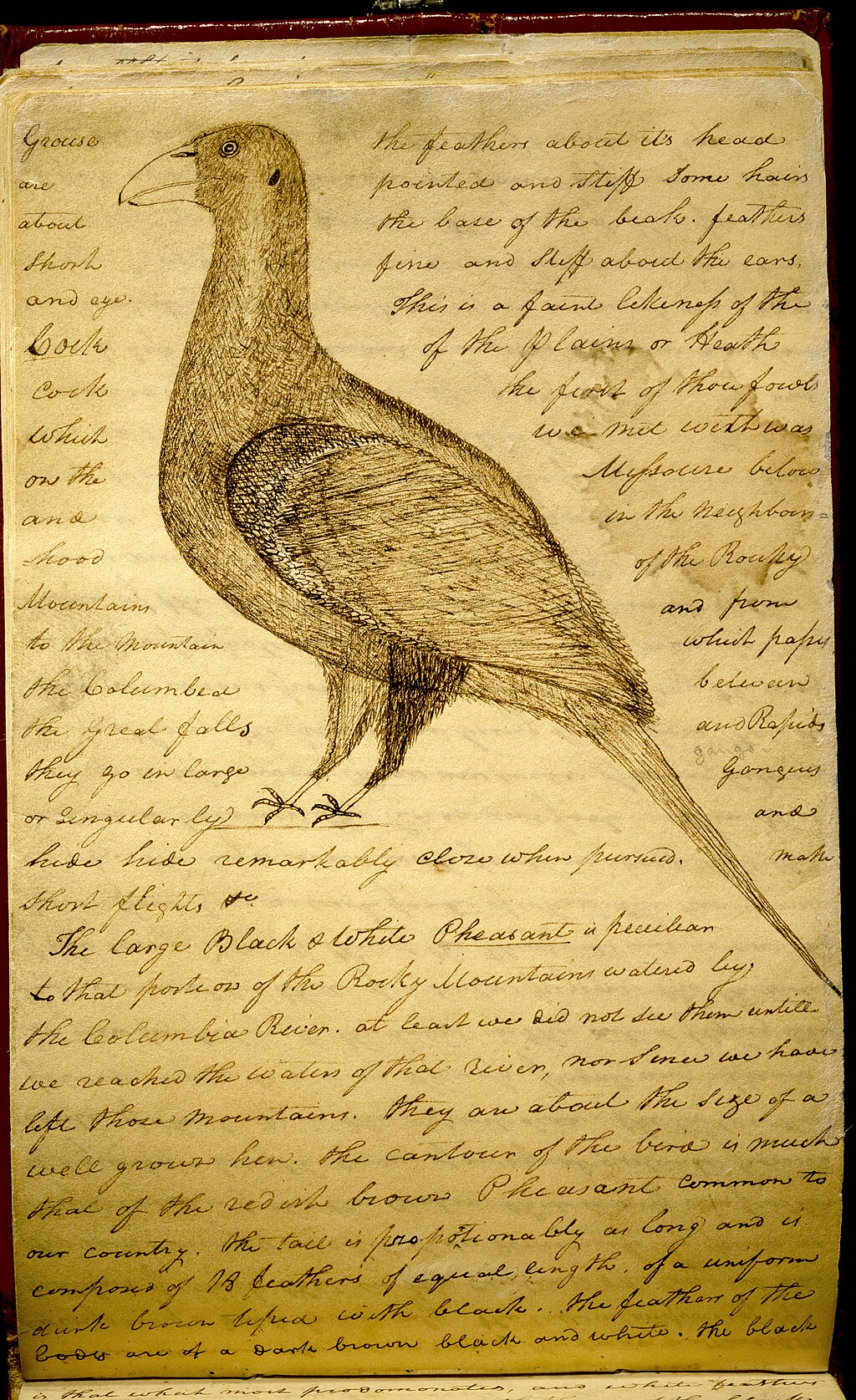
Audubon’s “Cock of the Plains” illustration, depicting the Greater Sage-Grouse, showcases the bird in a striking pose, with its large, spiked tail feathers fanned out and air sacs on its chest prominently inflated. Published in The Birds of America (Plate CCCLXXI), the meticulous detail captures the bird’s unique plumage and the rugged sagebrush habitat, highlighting both its grandeur and its connection to the Western plains. William Clark’s drawing and journal entry of the “Grouse” from March 2, 1806, depicts the bird’s distinctive features and provides detailed observations of its behavior, habitat, and abundance in the early 1800s. Clark’s documentation highlights the significance of the Sage Grouse in the natural history of the Lewis and Clark expedition. See more fascinating information about this historic bird here. Smith’s 2024 illustration depicts a male and female greater sage-grouse, showcasing the relative size of each.
Cover photo credit: Greater sage-grouse (Centrocercus urophasianus) with its gular sacs inflated to attract mates during courtship display (Wick, 2012)
References
Click here to view all of the references used for this post
Audubon, John James. (1837) The Birds of America, Plate CCCLXXI; Cock of the Plains
[photograph of colored engraving]. Public domain. Retrieved September , 28, 2024, from https://www.nga.gov/collection/art-object-page.32512.html
Clark, W. (1806). Grouse. [photograph of journal entry] from Clark Family Collection: Volume 2. Voorhis Journal No. 2, page 73, March 2, 1806. Public domain, via Wikimedia Commons. Retrieved February 23, 2025, from https://commons.wikimedia.org/wiki/File:Clark_Family_Collection-_Volume_2._Voorhis_Journal_No._2,_page_73,_March_2,_1806.jpg
Greater Sage Grouse (centrocercus urophasianus): U.S. Fish & Wildlife Service. FWS.gov. (n.d.). https://www.fws.gov/species/greater-sage-grouse-centrocercus-urophasianus
Greater sage-grouse identification, all about birds, Cornell Lab of Ornithology. All About Birds, Cornell Lab of Ornithology. (n.d.). https://www.allaboutbirds.org/guide/Greater_Sage-Grouse/id
Greater sage-grouse. Washington Department of Fish & Wildlife. (n.d.). https://wdfw.wa.gov/species-habitats/species/centrocercus-urophasianus
IUCN. (2016). Centrocercus urophasianus (Greater Sage-Grouse). The IUCN Red List of Threatened Species 2016: e.T22679503A92816586. Retrieved September 28, 2024, from https://www.iucnredlist.org/species/22679503/92816586
NatureServe. (2023). Centrocercus urophasianus (Greater Sage-Grouse). Retrieved September 28, 2024, from https://explorer.natureserve.org/Taxon/ELEMENT_GLOBAL.2.105314/Centrocercus_urophasianus
Sibley, D. (2003). The Sibley field guide to birds of Western North America. First edition. New York, Alfred A. Knopf.
Smith, I. (2024). Greater sage-grouse [photograph of painting]. Shared with permission.
Stafford/USFWS (2010-a). A greater sage-grouse male [Photograph]. Retrieved September 28, 2024, from https://commons.wikimedia.org/wiki/File:Greater_Sage-Grouse_(8694413616).jpg
Stafford/USFWS (2010-b). A greater sage-grouse male struts for a female [Photograph]. Retrieved September 28, 2024, from https://commons.wikimedia.org/wiki/File:Greater_Sage-Grouse_(8694413616).jpg
Wick, B/BLM. (2016). Greater sage-grouse (Centrocercus urophasianus) [Photograph]. Public Domain. Retrieved September 28, 2024, from https://commons.wikimedia.org/wiki/File:Greater_sage-grouse_(Centrocercus_urophasianus).jpg

 wild sprout

.jpg)
.jpg)
One Comment
Comments are closed.