
The Taylor’s checkerspot (Euphydryas editha taylori) is a butterfly endemic to the Pacific Northwest, and a subspecies of the Edith’s checkerspot. It inhabits prairies, grasslands, small forest openings, and coastal bluffs and dunes. The species depends heavily on native flowering plants from the broomrape family (Orobanchaceae) and the nonnative ribwort plantain (FWS, n.d.). These plants act as crucial hosts, offering both egg-laying sites and nourishment for the larvae, which feed on their leaves. Due to the fractured nature of the Taylor’s checkerspot population, each site and population has a specific host plant on which the females lay eggs (WDFW, n.d.).
“Nature is the source of all true knowledge.”
–Leonardo da Vinci
Status
***** Status References: WA State: WDFW North America: NatureServe Global: IUCN Red List *****
The Taylor’s checkerspot is considered endangered federally and in Washington state (WDFW, n.d.). According to the U.S. Fish and Wildlife Service, Taylor’s checkerspot was historically documented at more than 70 sites between British Columbia and Oregon (FWS, n.d.), spanning from Vancouver Island, British Columbia, through Western Washington, and to the Willamette Valley in Oregon. Historically, there were 45 sites in Washington (WDFW, n.d.). When the species was listed as endangered in 2013, there was 11 populations in Washington (FWS, n.d.) and more recently, 8 populations where documented in Washington. No additional populations have been found since 2009 (WDFW, n.d.).
There are various forms of habitat loss, including the displacement of native grassland species by invasive plants, an increase in trees and shrubs due to fire suppression, and the impacts of military training on populations (WDFW, n.d.).
Conservation
Conservation initiatives for Taylor’s Checkerspot include habitat restoration and captive breeding programs. Habitat restoration, focusing on prairies and grasslands, are vital to the butterfly’s lifecycle. The Washington Department of Fish and Wildlife has partnered with various organizations to reintroduce native plants, control invasive species, and manage habitat to promote butterfly population growth (WDFW, n.d.). Captive breeding programs and subsequent reintroduction of Taylor’s Checkerspot into restored habitats are also part of these efforts. One notable conservation project of the WDFW is the Sustainability in Prisons Project, founded by The Evergreen State College and the Washington State Department of Corrections. The program rears, breeds, and releases Taylor’s checkerspot butterflies, and has released around 20,000 individuals since 2011 (Sustainability in Prisons Project, n.d.).
Description
The Taylor’s checkerspot is a strikingly patterned butterfly with a wingspan of about 1.5 to 2 inches. Its wings are predominantly orange, black, and white, with a distinct checkerboard pattern.
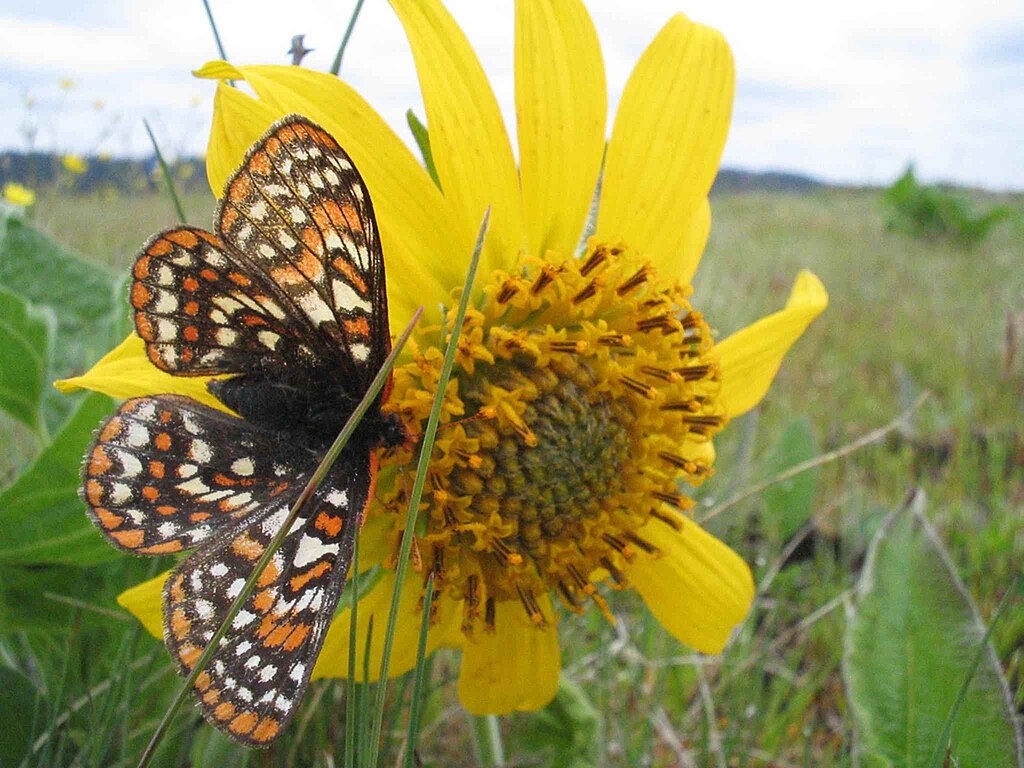
The forewings are marked with bright orange bands and smaller white spots against a black background, while the hindwings display a similar pattern but with more orange.
The body of the butterfly is dark, and its antennae are long and clubbed, typical of butterflies. This bold coloration serves as a warning to predators, as the Taylor’s checkerspot is toxic to many would-be attackers.
Lifecycle
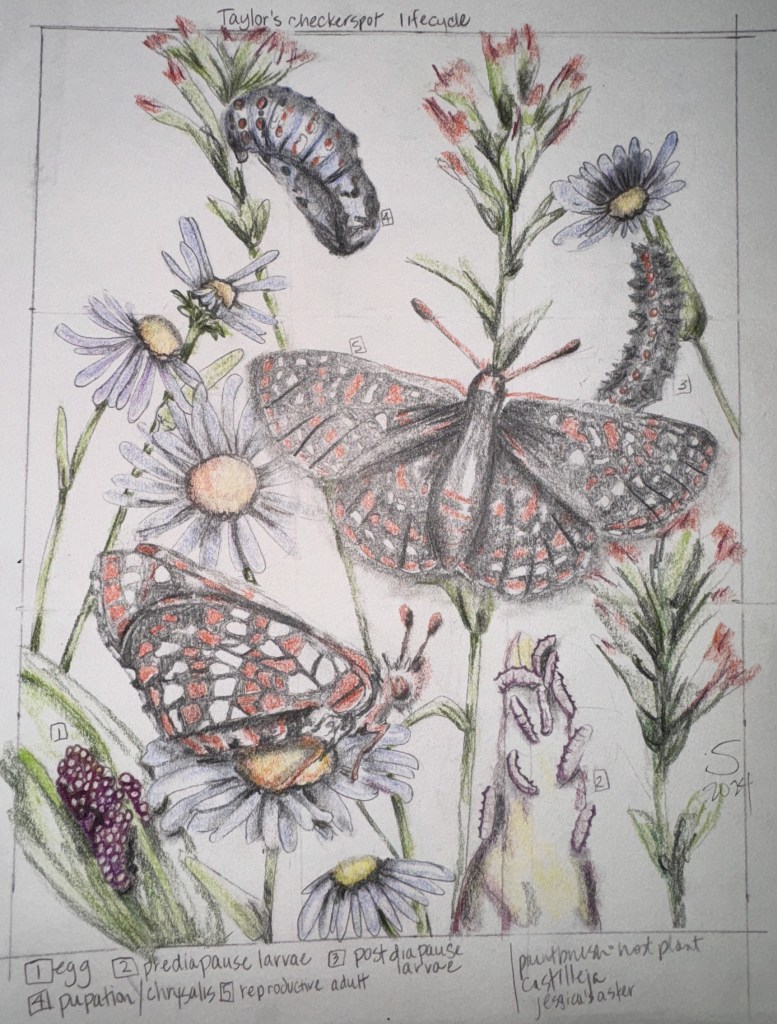
The lifecycle of Taylor’s Checkerspot begins with the laying of eggs by adult females, typically on the leaves of specific host plants, such as English plantain (Plantago lanceolata) and harsh paintbrush (Castilleja hispida). After about a week, the eggs hatch into larvae (caterpillars), which go through several growth stages called instars. The larvae feed on the host plants for a few weeks before entering diapause (a form of hibernation) during the winter months. In early spring, the larvae emerge from diapause and continue feeding, eventually pupating into a chrysalis. After a few weeks, adult butterflies emerge from the chrysalis. The adult stage of Taylor’s Checkerspot is short-lived, lasting only a few weeks, during which time they focus on mating and laying eggs to begin the cycle again. The butterfly is univoltine, meaning it completes one generation per year (WDFW, n.d.).
Photo credit: Taylor’s checkerspot on yellowish flower (Barna, 2013)
Nature Art
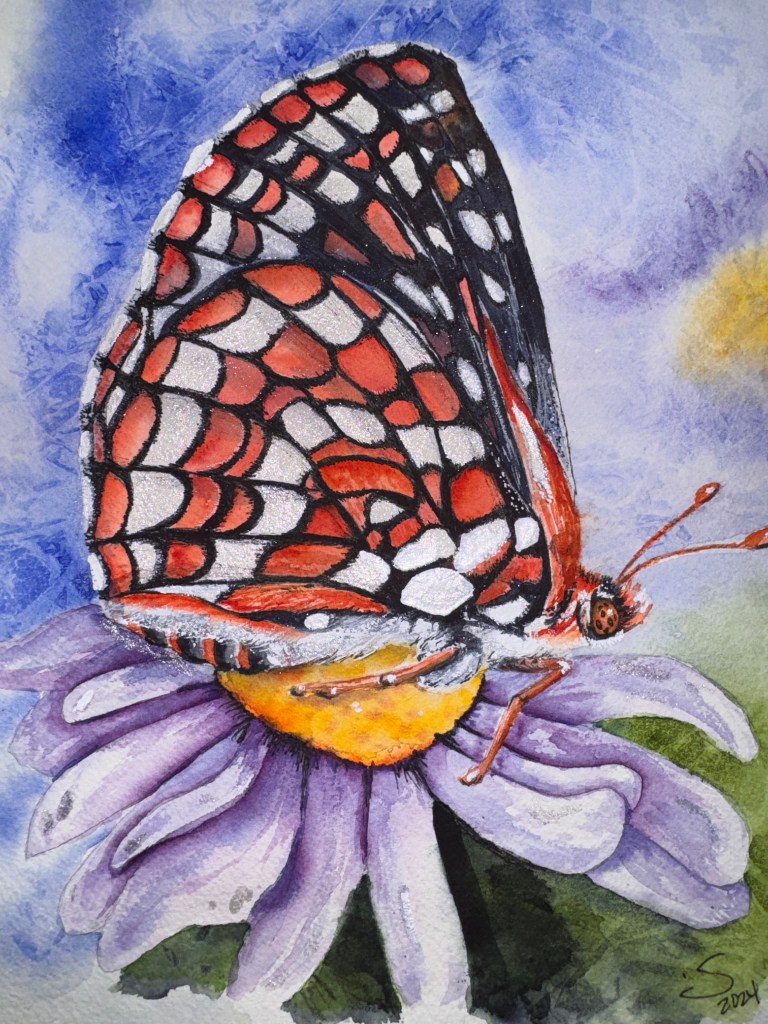
Smith depicts a Taylor’s checkerspot resting on an aster, with closeup view of the intricate black-orange-white pattern of this endangered invertebrate. Smith’s field journal showcases the Taylor’s checkerspot lifecycle with native plants, including the very important fireweed. No other historical illustrations have been found in public domain.
Cover photo credit: Checkerspot (Trail, P., 2019)
References
Click here for full reference list
Barna, A. / U.S. Fish and Wildlife Service (2013). Taylor’s checkerspot butterfly on yellowish flower [photograph]. Public domain, via Wikimedia Commons. Retrieved September 3, 2024, from https://commons.wikimedia.org/wiki/File:Taylor_checkerspot_butterfly_on_yellowish_flower_euphydryas_editha_taylori.jpg
Smith, I. (2024). Taylor’s checkerspot [photograph of painting]. Shared with permission.
Smith, I. (2024). Taylor’s checkerspot lifecycle [photograph of sketch]. Shared with permission
Sustainability in Prisons Project. (n.d.). Taylor’s checkerspot butterfly program. https://sustainabilityinprisons.org/spp-programs-in-wa/conservation/taylors-checkerspot-butterfly-program-2/
Trail, P. (2019). Checkerspot [photograph]. Content License. Retrieved February 25, 2024, from https://pixabay.com/photos/butterfly-checkerspot-flower-4669283/
U.S. Fish and Wildlife Service. (n.d.). Taylor’s checkerspot (Euphydryas editha taylori). https://www.fws.gov/species/taylors-checkerspot-euphydryas-editha-taylori
Washington Department of Fish & Wildlife (WDFW, n.d.). Taylor’s checkerspot (Euphydryas editha taylori). Washington Department of Fish & Wildlife. https://wdfw.wa.gov/species-habitats/species/euphydryas-editha-taylori#desc-range

 wild sprout

You must be logged in to post a comment.