
The woodland caribou (Rangifer tarandus) is one of four subspecies of caribou living within North America, and it has the southernmost range (Washington Department of Fish and Wildlife, n.d.). When discussing the woodland caribou and conservation, smaller sections of the population are talked about. The woodland caribou subspecies can be organized into populations, and those populations can be organized into subpopulations, also known as herds. While the majority of woodland caribou are in Canada, there are populations of woodland caribou that live in the contiguous United States. One such population of woodland caribou, the southern mountains caribou, live partly in northeastern Washington and northern Idaho, as well as migrating occasionally into Montana. Southern mountain caribou live in steep mountainous regions that have deep winter snowpack and arboreal lichens. The southern mountain caribou’s dependence on these arboreal lichens instead of lichens on the ground makes them distinct from other caribou populations (U.S. Fish and Wildlife Service, n.d.-b). A notable now extirpated herd of southern mountain caribou, the South Selkirk herd, lived on the southern Selkirk Mountains in Canada and the United States (U.S. Fish and Wildlife Service, n.d.-a).
“The clearest way into the Universe is through a forest wilderness”
-JOHN MUIR
Description
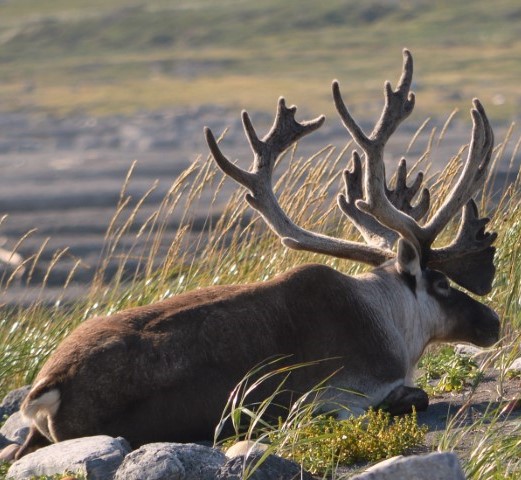
The woodland caribou is a sturdy, medium-to-large ungulate with a thick coat of brown fur, lighter underbelly, and distinctive white neck and rump patches. Both males and females have broad, sweeping antlers, though the males’ are typically larger and more complex.
| Male (bulls) | Female (cows) | |
|---|---|---|
| Height at shoulders | 49-47 in (100-120 cm) | 35-43 in (90-110 cm) |
| Weight | 330-600 lbs (150-275 kg) | 180-330 lbs (80-150 kg) |
| Shed horns | November – April | May – June |
Status
***** Status References: WA State: WDFW North America: NatureServe Global: IUCN Red List *****
The southern mountains caribou are federally endangered, and within Washington the South Selkirk herd are considered endangered and extirpated as of 2019 due to relocation. It was estimated there was a population of 1,544 animals during 2008 to 2014, and of the 17 subpopulations (herds) within the southern mountains population, nine herds have less than 50 individuals and three have been extirpated.
Threats
The main causes for decline are predation, logging, and roads. Predation was the largest direct cause, as logging created more habitat for species like deer, but also attracted more predators such as wolves and bears as a result. Woodland caribou are also classified as highly sensitive to climate change due to their reliance on deep snow and old growth forests with arboreal lichen. (Washington Department of Fish and Wildlife, n.d.)
Conservation
According to the U.S. Fish and Wildlife Service, the South Selkirk Caribou Management Plan was finalized in February 2019, and highlights a need for collaboration with Canada on development and implementation of a recovery plan. The sole member of the South Selkirk herd was relocated to the Columbia North subpopulation. (U.S. Fish and Wildlife Service, n.d.-a). Woodland caribou are also protected federally in Canada under the Species at Risk Act and the Canada National Parks Act (Nature Canada, n.d.).
Nature Art
Audubon’s “Tarandus furcifer, Caribou, or American Rein Deer” depicts two male caribou in contrasting seasonal pelages. The first caribou, shown in its summer coat, features a sleeker, darker fur with a more streamlined appearance. The second caribou, in winter pelage, displays a thicker, lighter-colored coat, illustrating the animal’s adaptation to colder temperatures. Both animals are portrayed with intricate detail, showcasing their broad antlers and sturdy build, set against a naturalistic landscape that reflects Audubon’s keen eye for both scientific accuracy and artistic beauty. Smith’s “Caribou Portrait” depicts a male caribou showcasing soft antlers and amber colored eyes.
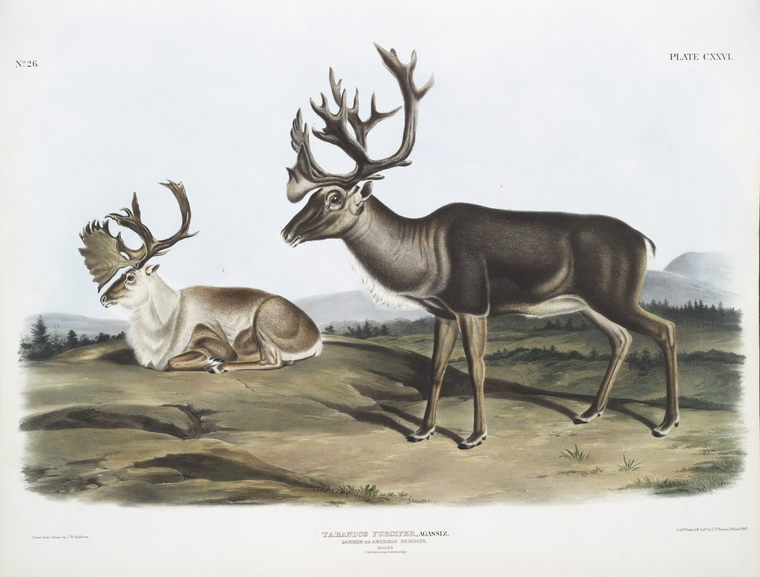
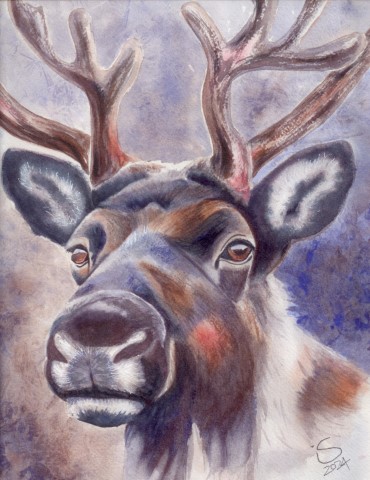
Cover page photo credit: Woodland caribou in the Southern Selkirk Mountains of Idaho (Forest, 2007)
References
Click to see the amazing references that were used to created this post
Forrest, F (2007). Woodland caribou in the Southern Selkirk Mountains of Idaho [photograph]. CC BY 2.0. Retrived July 22, 2024, from https://commons.wikimedia.org/wiki/File:Woodland_Caribou_Southern_Selkirk_Mountains_of_Idaho_2007.jpg
Hodnett, R. (2019). Caribou (Rangifer tarandus) in Port au Choix, Newfoundland and Labrador, Canada [photograph]. CC BY-SA 4.0. Retrieved July 22, 2024, from https://commons.wikimedia.org/wiki/File:Caribou_%28Rangifer_tarandus%29_-_Port_au_Choix,_Newfoundland_2019-08-19_%2816%29.jpg
IUCN. (n.d.). Reindeer. The IUCN Red List of Threatened Species 2020: e.T22689089A180937862. Retrieved July 19, 2024, from https://www.iucnredlist.org/species/29742/22167140
NatureServe Explorer. (n.d.). Rangifer tarandus. Retrieved July 19, 2024, from https://explorer.natureserve.org/Taxon/ELEMENT_GLOBAL.2.103369/Rangifer_tarandus
Rare Book Division, The New York Public Library. (1845 – 1848). Tarandus furcifer, Caribou, or American Rein Deer. Males. 1. Summer pelage, 2. Winter pelage. [photograph of Audubon illustration]. Retrieved September 4, 2024, from https://digitalcollections.nypl.org/items/510d47da-7881-a3d9-e040-e00a18064a99
Saving the “gray ghosts”: U.S. Fish & Wildlife Service. FWS.gov. (n.d.-a). https://www.fws.gov/story/saving-gray-ghosts
Smith, I. (2024). Greater sage-grouse [photograph of painting]. Shared with permission.
Woodland Caribou. Washington Department of Fish & Wildlife. (n.d.). https://wdfw.wa.gov/species-habitats/species/rangifer-tarandus
Woodland Caribou. Nature Canada. (2022, August 3). https://naturecanada.ca/discover-nature/endangered-species/woodland-caribou/
Woodland Caribou (Rangifer tarandus caribou): U.S. Fish & Wildlife Service. FWS.gov. (n.d.-b). https://www.fws.gov/species/woodland-caribou-rangifer-tarandus-caribou

 wild sprout


You must be logged in to post a comment.