
The gray wolf (Canis lupus) is a species that was once common throughout Washington. They live in packs of around five-10 animals, that hunt, travel, and rear pups together. They can live in a variety of habitats as long as there is enough prey for them to hunt, though do best in remote areas far from humans. Gray wolves tend to hunt mainly on younger, older, or debilitated animals. According to the Washington Department of Fish and Wildlife (WDFW), there are theories that the presence of wolves influences prey behavior of other species, this impacting the whole ecosystem. Wolves also help prevent overpopulation of prey, helping maintain plant and other wildlife populations (WDFW, n.d.-b).
“The earth has music for those who listen.”
-WILLIAM SHAKESPEARE
Description
Gray wolves are large, powerful carnivores with thick, dense fur that ranges in color from gray to brown, black, or white. They have long legs, bushy tails, and sharp, pointed ears, with strong jaws built for hunting and tearing meat.
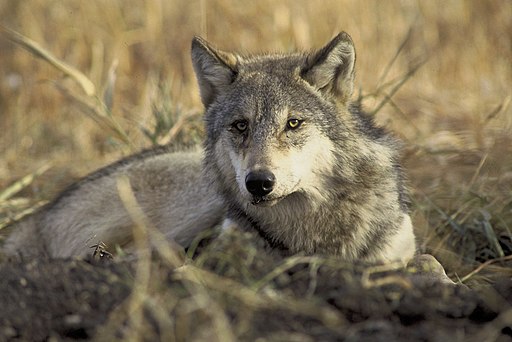
| Male | Female | |
|---|---|---|
| Height at shoulders | 26-36 in | 26-32 in |
| Weight | 100-130 lbs | 80-110 lbs |
Status
***** Status References: WA State: WDFW North America: NatureServe Global: IUCN Red List *****
Gray wolves are considered endangered in Washington, and federally. They were historically trapped, poisoned, and hunted between 1850-1900, and were considered eradicated from Washington by the 1930s (WDFW, n.d.-b).
Threats
In the northern Rocky Mountains, humans are the cause of most wolf deaths, through vehicle collisions, illegal killings, or legal harvest and management removals (WDFW, n.d.-b).
Conservation
The reintroduction of gray wolves into Washington was not due to federal or state actions– instead, wolf populations dispersed on their own from surrounding states and Canada. In 2022, gray wolves were federally delisted in eastern Washington, but are still considered federally endangered in western Washington. In July 2008, wolves were documented and confirmed to be breeding in Washington. Since then, according to WDFW, the wolf population has increased 28% every year within the state (WDFW, n.d.-b). At the end of 2023, there were 260 wolves, organized into 42 packs (Demkovich, L., 2024). The Washington Department of Fish and Wildlife has a conservation and management plan for eastern Washington that focuses on recovering gray wolf populations while minimizing livestock loss from gray wolves (WDFW, n.d.-a).
Nature Art
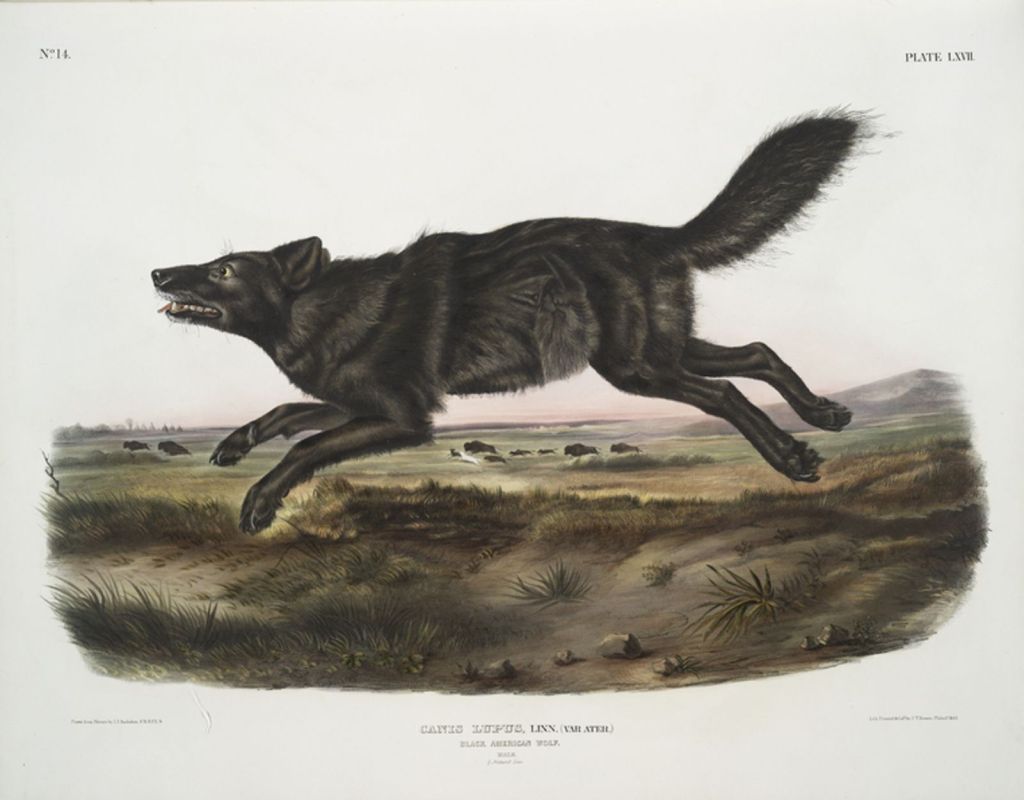
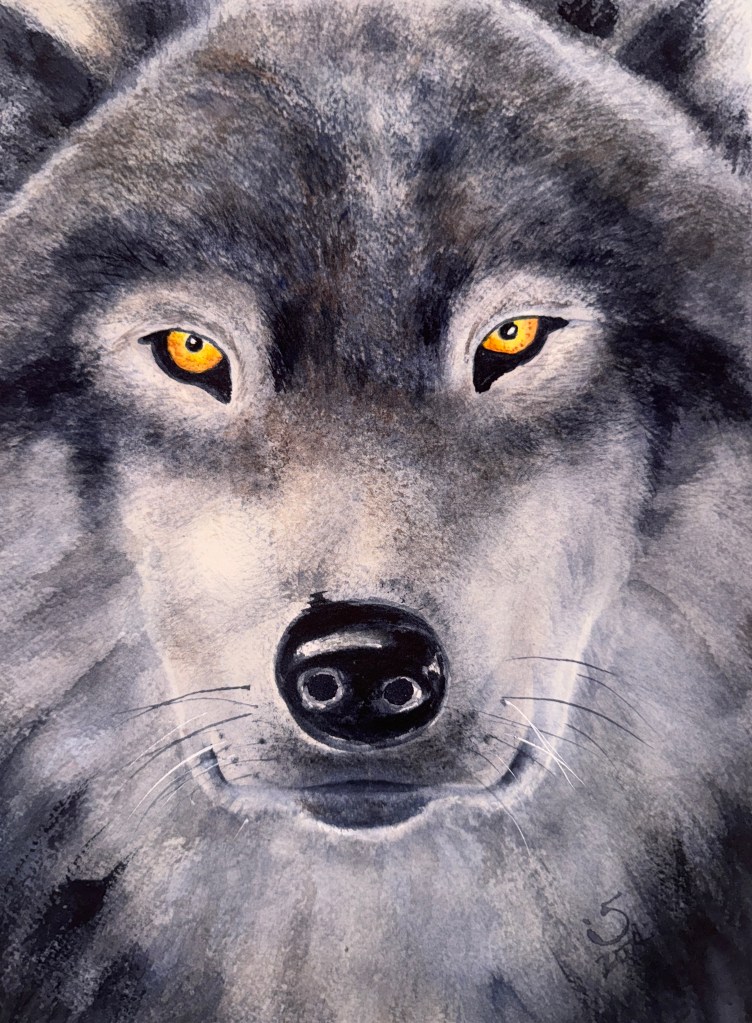
Audubon’s painting, “Black American Wolf,” depicts a black wolf running across an open field with its legs stretched out and tail raised. The hand-colored lithograph captures the dynamic movement and wild essence of the wolf. Smith’s “Gray wolf portrait” is a macro view of the animal’s face, showcasing the colors of rich black, highlighted with subtle blue-grays and tan-taupe hues.
Cover page photo credit: Gray wolf at Omega Park, Quebec (de Tilly, 2015)
References
Click to see the references that were used to created this post
Audubon, John James / Rare Book Division, The New York Public Library. (1845 – 1848). Canis lupus, Black American Wolf. Male. 1/3 Natural size. [photograph of Audubon illustration]. Retrieved September 4, 2024, from https://digitalcollections.nypl.org/items/510d47da-7835-a3d9-e040-e00a18064a99
Demkovich, L. (2024, April 24). Latest count finds Washington’s wolf population is increasing • Washington State Standard. Washington State Standard. https://washingtonstatestandard.com/2024/04/22/latest-count-finds-washingtons-wolf-population-is-increasing/
de Tilly, B. (2015). Gray wolf at Omega park, Quebec. [photograph]. CC BY-SA 4.0 https://creativecommons.org/licenses/by-sa/4.0, via Wikimedia Commons. Retrieved September 4, 2024, from https://commons.wikimedia.org/wiki/File:Grey_wolf.jpg
Gray Wolf Conservation and Management Plan. Washington Department of Fish & Wildlife. (n.d.-a). https://wdfw.wa.gov/species-habitats/at-risk/species-recovery/gray-wolf/management-plan
Gray Wolf. Washington Department of Fish & Wildlife. (n.d.-b). https://wdfw.wa.gov/species-habitats/species/canis-lupus
Hollingsworth, J & K/USFWS Endangered Species. Gray wolf. [photograph]. CC BY 2.0 https://creativecommons.org/licenses/by/2.0, via Wikimedia Commons. Retrieved September 5, 2024, from https://commons.wikimedia.org/wiki/File:Endangered_gray_wolf_%28Canis_lupus%29.jpg
International Union for Conservation of Nature. (2022). Canis lupus (errata version published in 2021). The IUCN Red List of Threatened Species 2022: e.T3746A247624660. Retrieved September 4, 2024, from https://www.iucnredlist.org/species/3746/247624660
NatureServe. (2023). Canis lupus. NatureServe Explorer. Retrieved September 4, 2024, from https://explorer.natureserve.org/Taxon/ELEMENT_GLOBAL.2.105212/Canis_lupus
Smith, I. (2024). Gray wolf portrait. [photograph of painting]. With permission. Retrieved October 3, 2024, from https://ingajsmith.com/2024/09/18/gray-wolf/

 wild sprout


You must be logged in to post a comment.