
Jessica’s aster (Symphyotrichum jessicae) is a native perennial that grows in eastern Washington, commonly found near streambanks (Giblin, D.E. & B.S. Legler, 2003+). Their native habitat includes grasslands and transition zones between forest and prairies, though they have a small range with few populations. They flower in late July to mid September (Washington Department of Natural Resources, n.d.) and they are pollinated by bees, flies, and butterflies (Giblin, D.E. & B.S. Legler, 2003+).
“If we save our wild places, we will ultimately save ourselves.”
– Steve Irwin
Description
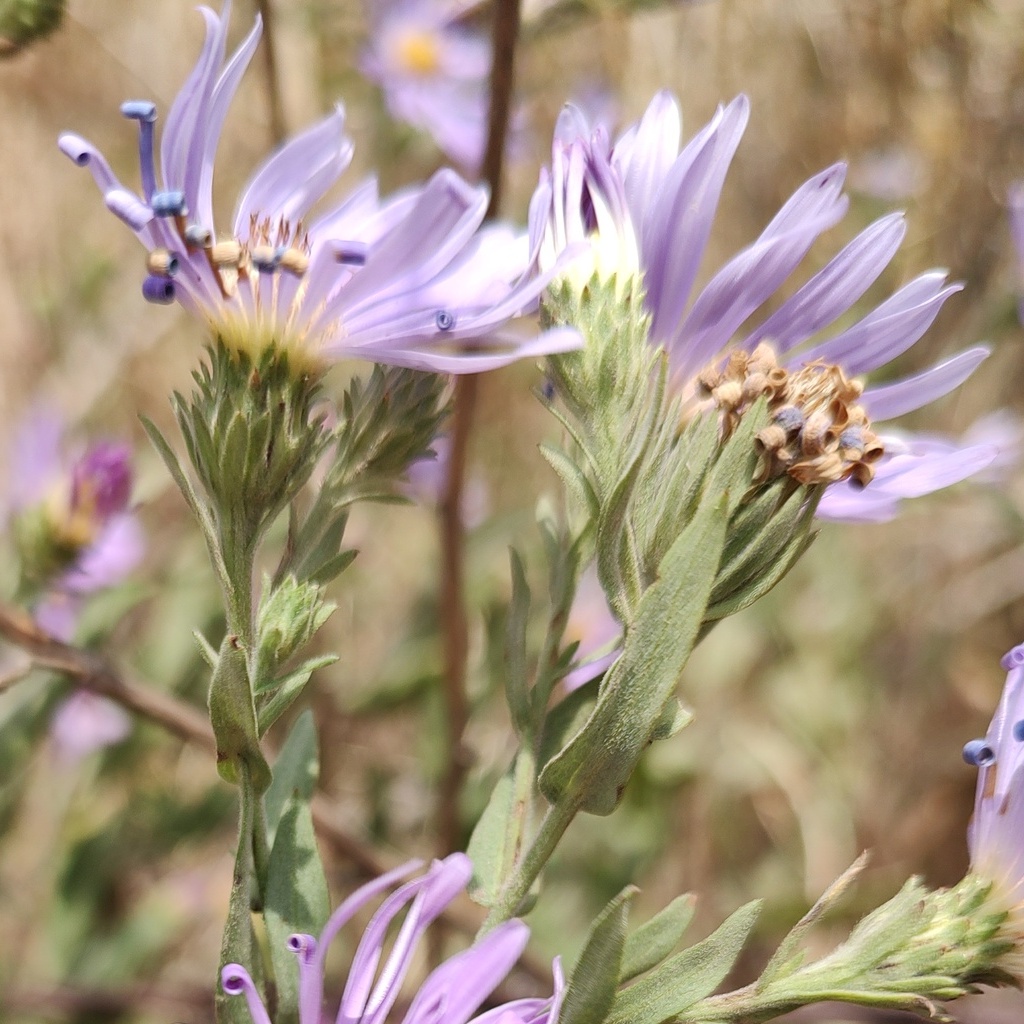
Jessica’s aster is a composite flower, comprised of numerous yellow disk flowers in the center, surrounded by 18-30 bluish ray flowers. The flowers are organized in a panicle, with many branches that separate into multiple flowers. The leaves have a petiole (or a stalk attaching the leaf to the stem), and range from being lanceolate (pointed at both ends) or ovate (egg shaped, wider near the stem). The plant is largely pubescent, or covered in small hairs. (Giblin, D.E. & B.S. Legler, 2003+).
Floral: panicle with many heads clustered at top
Leaves: mid-step leaves sessile, auriculate lance-shaped
Stems: 9 dm tall (average) and up to 15 dm tall
Root: thick creeping rhizomes
source: Washington State Department of Natural Resources, n.d.
Photo credit: Jessica’s Aster (Fertig, 2023-a)
Status
State
Critically Imperiled
🔶
North America
Imperiled
🔶
Global
NOT LISTED
⚪
***** Status References: WA State: WA-DNR North America: NatureServe Global: IUCN Red List *****
Jessica’s aster is endangered in Washington and federally imperiled (NatureServe Explorer, n.d.). Their habitat is limited, with the majority of their possible habitat converted for agriculture. Jessica’s aster is threatened by domestic grazing, exotic weeds, and direct human actions like chemical sprays and road construction (Washington DNR, n.d.).
Conservation
Conservation efforts for Jessica’s aster in Washington focus on habitat preservation and restoration, as the species is primarily found in wetland and riparian areas that are increasingly threatened by development, agriculture, and invasive species. The Washington Department of Natural Resources, is working to monitor existing populations, protect critical habitats, and reduce the impact of human activities. Public awareness and collaboration with landowners are also key components of these conservation strategies (Semple, 2021).
🐝Aster’s have a long growing season, even in Western Washington. In early fall, you can find honey bees foraging on these beautiful flowers. While most garden centers do not specify the aster’s subspecies, adding a hardy aster or two can improve pollination in your yard and help the bees prepare for our long winters. For more information about optimizing your yard for pollinators here in Washington, please check out this article.
Nature Art
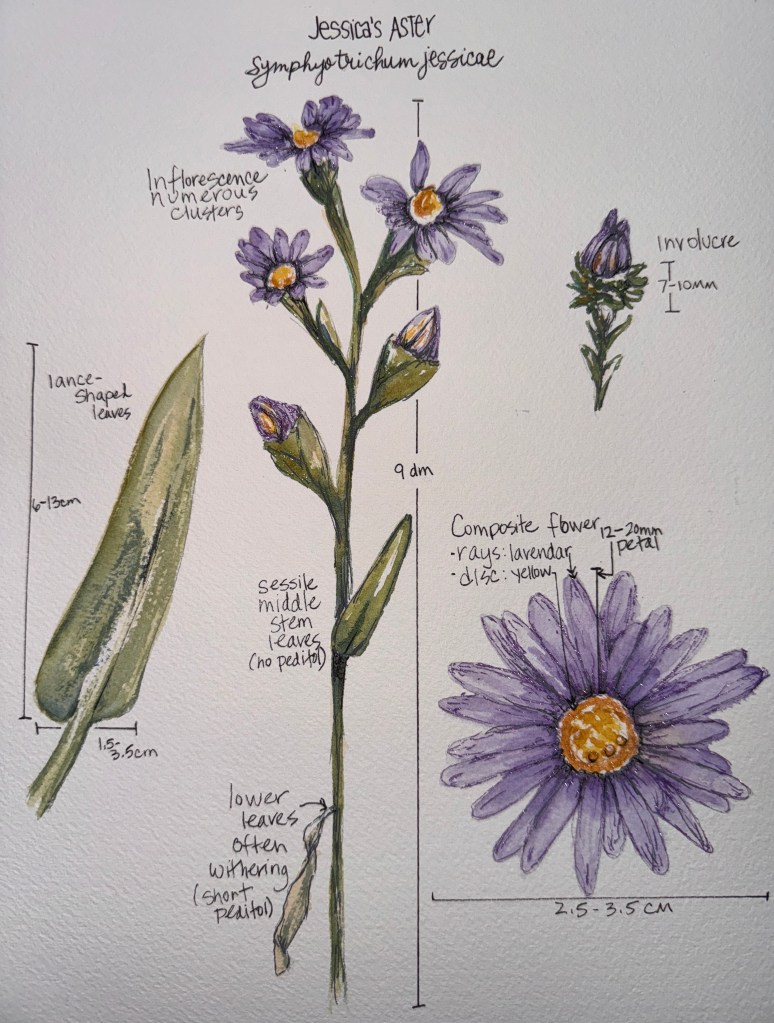
Cover art credit: Jessica’s Aster (Symphyotrichum jessicae)-b (Fertig, 2023)
References
Click here to view the references used for this post
Fertig, W. (2023-a). Jessica’s Aster (Symphyotrichum jessicae) [photograph]. CC0, via Wikimedia Commons. Retrieved July 21, 2024, from https://commons.wikimedia.org/wiki/File:Symphyotrichum_jessicae_315092177_(cropped).jpg
Fertig, W. (2023-b). Jessica’s Aster (Symphyotrichum jessicae) [photograph]. CC0, via Wikimedia Commons. Retrieved July 21, 2024, from https://commons.wikimedia.org/wiki/File:Symphyotrichum_jessicae_315091886.jpg
Giblin, D.E. & B.S. Legler (eds.). 2003+. Symphyotrichum jessicae. In: WTU Image Collection Web Site: Vascular Plants, MacroFungi, & Lichenized Fungi of Washington State. University of Washington Herbarium. Retrieved September 8, 2024, from https://burkeherbarium.org/imagecollection/
NatureServe Explorer. (n.d.). Symphyotrichum jessicae. NatureServe. Retrieved July 21, 2024, from https://explorer.natureserve.org/Taxon/ELEMENT_GLOBAL.2.137134/Symphyotrichum_jessicae
Semple, J. C. (2021). Symphyotrichum jessicae. Astereae Lab, University of Waterloo. Retrieved September 13, 2024, from https://uwaterloo.ca/astereae-lab/research/asters/symphyotrichum/symphyotrichum-subsect-occidentales/symphyotrichum-jessicae
Smith, I. (2024). Jessica’s Aster Botanical Illustration. [photograph of painting]. With permission.
Washington State Department of Natural Resources. (n.d.). Symphyotrichum Jessicae. Retrieved September 8, 2024, from https://www.dnr.wa.gov/publications/amp_nh_syje.pdf
Washington State Department of Natural Resources. (n.d.-a). Natural Heritage Program field guide. Retrieved July 21, 2024, from https://www.dnr.wa.gov/NHPfieldguide

 wild sprout
.jpg)

You must be logged in to post a comment.