
Streaked horned larks (Eremophila alpestris strigata) are a subspecies of the horned lark, a widespread North American songbird. This subspecies is native to the Pacific Northwest and can be found in large fields where they forage for seeds and grass and build their nests on the ground (Washington Department of Fish and Wildlife, n.d.; Cornell Lab of Ornithology, n.d.). Its preference for ground-dwelling habitats, combined with habitat loss and fragmentation, has led to its designation as a threatened species, making conservation efforts critical for its survival.
“If you truly love nature, you will find beauty everywhere.”
–Vincent van Gogh
Description
Characterized by its striking plumage, the small streaked horned lark features a blend of brown, black, and white feathers, with prominent black “horns” of feathers that give the bird its name. It has a white or pale yellow face with a black mask and bib, and streaked brown upperparts with a white or buffy underbelly. Females are slightly smaller than males, with less pronounced markings.
The streaked horned lark is also noted for its melodic song, which males use to establish territories and attract mates during the breeding season.
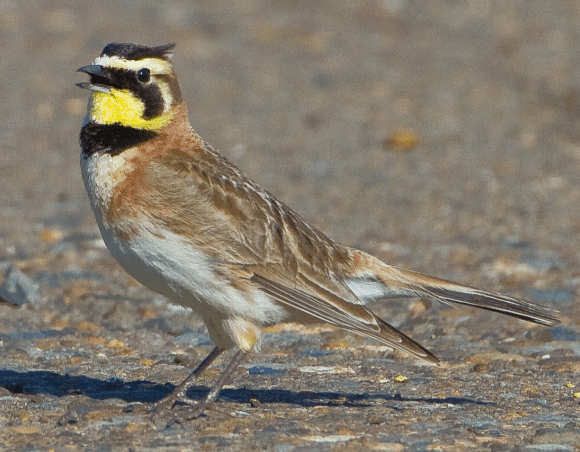
Streaked Horned Lark
Length: 6-8″
Wingspan: 9-11 “
Weight: 1-1.5 oz
Photo credit: Streaked-horned-lark(female) (Leonard, D., 2022)
Status
***** Status References: WA State: WDFW North America: NatureServe Global: IUCN Red List *****
Horned larks are considered Least Concern according to the International Union for Conservation of Nature’s Red List of Threatened Species (Audubon, n.d.) despite a 64% population decrease between 1966 to 2019 (Cornell Lab of Ornithology, n.d.). In contrast, the streaked horned lark subspecies are endangered in Washington and threatened federally. According to the Washington Department of Fish and Wildlife, as of 2022, it is estimated that there are 1,170-1,610 individuals, rangewise, in Washington and Oregon (see map below). They are considered extirpated within British Columbia and are becoming very rare within Washington. Their main cause of decline is loss of habitat and nesting site disturbance (WDFW, n.d.).
Range
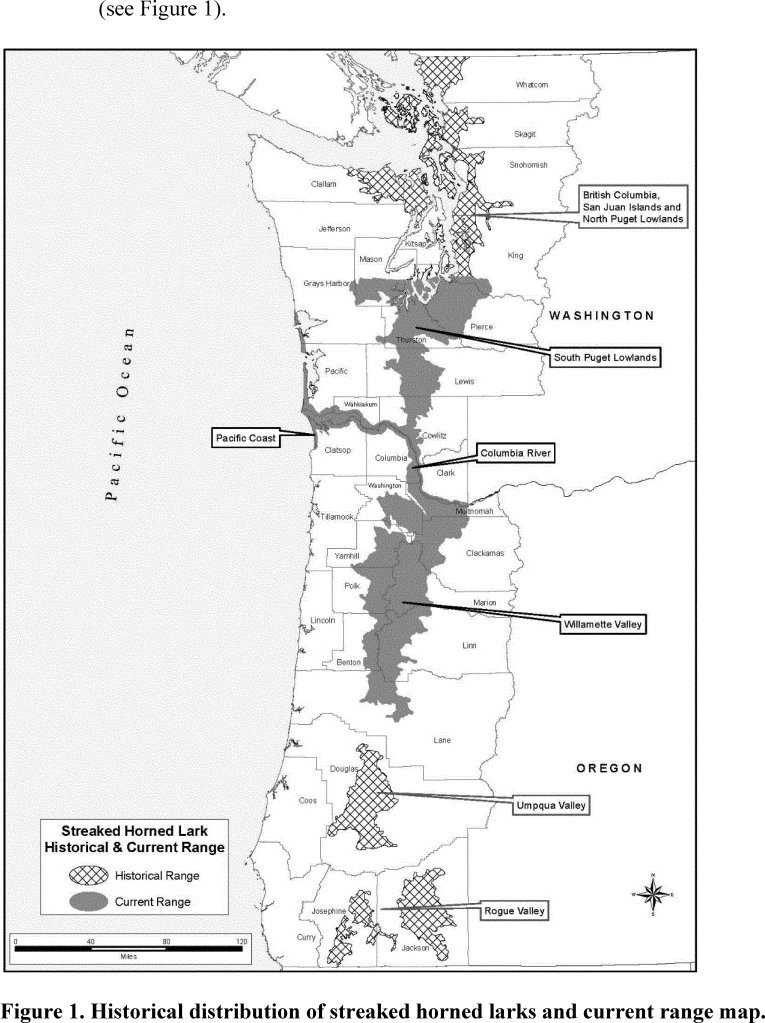
The streaked horned lark lives in southwestern Washington and western Oregon, preferring sparsely vegetated or bare habitats, such as prairies and fields. Within Washington, they are found in grasslands south of the Puget Sound, as well as coastal beaches and shorelines near the Columbia River. They also nest on airfields, notably on Joint Base Lewis McCord (WDFW, n.d.).
Range map credit: Fish and Wildlife Service (2022). Endangered and threatened wildlife and plants; species status for streaked horned lark with section 4(d) rule
Conservation
Washington’s conservation efforts for the streaked-horned lark focus on habitat restoration and management, including the creation of suitable nesting areas and the control of invasive species. Some steps have also been taken by Joint Base Lewis-McChord to monitor nests to minimize disturbances, which improved lark reproductive success in 2014-2015 (WDFW, n.d.). In general, these efforts aim to stabilize and increase the population of this threatened bird by ensuring it has the necessary environments to thrive.
To help Washington’s researchers, please share observations using the WDFW wildlife reporting form.
Nature Art
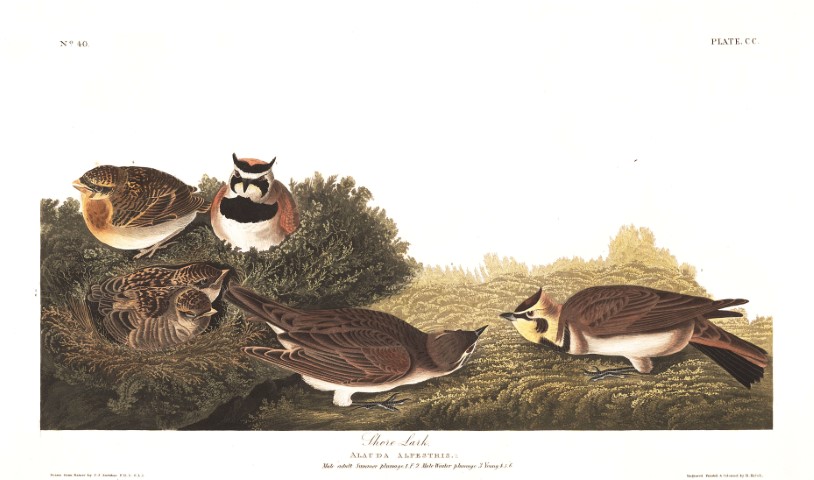
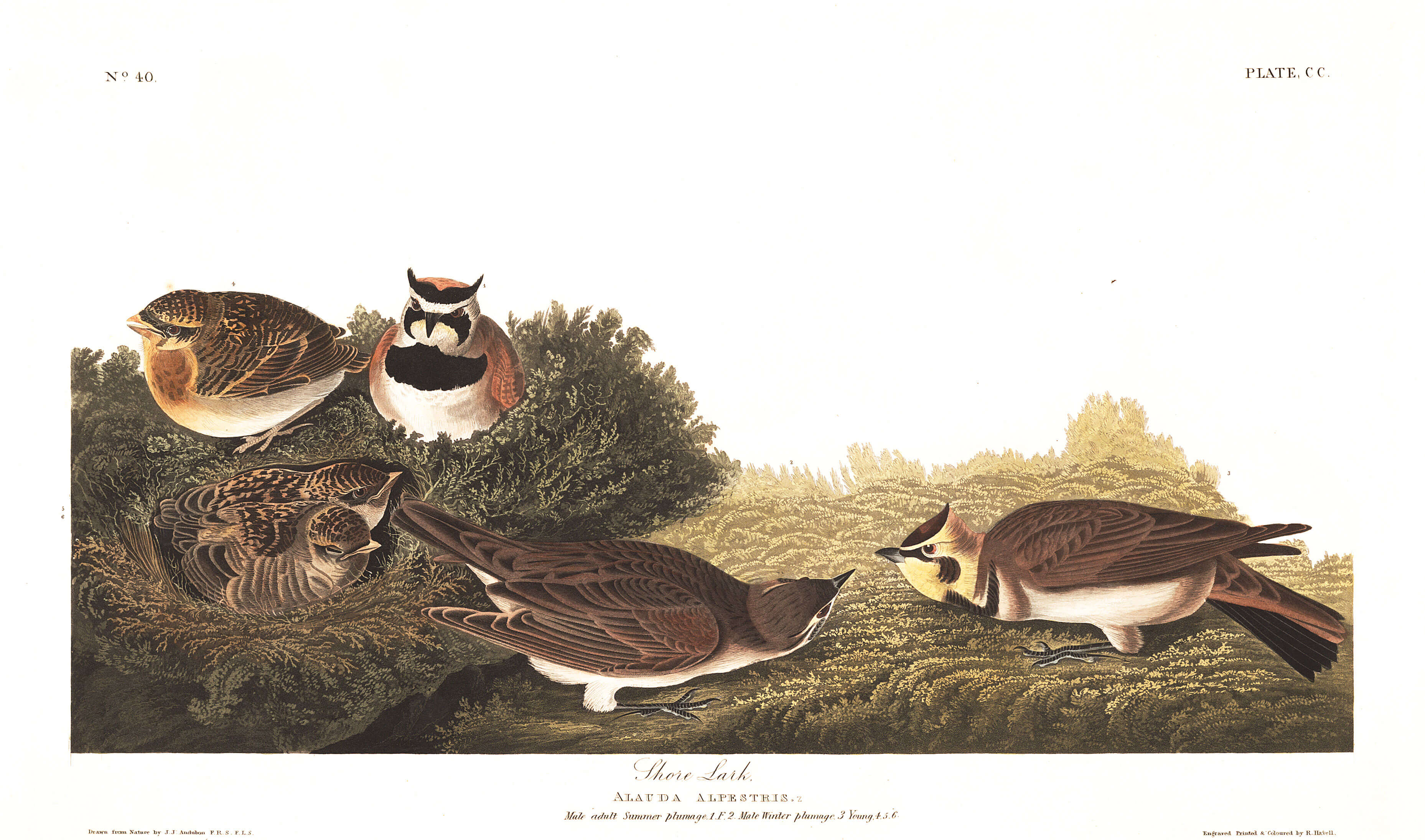
Smith (2024) composed a male and female lark on a contemporary barbed wire fence post, which is found commonly in fields of Washington. Audubon (1834) and Linnaeus (1758) composed shore larks in their preferred ground-dwelling habitats.
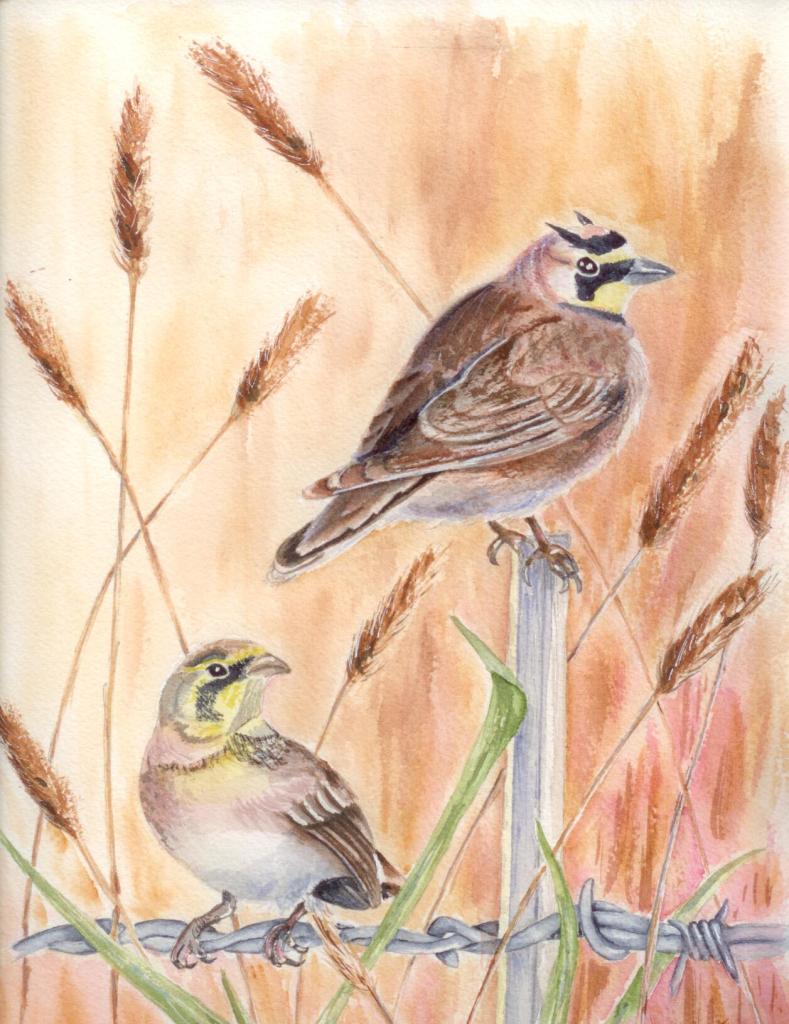
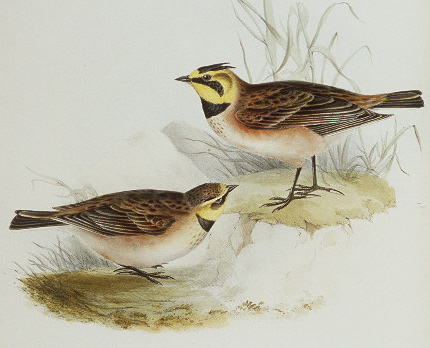
Cover photo credit: Horned lark (Wolf, 2019)
References
Click to see the amazing references that were used to created this post
Audubon, J. (1834). Shore Lark. The Birds of America, Plate CC; Shore Lark [photograph of colored engraving]. Public domain. Retrieved February 26, 2024, from https://www.audubon.org/sites/default/files/boa/illustration/plate-200-shore-lark.jpg
Fish and Wildlife Service (2022). Endangered and threatened wildlife and plants; species status for streaked horned lark with section 4(d) rule: Prepared by Fish and Wildlife Service, Interior. Federal Register. Vol. 87, No. 71. Oregon, USA. Retrieved May 24, 2024, from https://ecos.fws.gov/ServCat/DownloadFile/201158
Horned Lark Overview, All About Birds, Cornell Lab of Ornithology. Overview, All About Birds, Cornell Lab of Ornithology. (n.d.). Retrieved June 2, 2024, https://www.allaboutbirds.org/guide/Horned_Lark/overview#
Horned Lark. Audubon. (n.d.). Retrieved June 2, 2024, from https://www.audubon.org/field-guide/bird/horned-lark
IUCN. (n.d.). Eudyptes chrysocome. The IUCN Red List of Threatened Species 2020: e.T22717434A137693170. Retrieved July 19, 2024, from https://www.iucnredlist.org/species/22717434/137693170
Leonard, D. /USFWS. (2022). Streaked-horned-lark [photograph]. CC BY 2.0. Retrieved June 2, 2024, from https://www.fws.gov/media/streaked-horned-lark-dleonard-usfws.jpg
Linnaeus (1758). Shore Lark, Alouette hausse-col (Eremophila alpestris) [scan from original painting]. Public domain. Retrieved February 26, 2024, from https://en.m.wikibooks.org/wiki/File:Eremophila_alpestris.jpg
NatureServe Explorer. (n.d.). Eremophila alpestris strigata. Retrieved July 19, 2024, from https://explorer.natureserve.org/Taxon/ELEMENT_GLOBAL.2.102946/Eremophila_alpestris_strigata
Smith, I. (2024). Streaked horned lark [photograph of watercolor paintings]. Retrieved June 9, 2024, from https://wordpress.com/post/ingajsmith.com/3200
Streaked horned lark. Washington Department of Fish & Wildlife. (n.d.). Retrieved June 2, 2024, from https://wdfw.wa.gov/species-habitats/species/eremophila-alpestris-strigata#climate
Wolf, L. (2019). Horned Lark [photograph]. CC BY 2.0. Retrieved July 18, 2024, https://commons.wikimedia.org/wiki/File:Horned_lark_bombay_hook_6.2.19_DSC_0706.jpg
Wrey, S., Oregon Department of Fish & Wildlife. (n.d.). CC BY-SA 2.0 Retrieved February 25, 2024, from https://myodfw.com/wildlife-viewing/species/horned-lark

 wild sprout


You must be logged in to post a comment.