
The Oregon vesper sparrow (Pooecetes gramineus affinis) is a migratory bird that spends April through September within Washington (WDFW, n.d.). They are a subspecies of the vesper sparrow, a species found throughout the United States that prefers open areas with sparse grass and other vegetation (Cornell Lab of Ornithology, n.d.).
“All good things are wild, and free.”
-HENRY DAVID THOREAU
Description
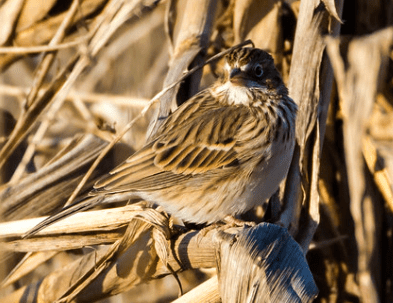
Oregon vesper sparrows are similar to vesper sparrows in appearance, with slightly paler coloration, having mostly grey-brown on their upperparts and white on their underparts. Oregon vesper sparrows forage on the ground near the base of shrubs or grass clumps. They use taller vegetation for cover as well as using manmade structures like fences for singing perches (WDFW, n.d.).
Vesper Sparrow
Length: 6.25″
Wingspan: 10″
Weight: .91 oz (26 g)
Photo Credit: McMasters, M. (2017). Vesper sparrow
Status
***** Status References: WA State: WDFW North America: NatureServe Global: IUCN Red List *****
While the vesper sparrow is common throughout the United States, the Oregon vesper sparrow is considered endangered and near local extinction within Washington (WDFW, n.d.). Their current population is around 3,000 individuals and only around 300 reside within Washington. The main habitat is now located within grasslands in Pierce and Thurston counties, especially on Joint Base Lewis-McChord military base which is home to 90% of the population (Cornell Lab of Ornithology, n.d., Altman, et.al., 2020).
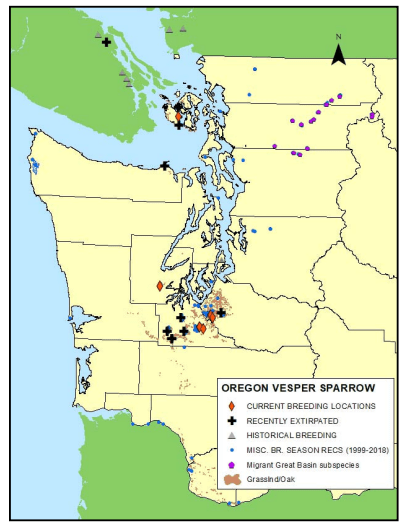
The Vesper Sparrow is the only breeding subspecies west of the Cascades. The current known breeding grounds are limited to grasslands of Pierce and Thurston counties.
Range map credit: Status Report for the Oregon Vesper Sparrow in Washington (Altman, Stinson & Hayes 2021)
Threats
Many factors are contributing to the species decline such as habitat loss due to agriculture and increased predation from domestic and feral cats (WDFW, n.d.). According to the WDFW, the Oregon Vesper Sparrow within Washington may also be threatened by disturbances during nesting season (Altman, et.al, 2020).
Conservation
Washington State is actively working to conserve the Oregon Vesper Sparrow through a variety of measures. The state focuses on restoring and protecting prairie and savannah habitats, particularly on Joint Base Lewis-McChord, which supports the majority of the state’s population. Efforts include managing invasive species, conducting controlled burns, and implementing best management practices like adjusted grazing and mowing schedules.
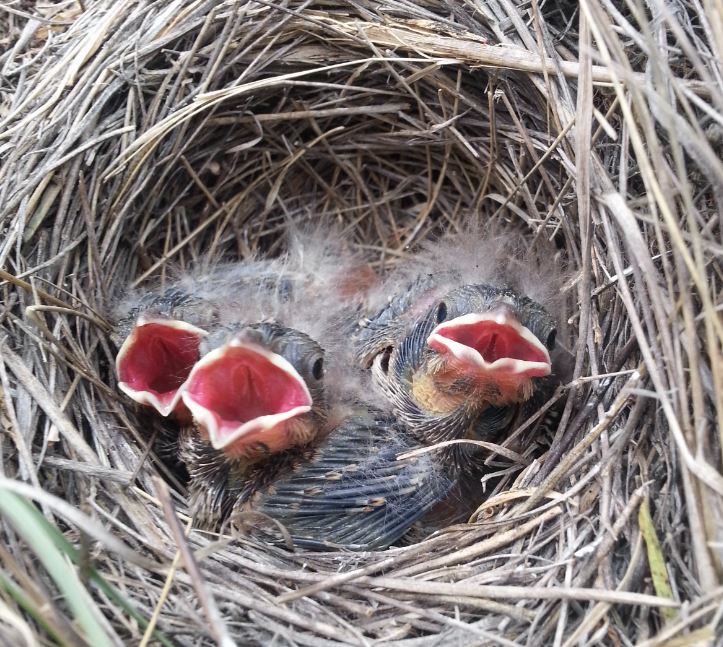
Photo credit: Vesper sparrow nestlings. (Fleming, K., 2013)
To help with Oregon Vesper Sparrows in Washington, individuals can participate with organizations to remove invasive species and to plant native vegetation. In addition, we can support land conservation initiatives through donations or advocacy to help secure critical habitats from development and degradation.
Please report sightings, which helps researchers target progress and continued efforts: https://wdfw.wa.gov/get-involved/report-observations.
Nature Art
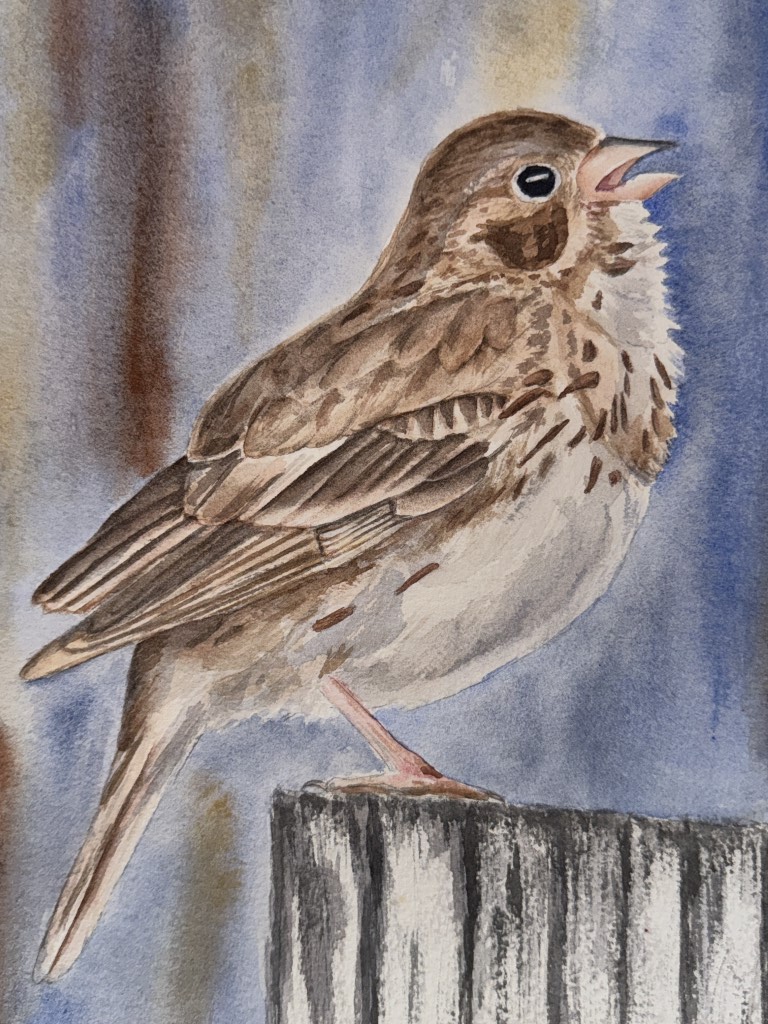
Smith (2024) and Fuertes (1919) depicts a singing vesper sparrow perched on a wooden post. Chapman and Seton (1899) showcases the species’ intricate feather groups.
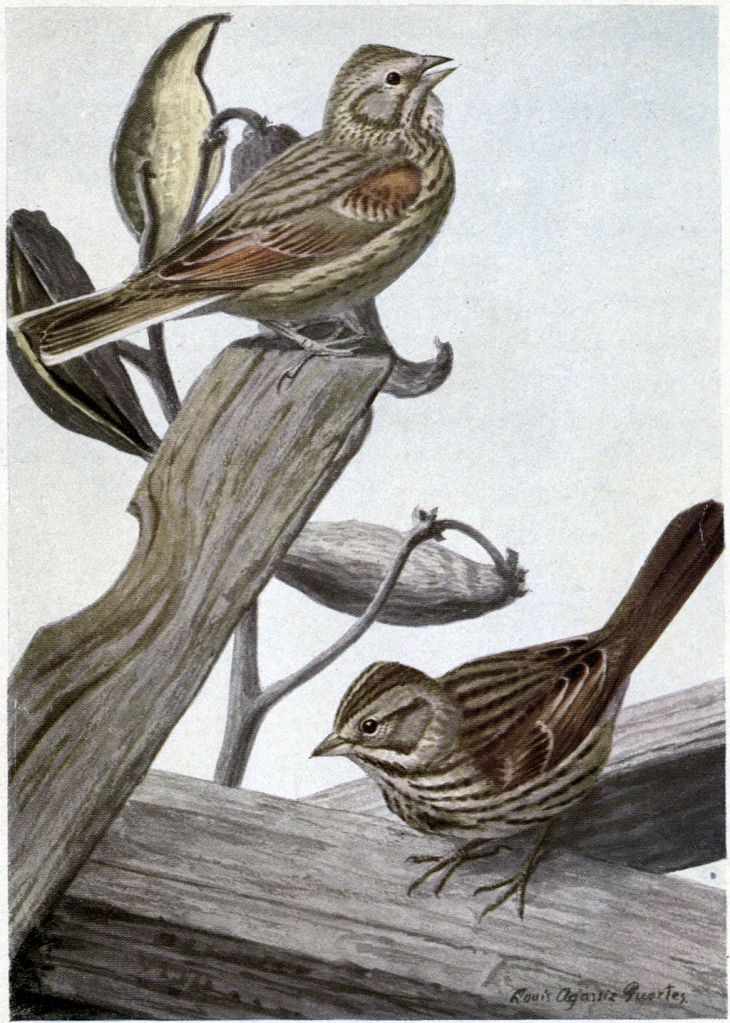
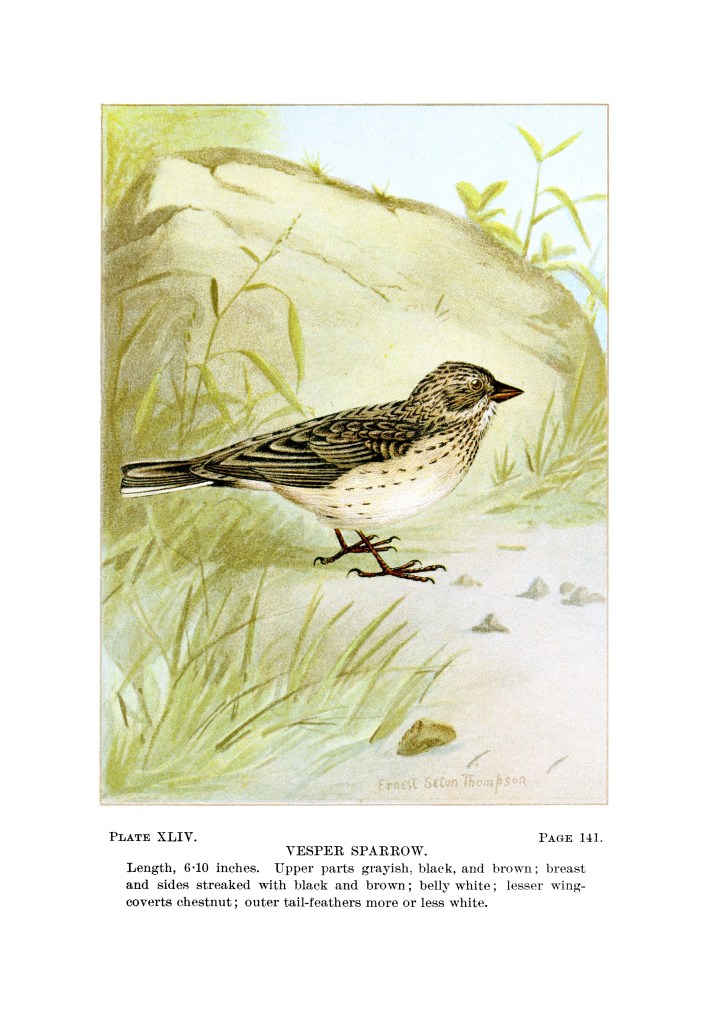
Cover photo credit: Vesper sparrow (McMasters, 2017)
References
Click to see all the awesome references
Altman, B., D.W. Stinson, and G.E. Hayes. 2021. Status Report for the Oregon Vesper Sparrow in Washington. Washington Department of Fish and Wildlife, Olympia, Washington. 33+ iii pp. Retrieved May 20, 2024, from http://wdfw.wa.gov/sites/default/files/publications/02147/wdfw02147.pdf
Chapman, F. & Seton, E. (1899). Vesper Sparrow Plate No. XLIV, from Bird-Life: A guide to the study of our common birds. The Internet Archive, Public Domain. Retrieved February 26 2024, from https://commons.wikimedia.org/w/index.php?curid=69364544
Fleming, K. (2013) Vesper sparrow nestlings [photograph]. CC BY-SA 3.0. Retrieved February 25, 2024, from https://commons.wikimedia.org
Fuertes, L. (1919) Vesper Sparrow and a Song Sparrow [photo of illustration from book], The Burgess Bird Book for Children. Retrieved July 19, 2024, from https://commons.wikimedia.org/wiki/File:Sweet_Voice_the_Vesper_Sparrow,_Little_Friend_the_Song_Sparrow.jpg
IUCN. (n.d.). Dicaeum aureolimbatum. The IUCN Red List of Threatened Species 2016: e.T22721188A136927420. Retrieved July 19, 2024, from https://www.iucnredlist.org/species/22721188/136927420
McMasters, M. (2017). Vesper sparrow [photograph]. CC BY-SA 2.0. Retrieved February 25, 2024, from https://flickr.com/photos/132545975@N04/38708161074
NatureServe Explorer. (n.d.). Pooecetes gramineus affinis. Retrieved July 19, 2024, from https://explorer.natureserve.org/Taxon/ELEMENT_GLOBAL.2.106361/Pooecetes_gramineus_affinis
Oregon Vesper Sparrow. Washington Department of Fish & Wildlife. (n.d.). Retrieved May 20, 2024, from https://wdfw.wa.gov/species-habitats/species/pooecetes-gramineus-affinis#desc-range
Sibley, D. (2003). The Sibley field guide to birds of Western North America. First edition. New York, Alfred A. Knopf.
Smith, I. (2024) Vesper Sparrow on fence [photograph of painting]. Retrieved May 4, 2024, from https://ingajsmith.com/2024/05/04/vesper-sparrow/
Vesper Sparrow Overview, all about birds, Cornell Lab of Ornithology. Overview, All About Birds, Cornell Lab of Ornithology. (n.d.). Retrieved May 20, 2024, from https://www.allaboutbirds.org/guide/Vesper_Sparrow/overview#

 wild sprout

You must be logged in to post a comment.