
The northern spotted owl (Strix occidentalis caurina) is a medium-sized owl native to the old-growth forests of the Pacific Northwest in the United States and Canada. The species is known for its association with old-growth forests, which provide its preferred habitat for nesting and hunting.
“When one tugs at a single thing in nature, he finds it attached to the rest of the world.”
-JOHN MUIR
Description
The northern spotted owl (Strix occidentalis caurina) is one of three subspecies of the spotted owl (Strix occidentalis). In comparison to other subspecies (the California spotted owl and the Mexican spotted owl), the northern spotted owl is darker brown with small white spots, and lives from British Columbia to Northern California (Cornell Lab of Ornithology, n.d.-b).
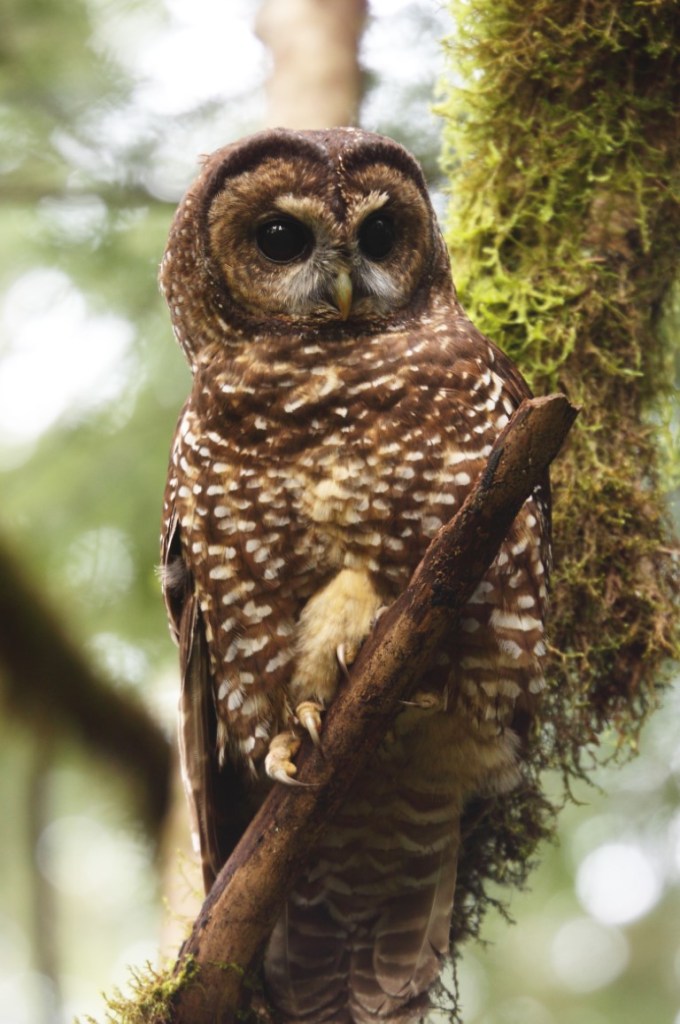
Northern Spotted Owl
Length: 17.5″
Wingspan: 40″
Weight: 1.3 lbs (610 g)
Photo credit: Northern spotted owl (female) (Perensovich, K., 2014)
Within Washington, northern spotted owls live in old growth coniferous forests, usually with large amounts of downed wood, decaying trees, and other features. They predominately eat small mammals, with northern flying squirrels being their most common prey (Washington Department of Fish and Wildlife (WDFW), n.d.). Spotted owls do not breed every year and survival of young owls is low while adult survival is high (Cornell Lab of Ornithology, n.d.-b).
Status
***** Status References: WA State: WDFW North America: NatureServe Global: IUCN Red List *****
Northern spotted owls are considered endangered within Washington and listed as threatened federally and globally. According to the Washington Department of Fish and Wildlife, around 25% or less of their original 1,200 documented territories are occupied. The species no longer breeds in the Puget Lowlands and has been rare in southwest Washington (WDFW, n.d.)
Threats
In general, the main threats of the northern spotted owl are habitat loss due to logging and land development and competition from the invasive barred owl. In 1990, habitat loss was said to be the number one threat to the Northern Spotted Owl (WDFW, n.d.), but there have since been protections put in place. Today, it appears the main cause of population decline is competition to the barred owl (WDFW, n.d.). Barred owls that once lived in the eastern half of the United States and Canada have expanded their range westward into areas where northern spotted owls reside (Cornell Lab of Ornithology, n.d.-a). Barred owls are more generalist — meaning they do not require as specific of conditions to survive like northern spotted owls do — giving northern spotted owls a competitive disadvantage against them (WDFW, n.d.).
Conservation
Conservation measures include habitat protection and efforts to control the barred owl population. In 1994, the federal government created the Northwest Forest Plan, a plan to conserve old growth forests and the species that live within them. This plan resulted in federal timber harvesting being reduced by 98% in Washington State (northernspottedowl.org, n.d). In addition to forest protection, the United States Fish and Wildlife Service is proposing to reduce barred owl populations through a process of targeted culling, which involves capturing and euthanizing them in specific areas where they pose the greatest threat to the northern spotted owl (USFWS, 2024). As of the publication of this blog post (July 2024), it remains to be be seen if this proposal will be approved. Despite conservation efforts, the northern spotted owl population continues to decline, making it a continued discussion about forest management and biodiversity conservation in the region.
Nature Art
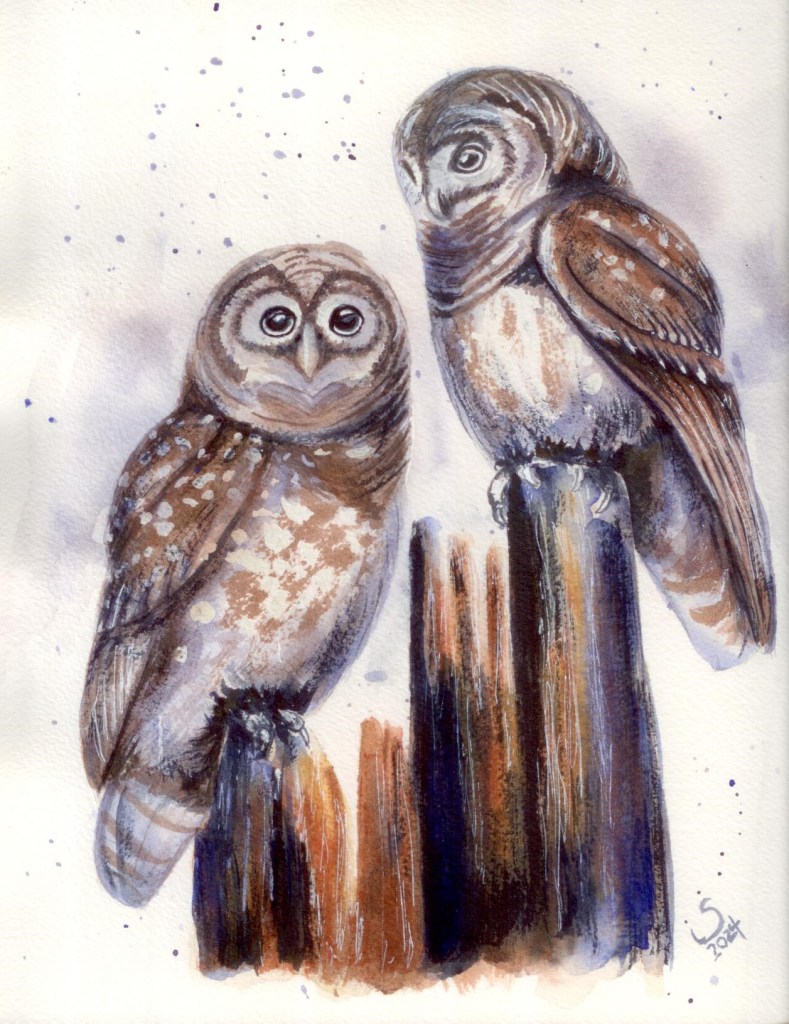
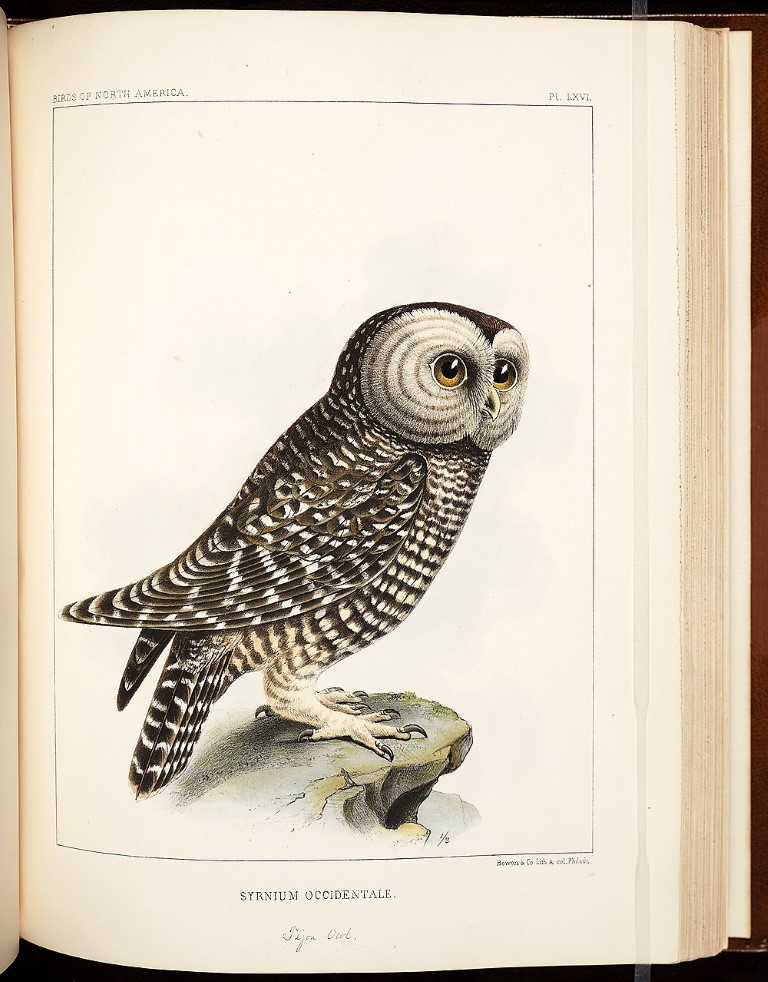
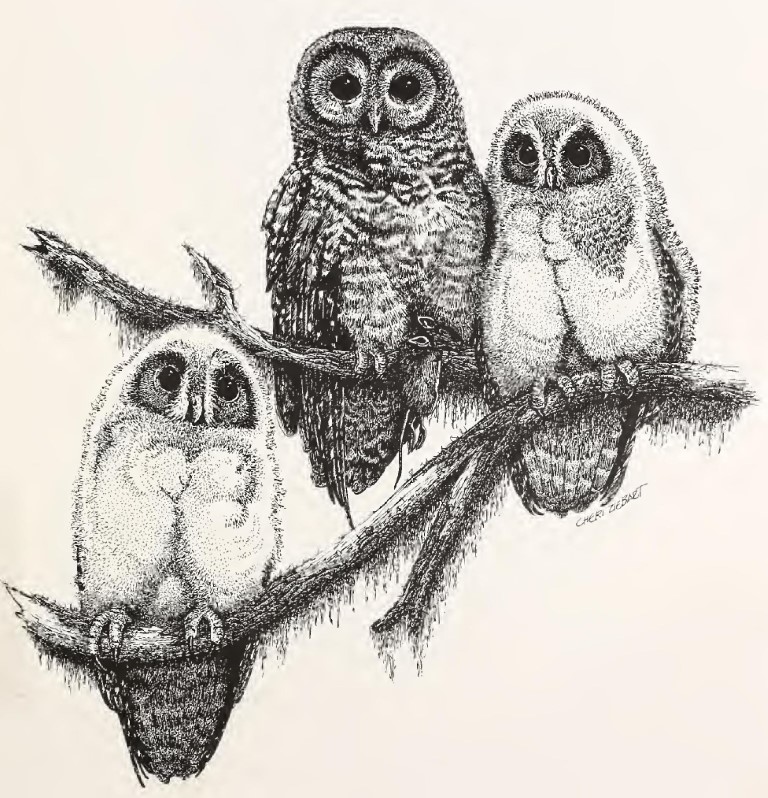
Smith composed two northern spotted owls perched in rotting, broken tree stumps. Historical illustrations have also been included for reference. Note that the Baird illustration entitled “Syrnium Occidentale,” is the real-deal. Syrnium Occidentale was renamed to Strix occidentalis caurina in the 1980s, as part of a broader taxonomic revisions by ornithologists to better reflect evolutionary relationships among owl species.
Cover page photo credit: Female Northern owl (Brouwer, E., 2014)
References
Click to see the amazing references that were used to create this post
Baird, Spencer Fullerton. (1860). The birds of North America. [image from book]. Public domain. Philadelphia : J.B. Lippincott & Co., Retrieved February 29, 2024, from https://library.si.edu/image-gallery/70998
Barred owl overview, all about birds, Cornell Lab of Ornithology. Overview, All About Birds, Cornell Lab of Ornithology. (n.d.-a). Retrieved July 10, 2024, from https://www.allaboutbirds.org/guide/Barred_Owl/overview
Brouwer, E. (2014). Female spotted owl [photograph]. CC BY 2.0 via Wikimedia Commons. Retrieved February 13, 2024, from https://www.flickr.com/photos/mountrainiernps/14412489519
NatureServe Explorer. (n.d.). Strix occidentalis caurina. Retrieved July 19, 2024, from https://explorer.natureserve.org/Taxon/ELEMENT_GLOBAL.2.104619/Strix_occidentalis_caurina
IUCN. (n.d.). Strix occidentalis caurina. The IUCN Red List of Threatened Species 2020: e.T22689089A180937862. Retrieved July 19, 2024, from https://www.iucnredlist.org/species/22689089/180937862
National Wildlife Federation. (n.d.). Northern Spotted Owl. Retrieved February 10, 2024, from https://www.nwf.org/Educational-Resources/Wildlife-Guide/Birds/Northern-Spotted-Owl
NatureServe Explorer. (n.d.). Strix occidentalis caurina. Retrieved July 19, 2024, from https://explorer.natureserve.org/Taxon/ELEMENT_GLOBAL.2.104619/Strix_occidentalis_caurina
Northern spotted owl. Washington Department of Fish & Wildlife. (n.d.). Retrieved July 10, 2024, from https://wdfw.wa.gov/species-habitats/species/strix-occidentalis-caurina#:~:text=Formerly%20a%20widespread%20and%20uncommon,breeds%20in%20the%20Puget%20Lowlands.
Perensovich, K. (2014). Northern Spotted Owl (female) [photograph]. CC BY-SA 2.0 via Wikimedia Commons. Retrieved February 29, 2024, from https://commons.wikimedia.org/
Sibley, D. (2003). The Sibley field guide to birds of Western North America. First edition. New York, Alfred A. Knopf.
Smith, I. (2024). Northern Spotted Owls on Old Growth Tree Trunk. Retrieved May 24, 2024, from https://ingajsmith.com/2024/05/24/northern-spotted-owl/
Spotted owl overview, all about birds, Cornell Lab of Ornithology. Overview, All About Birds, Cornell Lab of Ornithology. (n.d.-b). Retrieved July 10, 2024, from https://www.allaboutbirds.org/guide/Spotted_Owl/overview
USFWS-Pacific Region (2004). Northern Spotted Owlets [photograph]. CC BY 2.0. Retrieved February 16, 2024, from https://commons.wikimedia.org/wiki/File:Northern_Spotted_Owlets.jpg
Vyn, G. (2016). Northern Spotted Owl [photograph]. Retrieved February 10, 2024, from https://www.allaboutbirds.org/news/evidence-of-absence-northern-spotted-owls-are-still-vanishing-from-the-northwest/
USDA-Forest Service. (1992). Final environmental impact statement on management for the northern spotted owl in the national forests : states of Washington, Oregon and California [cover illustration]. Public domain. Retrieved February 26, 2024, from https://ia902807.us.archive.org/12/items/CAT10689682002/CAT10689682002.pdf
U.S. Fish and Wildlife Service (USFWS). (2024). Barred owl management. U.S. Department of the Interior. Retrieved July 13, 2024, from https://www.fws.gov/project/barred-owl-management
Washington Forest Protection Association. WFPA – NSO Conservation in WA – Northwest Forest Plan. (n.d.). Retrieved July 13, 2024, from https://www.northernspottedowl.org/jurisdictions/nwfp.html

 wild sprout

One Comment
Comments are closed.