
The Yellow-billed cuckoo (Coccyzus americanus) is a type of migratory bird in North, Central, and South America. They nest mostly in the Central and Eastern United States, along with Mexico and Canada, (Washington Department of Fish & Wildlife, n.d.-b) and tend to be found in deciduous woodlands. When found in the western states of the United States, they prefer cottonwood forests near rivers. Yellow-billed cuckoos are predominately insectivores, and are able to eat hairy caterpillars, something other birds are unable to do (Cornell Lab of Ornithology, n.d.).
“Study nature, love nature, stay close to nature. It will never fail you.”
–Frank Lloyd Wright
Description
This elusive bird is long and slender, with a bright yellow bill, and distinctive white spots on a black tail.
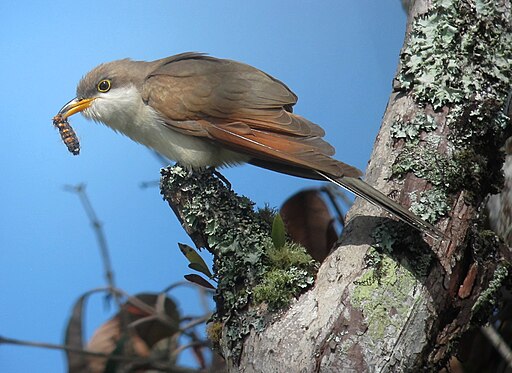
Yellow-billed Cuckoo
Lenth: 12″
Wingspan: 18″
Weight: 2.3 oz (65 g)
Photo credit: Coccyzus americanus Cuco americano (Uribe, 2013).
Status
***** Status References: WA State: WDFW North America: NatureServe Global: IUCN Red List *****
The yellow-billed cuckoo is a federally-listed Threatened species. It is Endangered in Washington, where it is also believed to be extirpated. There have not been confirmed documented observations of yellow-billed cuckoos breeding since 1923, and from the 1950s to 2017, there were only 20 sightings of yellow-billed cuckoos (WDFW, n.d.-a). Due to the rarity of of the species within Washington, there is no management in place to protect it (WDFW, N.d.-a). That being said, there is a lack of surveys to validate whether or not yellow-billed cuckoos are still breeding within Washington and more information is needed (WDFW, n.d.-a).
Range
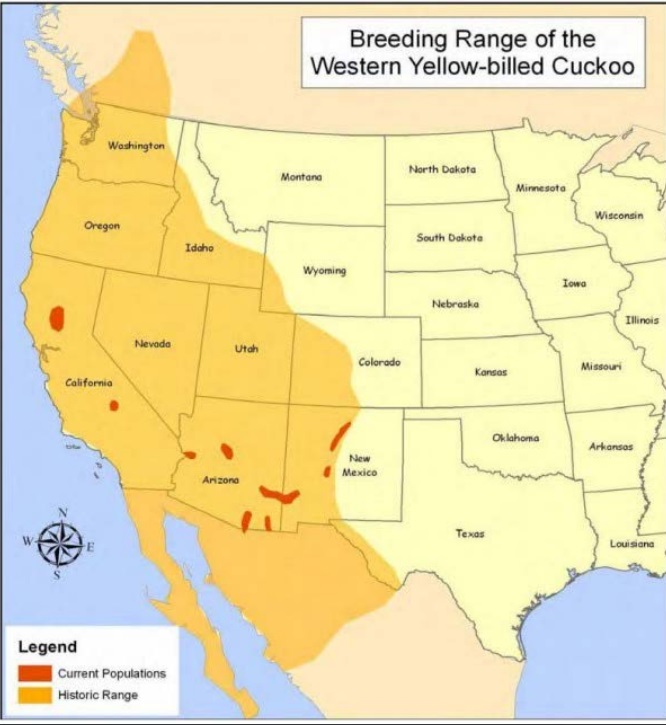
Historically, yellow-billed cuckoos migrated across the western part of the United States. Within Washington, they nested within six locations in the Western part of the state with abundant nesting sites around the Columbia River (Washington Department of Fish & Wildlife, n.d.-a). They predominately reside within cottonwood and willow forests close to riparian zones (meaning, close to rivers) (WDFW, n.d.-b).
As the range map indicates, the species no longer breeds in the Pacific Northwest.
Range map credit: Western Yellow-billed Cuckoo (Southern Sierra Research Station, n.d.)
Conservation
Although this species is extirpated in Washington, it remains important to promote conservation efforts at the local and national levels.
Native willow and cottonwood trees must be protected and promoting a healthy insect environment, while reducing insecticides, would improve both habitat and food source required to support a healthy yellow-billed cuckoo population. Meanwhile, with first-hand proof of yellow-tailed cuckoo extirpation, Washington could take a leadership role at the national level to promote national-level conservation efforts.
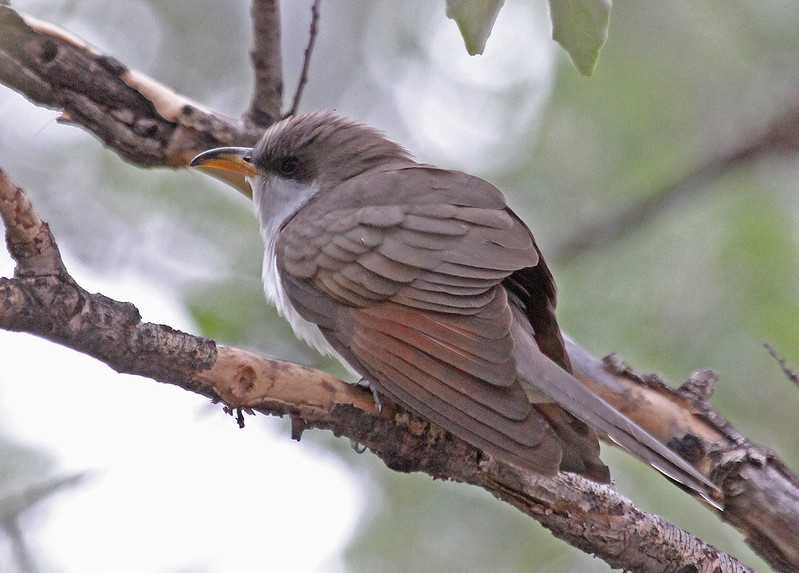
Photo Credit: Yellow-billed Cuckoo at the North Roosevelt Trap. (Oldenettel, 2005).
Help researchers by reporting sightings of this amazing bird: https://wdfw.wa.gov/get-involved/report-observations
Nature Art
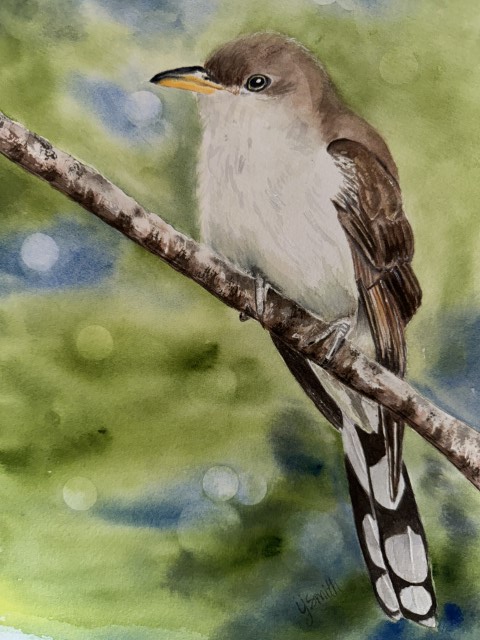
Smith depicts the adult male cuckoo perched on a nondescript tree branch, whereas the historical pieces showcase more detailed habitats: Audubon’s piece depicts two cuckoos foraging in a paw paw tree and in Prang & Co’s lithograph the cuckoo is perched in a dogwood tree.
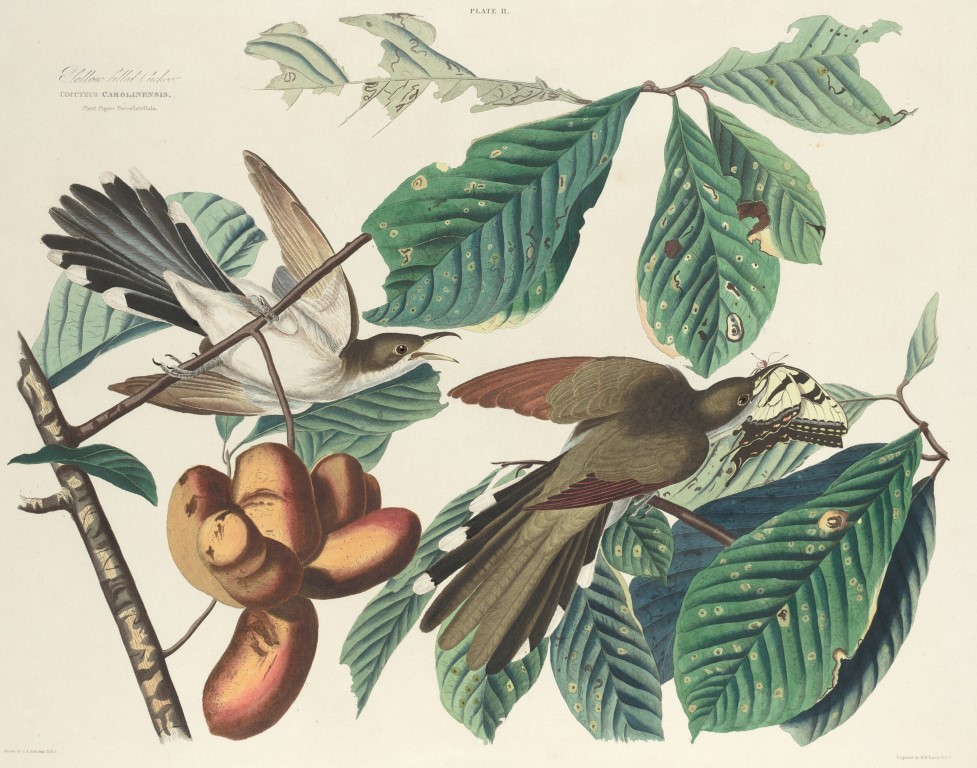
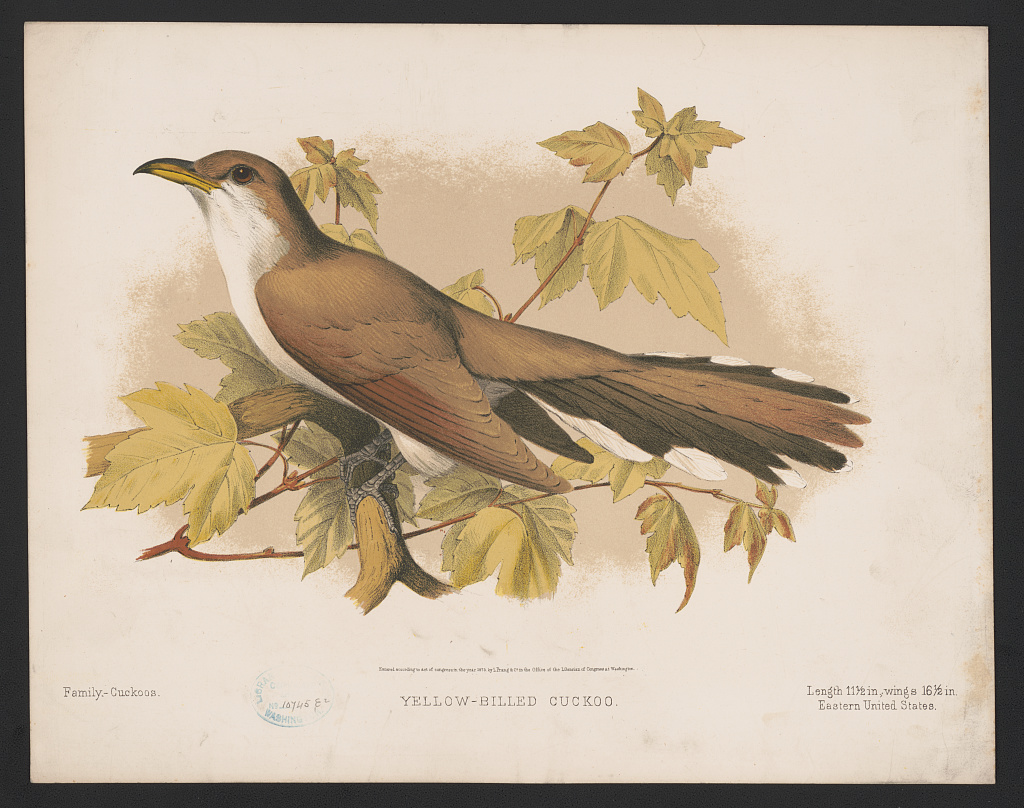
Cover photo credit: Yellow-billed Cuckoo at the North Roosevelt Trap (Oldenettel, 2011)
References
Click here to see the resources used for this post
Audubon, J. (1837). The Birds of America, Plate II; Yellow-billed cuckoo [photograph of colored engraving]. Public domain. Retrieved February 26, 2024, from https://www.nga.gov/collection/art-object-page.32143.html
Barth, S. (2018). Yellow-billed Cuckoo [photograph]. Retrieved February 10, 2024, from https://macaulaylibrary.org/asset/102608081
IUCN. (n.d.). Yellow-billed cuckoo. The IUCN Red List of Threatened Species 2020: e.T22684331A188608493. Retrieved July 19, 2024, from https://www.iucnredlist.org/species/22684331/188608493
NatureServe Explorer. (n.d.). Yellow-billed cuckoo. Retrieved July 19, 2024, from https://explorer.natureserve.org/Taxon/ELEMENT_GLOBAL.2.105709/Coccyzus_americanus
Oldenettel, J. (2011). Yellow-billed Cuckoo at the North Roosevelt Trap [photograph] CC BY-NC-SA 2.0. Retrieved February 16, 2024, from https://flic.kr/p/9JRf2y
Sibley, D. (2003). The Sibley field guide to birds of Western North America. First edition. New York, Alfred A. Knopf.
Smith, I. (2024). Yellow-billed cuckoo [watercolor painting]. Retrieved February 16, 2024, from https://ingajsmith.com/2024/02/16/yellow-billed-cuckoo/#jp-carousel-2693
Southern Sierra Research Station, Research for Conservation of Biological Diversity (n.d.). Western Yellow-billed Cuckoo (Cuculiformes: Cuculidae: Coccyzus americanus): distribution, identification, and status. Retrieved May 3, 2024, from https://www.southernsierraresearch.org/
Status report for the yellow-billed cuckoo (May 2017). Washington Department of Fish & Wildlife. (n.d.-b). Retrieved March 30, 2024, from https://wdfw.wa.gov/publications/01881
Uribe, F. (2013). Coccyzus americanus Cuco americano Yellow-billed Cuckoo [photograph]. CC BY-SA 2.0. Retrieved May 4, 2024 from https://commons.wikimedia.org/wiki/File:Coccyzus_americanus_Cuco_americano_Yellow-billed_Cuckoo_%2810761116064%29.jpg
Yellow-billed cuckoo overview, All About Birds, Cornell Lab of Ornithology. Overview, All About Birds, Cornell Lab of Ornithology. (n.d.). Retrieved March 30, 2024, from https://www.allaboutbirds.org/guide/Yellow-billed_Cuckoo/overview
Yellow-billed cuckoo. Washington Department of Fish & Wildlife. (n.d.-b). Retrieved March 30, 2024, from https://wdfw.wa.gov/species-habitats/species/coccyzus-americanus#desc-range

 wild sprout

You must be logged in to post a comment.