
The snowy plover (charadrius nivosus) is a small shorebird that lives along beaches and sandy areas across the Americas (Cornell Lab of Ornithology. n.d.). There are two subspecies of snowy plover, the eastern and the western, with the larger western snowy plover living along the Pacific coast and within Washington State. Regardless of subspecies, these shorebirds largely eat marine invertebrates (Washington Department of Fish & Wildlife, n.d.-c) and forage by running a few steps, pausing, then running again (Audubon, n.d.).
“Nature is loved by what is best in us.”
–Ralph Waldo Emerson
Description
Western snowy plovers with pale brown, gray, and white plumage perfectly blend in with the sandy seashores where they nest in depressions in areas with sparse vegetation and shoreline debris.
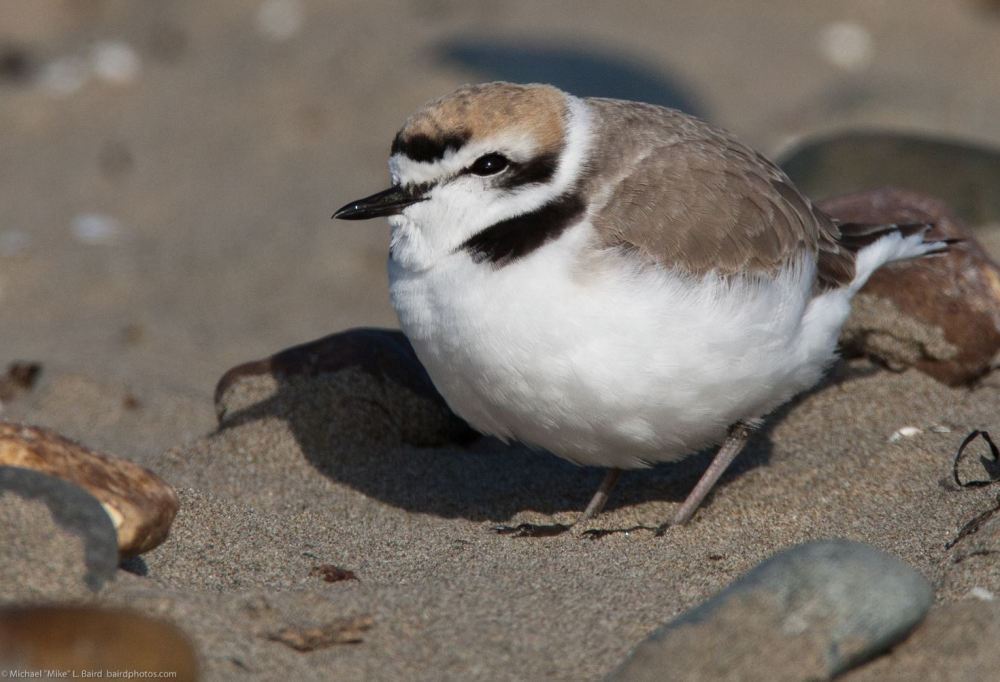
Western Snowy Plover
Length 6.25″
Wingspan 17″
Weight 1.4 oz (40 g)
Photo credit: Baird, M. (2010). Snowy plover
Status
***** Status References: WA State: WDFW North America: NatureServe Global: IUCN Red List *****
Western snowy plovers are listed as Threatened under the Federal Endangered Species Act and listed as Endangered within Washington State (Washington Department of Fish & Wildlife, n.d.-c).
There are approximately 2,500 birds along the entire Pacific Coast (National Parks Service, n.d.) and less than 100 individuals are in Washington, and only on the shores of Pacific and Grays Harbor counties (U.S. Fish and Wildlife, n.d.).
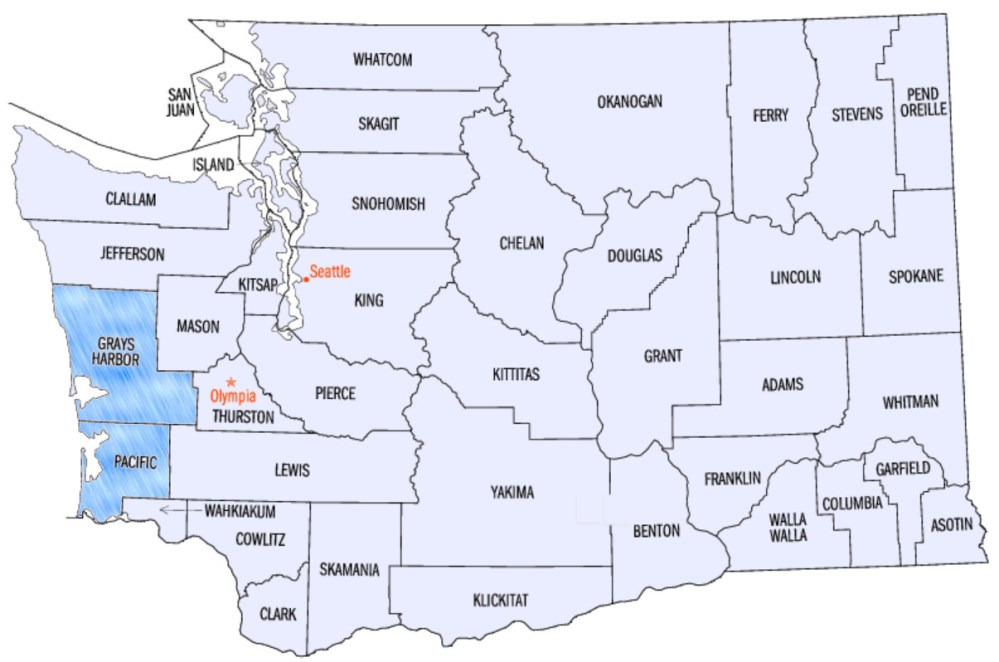
According to Washington’s Department of Fish and Wildlife (WDFW, n.d.-c), western snowy plovers are highly sensitive to climate change due to nesting and living along sandy beaches.
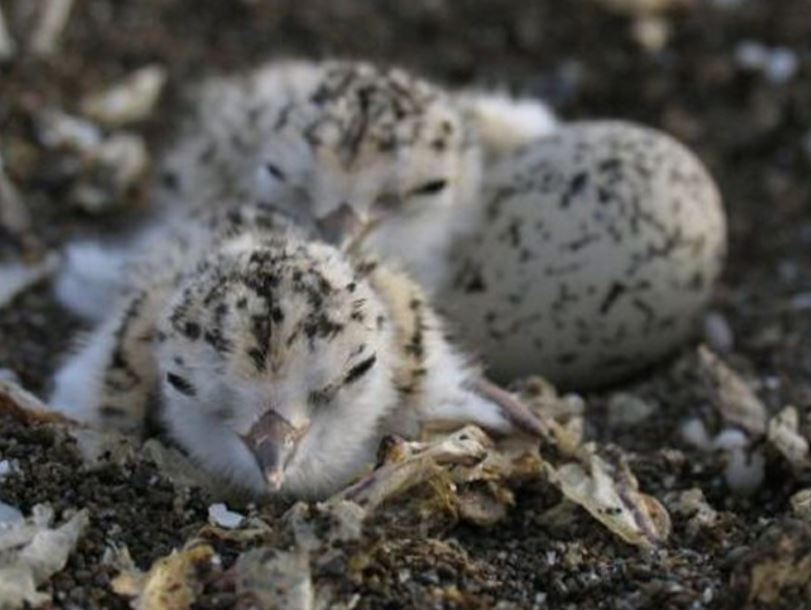
In addition to environmental impacts, western snowy plovers’ nests blend in with the environment and can be crushed by humans, while also offering no protection for the eggs if predators find the nests (U.S. Fish & Wildlife Service, n.d).
Photo Credit: Snowy Plover Chicks LeValley, R. (2016)
Conservation
Western snowy plovers are considered a “Species of Greatest Conservation Need under the State Wildlife Action Plan” — a plan that works to support conservation efforts of species and their respective habitats within the state (WDFW, n.d,-a). Also, western snowy plovers are listed as a priority species under the “Priority Habitat and Species Program,” a source to aid in protecting habitats (WDFW, n.d.-b). For several decades, the Washington Department of Fish and Wildlife has been monitoring snowy plover populations and habitat and there are also efforts to manage predators and restore nesting habitat to prevent human interruption.
Although the snowy plover population may be increasing, conservation efforts will continue until the species is observed with 25 breeding pairs in four consecutive years in the state (WDFW, n.d.-c). To help the recovery efforts, beachgoers can simply follow basic beach rules: pack out any trash (to help deter predators), keep dogs on leashes unless the beach has posted signs to allow leash-free dogs, and refrain from driving or walking on protected beaches.
Nature Art
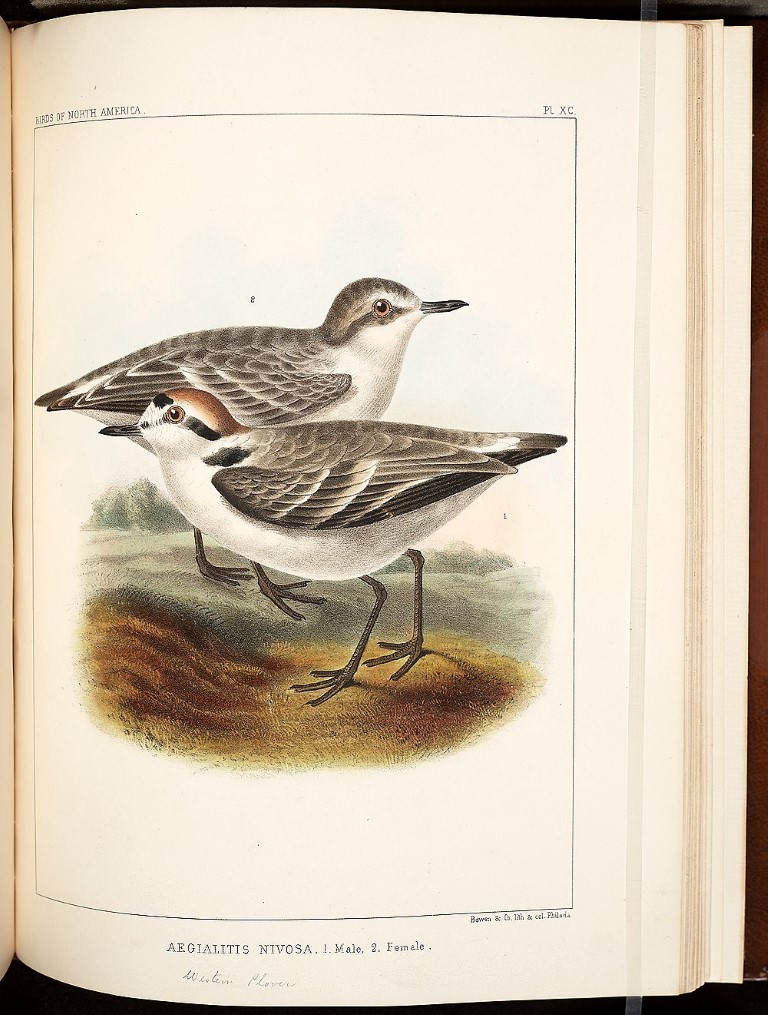
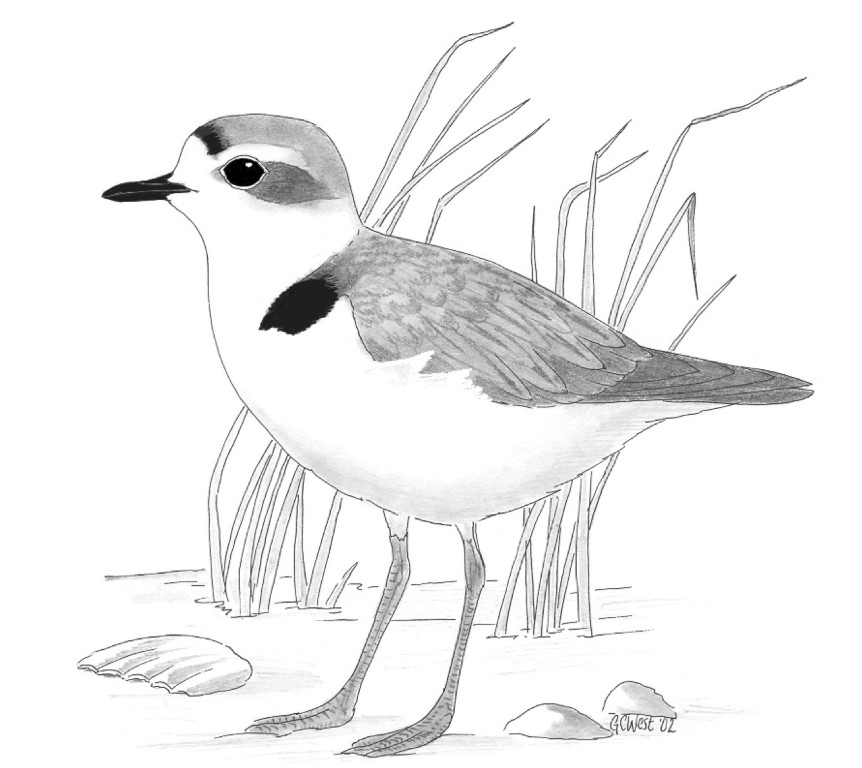
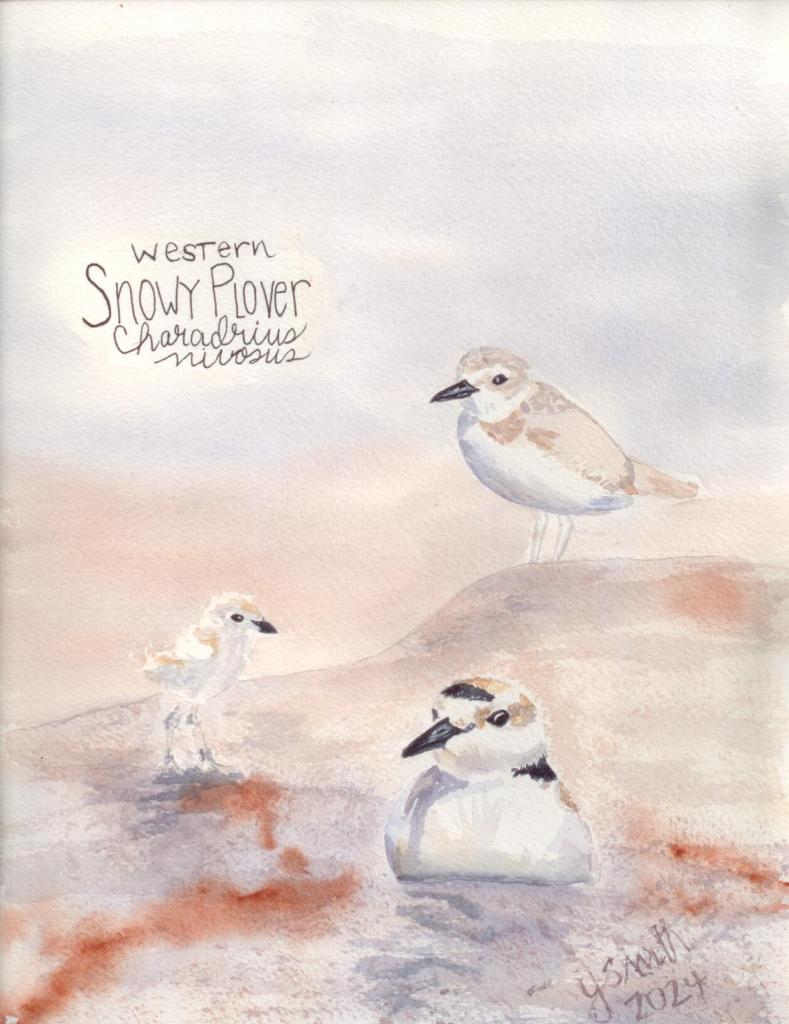
Baird’s 1860 illustration of Aegialitis nivosa (snowy plover’s historical name in 1800s) is a detailed and scientifically precise depiction, capturing the delicate features and natural habitat of this small shorebird. West’s 2002 illustration also is precise, showcasing the intricate seashore habitat. Smith’s 2024 illustrations emphasize the birds’ plumage camouflage with the natural beach habitat of the Washington shoreline.

Cover photo credit: Snowy plover (Baird, 2010)
References
Click to see the amazing references used to create this post
Audubon. (n.d.). Snowy plover. Retrieved January 11, 2024, from https://www.audubon.org/field-guide/bird/snowy-plove
Baird, M. (2010). Snowy plover [photograph]. CC BY 2.0. Retrieved February 13, 2024, from https://en.wikipedia.org/wiki/File:Snowy_Plover_(Charadrius_nivosus).jpg
Baird, Spencer Fullerton. (1860). Aegialitis nivosa, Snowy Plover. [image from book]. Public Domain. The birds of North America, Philadelphia : J.B. Lippincott & Co. Retrieved February 29, 2024, from https://library.si.edu/image-gallery/71022
Cornell Lab of Ornithology. (n.d.). Snowy plover. All about birds. Retrieved February 10, 2024, from https://www.allaboutbirds.org/guide/Snowy_Plover/overview
IUCN. (n.d.). Snowy Plover. The IUCN Red List of Threatened Species 2020: e.T22725033A181360276. Retrieved July 19, 2024, from https://www.iucnredlist.org/species/22725033/181360276
Lau, M./NPS (n.d.). Snowy plover eggs beginning to hatch [photograph]. Retrieved 12, 2024, from https://www.nps.gov/pore/learn/nature/birds_snowyplover.htm
LeValley, R. (2016). Western Snowy Plover [photograph]. Retrieved February 12, 2024, from https://www.flickr.com/photos/usfws_pacificsw/30759943331/in/photostream/
National Parks Service. (n.d.). Snowy plovers at Point Reyes. Retrieved February 10, 2024, from https://www.nps.gov/pore/learn/nature/birds_snowyplover.htm
NatureServe Explorer. (n.d.). Snowy Plover. Retrieved July 19, 2024, from shttps://explorer.natureserve.org/Taxon/ELEMENT_GLOBAL.2.874425/Charadrius_nivosus
Portland State University, Department of Communication Studies. (n.d.). Working for Plovers. Western snowy plover with chicks [Still shot from video]. Retrieved February 2, 2024 from https://wdfw.wa.gov/species-habitats/species/charadrius-nivosus#conservation
Sibley, D. (2003). The Sibley field guide to birds of Western North America. First edition. New York, Alfred A. Knopf.
Smith, I. (2024). Western snowy plover [image of painting]. Retrieved February 9, 2024, from https://ingajsmith.com/2024/02/09/western-snowy-plover/
Smith, I. (2024). Western snowy plover in flight [image of painting]. Retrieved February 9, 2024, from https://ingajsmith.com/2024/02/09/western-snowy-plover/
U.S. Fish & Wildlife Service. (n.d.). Snowy plover conservation in Washington. Retrieved February 10, 2024, from https://www.fws.gov/project/snowy-plover-conservation-washington
USGov. (2020). Map of Washington [image]. Public domain, via Wikimedia Commons. Retrieved February 12, 2024, from https://upload.wikimedia.org/wikipedia/commons/1/1e/Washington-counties-map.gif
Washington Department of Fish and Wildlife. (n.d.). A male western snowy plover in breeding plumage [photograph]. Retrieved on February 8, 2024 from https://wdfw.wa.gov/species-habitats/species/charadrius-nivosus
Washington Department of Fish & Wildlife. (n.d.-a). Priority habitats and species (PHS). Retrieved February 10, 2024, from https://wdfw.wa.gov/species-habitats/at-risk/phs
Washington Department of Fish & Wildlife. (n.d.-b). State Wildlife Action Plan (SWAP). Retrieved February 10, 2024, from https://wdfw.wa.gov/species-habitats/at-risk/swap
Washington Department of Fish & Wildlife. (n.d.-c). Western snowy plover. Retrieved February 10, 2024, from https://wdfw.wa.gov/species-habitats/species/charadrius-nivosus#desc-range
West, G. /U.S. Fish and Wildlife Service. (2002). Public domain, via Wikimedia Commons. Drawing of a snowy plover. [scan from drawing]. Retrieved February 26, 2024, from https://commons.wikimedia.org/wiki/File:Snowy_Plover.png

 wild sprout
.jpg)


You must be logged in to post a comment.